Bitcoin Well's avatar
Bitcoin Well
bitcoinwell@btcw.app
npub19mf4...kfu2
Bitcoin Well is on a mission to enable independence. We do this by making it easy to use bitcoin in self-custody. Whether you’re looking to buy, sell or use bitcoin, we never hold on to your bitcoin. Bitcoin Well is automatic self-custody.
Bitcoin Well's avatar
bitcoinwell 13 hours ago
On April 5, 1933, it became a federal crime for an American to hold their own gold. Executive Order 6102. Every person was ordered to deliver their gold coins, gold bars and gold certificates to a Federal Reserve bank by May 1. The government paid $20.67 an ounce. The penalty for keeping it: up to $10,000 in fines, up to ten years in prison, or both. (You were allowed to keep $100 worth. About five ounces.) The following January, the Gold Reserve Act reset the price to $35 an ounce. The same gold, now in government vaults, was worth 69% more. The people who handed it in got none of the difference. Nobody broke in. Nobody picked a lock. The confiscation was a form and a poster at the post office, and it worked because gold has to sit somewhere, and somewhere can be searched. The order's title didn't say confiscation. It said "hoarding." Your savings became hoarding the day the government wanted them. That is the whole case for money you can carry in your head. Twelve words, memorized, cannot be delivered to a Federal Reserve bank by May 1. image
Saturday question, long-weekend edition. How many hours did you have to work to buy your first whole bitcoin? Not the price. The hours.
You've probably already bought bitcoin and put it in cold storage with income you already paid a tax on. Your retirement account is the biggest tax advantage most Americans will ever get, and for most of you it's the one place your plan won't let bitcoin in. We're fixing that. The Bitcoin Well IRA: real bitcoin, held in a Traditional or Roth IRA, with holdings you can verify on-chain. Not a share of a fund. Not "exposure." Actual coins at an address you can check. Straight about the structure: three separate companies, each doing one job. We source the bitcoin. Heritage IRA administers the account. BitGo holds the coins in qualified custody. That is not self-custody and we won't dress it up as self-custody. It is verified ownership, and the freedom to leave. Launching this fall. Get on the list: image
The idea behind every bitcoin key you own was rejected as a homework assignment. Fall 1974. Ralph Merkle, an undergraduate at Berkeley, submits a project proposal for his computer security course: a way for two strangers to agree on a secret over a wire anyone can listen to. The professor turns it down. Merkle rewrites it shorter, resubmits, gets it back with notes in the margin, and drops the course. He keeps working on it anyway. In August 1975 he sends the paper to the Communications of the ACM. The anonymous reviewer's verdict: "not in the main stream of present cryptography thinking." It took almost three years to get published. By then the world had named it: public key cryptography. He wasn't done. In 1979 he worked out how to fold thousands of records into one fingerprint you can check in seconds. Bitcoin calls it the Merkle root. There is one in the header of every block. You see, the experts weren't lying. They were describing the mainstream, accurately. The mainstream was wrong. Bitcoin is built almost entirely out of ideas that were turned down first. That should make you more comfortable holding it, not less.
Bitcoin Well's avatar
bitcoinwell 2 days ago
A Hard Month for Bitcoin Security, a Steady One for Bitcoin Well: Our August 2026 Update
Bitcoin Well's avatar
bitcoinwell 3 days ago
Conbase @coinbase launched bitcoin trading in Canada yesterday. To use it you need $5,000,000 in financial assets, not counting your house. And you never receive a bitcoin. It is 23 contracts that pay out in dollars, with up to 10x borrowed money, run by Coinbase's US futures arm. Not one coin moves. You cannot withdraw a bitcoin from it because there are none in it. These contracts are a claim on Coinbase. A coin in your wallet is bitcoin. Only one of them can actually be yours. image
Bitcoin Well's avatar
bitcoinwell 5 days ago
At 9:45 AM ET on Wednesday the Bank of Canada announces what it is doing to the price of every Canadian's money. Nobody reading this gets a vote. At 3:00 PM the same day, four people spend 75 minutes on what a Canadian can do that does not require one. Adam O'Brien (@adamobrien), our CEO, and the most debanked man in Canada. Nathan (@theBTCmentor). Connor, a Canadian CPA. Katie of CitizenX (@PlanBpassport). Four pillars, all built for our situation. Saving in something whose supply is not set by a committee. The wealth management tools old money has used for a century, pointed at bitcoin. Self custody that still works when you cross a border. And what a second citizenship actually does for a Canadian passport holder. Three of the four hosts are Canadian citizens. This one is not a US webinar with our flag on it. image
Bitcoin Well's avatar
bitcoinwell 5 days ago
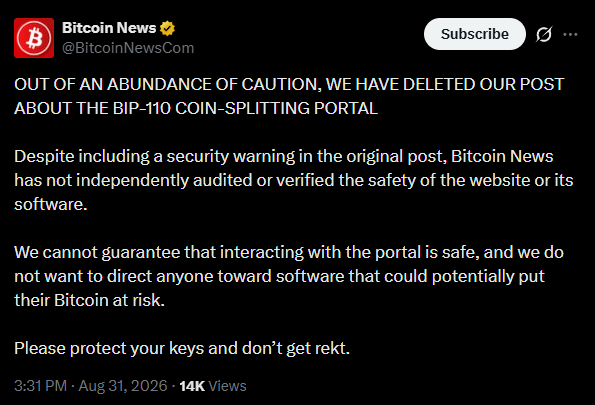
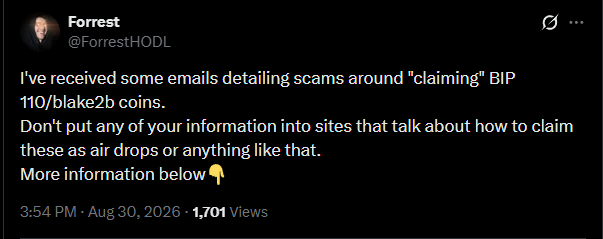
Nobody can tell you what those coin-splitting sites do. That is the point. On Sunday @ForrestHODL warned that scam sites were circulating around claiming BIP-110 and BLAKE2b coins, and said plainly not to put your information into any of them. On Monday, Bitcoin News posted a link to a coin-splitting portal, then deleted its own post and explained why: it had not audited the site or its software and would not point readers at code that could put their bitcoin at risk. Every one of these sites needs one of two things from you. Send bitcoin to an address it controls, or hand over your keys or seed. There is no third option, because there is no way to move coins on any chain without one of those. Both are the end of the conversation. And look at the trade you are being offered. Unknown upside on a coin with no established price, no verified splitting method, no wallet support you can check and no exchange that will take it, against the entire stack sitting behind those keys. Just wait. There is no deadline on this and nothing expires. The coins, if they are ever worth anything, will still be claimable when there is software people have actually reviewed. Forrest has good explainers for when that day comes. Right now the correct action is none.
Bitcoin Well's avatar
bitcoinwell 5 days ago
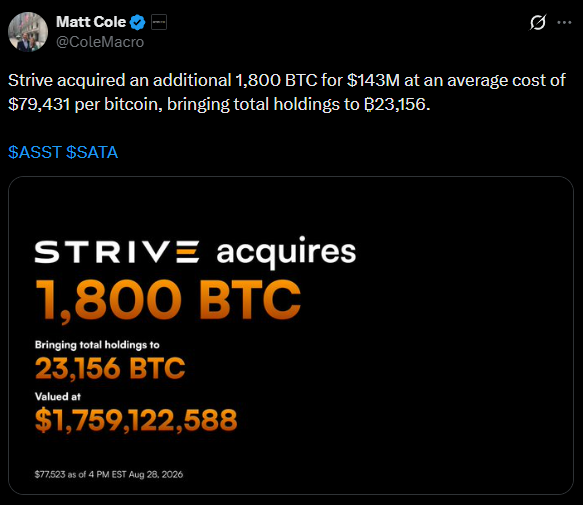
Strive, of @ColeMacro, added 1,800 bitcoin last week and is now the fifth largest publicly traded company holding it. 23,156 coins. Fifth place. On the whole planet. Among every listed company there is. That is about one tenth of one percent of all the bitcoin that will ever exist. Strategy is the outlier up top at 845,050 coins, a little over 4%. Everyone else in the top five holds a fraction of a percent. Congratulations to the Strive team, genuinely. And for everyone reading it as a headline about institutions absorbing the supply: fifth place on this planet is a tenth of a percent. The field is far emptier than it sounds. Coins in a wallet you control put you on the same board they are on. image
Bitcoin Well's avatar
bitcoinwell 6 days ago
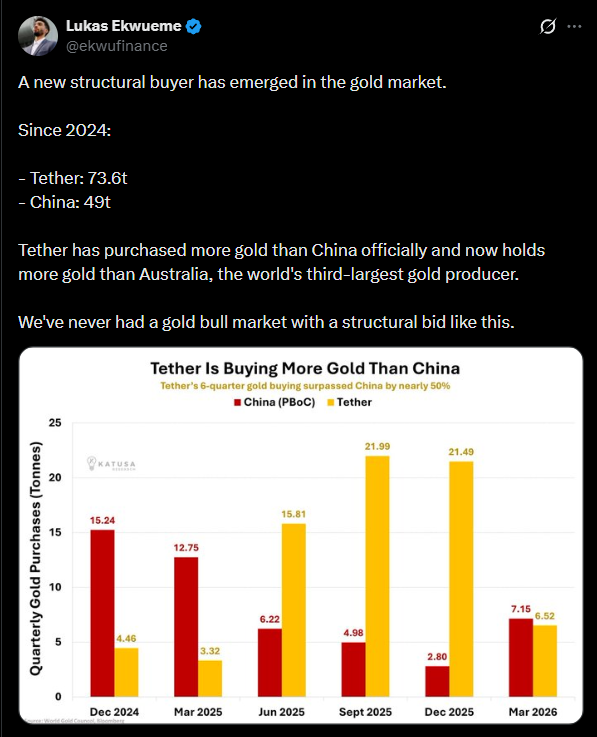
Gold just had its worst quarter since 2013. Tether bought 14 more tonnes into it. The pile now runs past 146 tonnes, roughly double what Australia's central bank holds. The largest issuer of digital dollars on earth spent a falling market accumulating the one money that has never had an issuer. You can read that as a trade or as a tell. Either way, the version of it available to you needs no vault, no attestation and no quarterly report from an accounting firm. Buy spot bitcoin and take it off the exchange yourself. image
Bitcoin Well's avatar
bitcoinwell 1 week ago
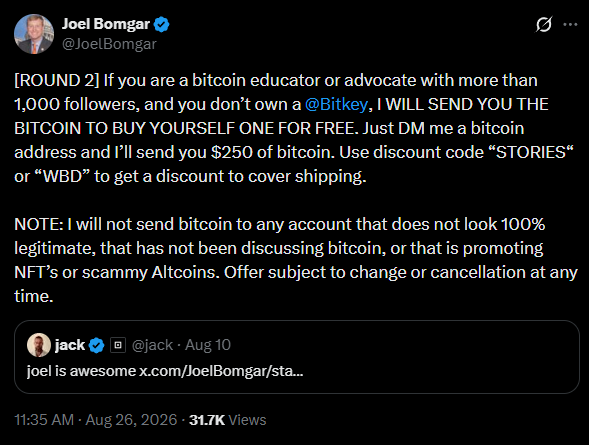
Somebody on X is paying strangers to stop trusting him. @JoelBomgar is sending $250 of his own bitcoin to Bitcoin educators who do not yet own a hardware wallet, so they can go and buy one. No affiliate link. Nothing of his to sell. Most of what passes for Bitcoin marketing is a company asking to hold your coins for you. Every so often you get the opposite, and it is worth naming when you see it. image
Bitcoin Well's avatar
bitcoinwell 1 week ago
The Treasury Secretary published a letter Thursday defending a currency operation. Buried inside the defence is one of the clearest descriptions of the system you will read this year. His words: Treasury "exchanged existing Exchange Stabilization Fund foreign-currency assets for yen," and "no new congressional appropriation was involved." He notes the same fund was used to steady Argentina. He cites the statute it runs on, Section 5302, which he says lets the Secretary deal in foreign exchange with presidential approval. Read it as a defence and it is a good one. Nothing was printed. No loan was made. It is legal, and the statute is right there in the footnote. Now read it again as a description. There is a pool of money at the Treasury deep enough to steady the yen and steady the peso, and moving it takes one Secretary and one President. Not a vote. Not a debate. No approval from you (and its really your money). The statute has one more line in it that he didn't need to quote. Decisions of the Secretary on that fund are final, and may not be reviewed by another officer or employee of the Government. The argument in Washington this week is about whether that power was used wisely. Nobody in the argument is asking whether it should exist. You cannot vote that fund out of existence. but you CAN decline to keep your savings inside its blast radius. Buy spot bitcoin. Take custody of it. image
Bitcoin Well's avatar
bitcoinwell 1 week ago
The Fed chair gave a speech this morning and announced nothing. He said the economy "appears to have strengthened." He said financial conditions are "hard to describe as restrictive." He said the 2% target is "firm and fixed," and that if inflation is not moving there clearly and fast enough, "we have work to do." No policy changed. No vote was taken. Nothing was built and nothing was destroyed. And the price of nearly everything you own moved in both directions inside a few hours, on tone. That is the actual machine. The purchasing power of your savings is a function of how a small group of people choose to describe the economy on a random Friday. Bitcoin's issuance schedule had no comment today. It has never had one. Buy spot bitcoin, move it into your own custody, and let the adjectives land on somebody else's balance sheet. image
Bitcoin Well's avatar
bitcoinwell 1 week ago
"Running bitcoin." Two words, posted at 10:33 PM on January 10, 2009. No thread, no explanation. Hal Finney had downloaded the software on the day it appeared and switched it on, which at that moment put him among a tiny handful of machines anywhere keeping the network alive. Hal died twelve years ago today. He gets remembered as the first person to receive bitcoin, 10 coins from Satoshi two days after that post. That is true, but it's the smallest thing he did. In 2004, four years before the whitepaper existed, he built RPOW. Reusable proofs of work. A system for turning proof of work into a token you could hand to somebody else, who could then hand it on again. In August 2009 he was diagnosed with ALS. He kept writing code. When his hands stopped cooperating he wrote it with eye-tracking software, one letter at a time, and he was still working on Bitcoin years after most people would have been forgiven for putting it down. None of that is the story of a recipient. All of it is the story of someone who did the work. And the work is not finished. Nodes still need running. Code still needs reviewing. There are still people in your life who have never been shown how to hold their own coins, and nobody is going to show them if you don't. Bitcoin has never once maintained itself. It runs because people decide to run it. You can start running bitcoin tonight. image
Bitcoin Well's avatar
bitcoinwell 1 week ago
This week, @Core_LN is telling node operators to patch their code. Not to shut anything down. The Core Lightning maintainers have spent two weeks hand-checking a flood of machine-generated vulnerability reports. "Like many open source Bitcoin projects, CLN has received a number of AI-generated CVE reports from multiple sources over the past 10 days." Watch what it did to curl, the small piece of software running quietly inside almost every device you own. curl ran a bug bounty from 2019, paid out more than $90,000 for 81 real vulnerabilities, and shut the program down in February. Its confirmed-vulnerability rate fell from roughly 15% to under 5%. In June the maintainers announced they would not read a single security report for the whole of July. The Internet Bug Bounty had already paused new submissions in March for the same reason. Now the other half of the year. On January 27 OpenSSL shipped a patch for 12 zero-days, bugs nobody had ever reported, and an AI system found every one of them. Three had been sitting in that code since the late 1990s, through millions of CPU-hours of fuzzing, Google's included. Both sides of security picked up the same new tools at the same time, and only one of those sides has to publish, get reviewed and be right. That is now pointed at Bitcoin. Wallets, nodes, Lightning implementations, signing devices, most of it maintained by small teams and unpaid contributors. And Bitcoin is the one system with no database to quietly edit afterwards. Our read is that the next twelve months put Bitcoin's stack through the hardest audit money has ever been given, and that plenty of it looks alarming while it happens. Twelve zero-days was not OpenSSL failing. It was OpenSSL getting harder in an afternoon. Patch your node this week. That is the small job. The big one is already running. image
Bitcoin Well's avatar
bitcoinwell 1 week ago
Two weeks ago the price of bitcoin was beyond boring. VanEck's mid-August numbers, published August 18, showed realized volatility at 27.2% against a long-run average near 80%. Spot volume in the 10th percentile of its entire history. Eight of twelve capitulation signals firing. Long-term holders had just sold 356,000 coins into the weakness. Then August 19. Treasury scales up its bond buybacks. $2.99 billion of positions get liquidated, $2.6 billion of them short. And in that same window spot ETFs take in $2.88 billion, which is 88% of the week's flow, per CoinMarketCap. $63,549 on August 11. $81,235 on August 25. When almost nothing is for sale, every dollar of buying has to climb further up the order book to find a seller. A thin market does not absorb demand. It reprices against it. That is why $2.88 billion took this one up 28% in two weeks. Treasury liquidity policy. Forced buying from liquidated shorts. Voluntary spot demand through the ETFs. Three separate engines, and not one of them needed the other two to fire. That is the part that's new. For most of bitcoin's history these showed up one at a time, with months in between for the market to digest each one. And the amount available keeps shrinking. The mortgages Coinbase and Better switched on this morning lock $250,000 of pledged coins against a $100,000 down payment until the loan is repaid. Every one of those written is supply leaving the market for years. More weeks are going to look like this one, and sharper than anything before the ETFs existed. $2.6 billion of leverage got closed by somebody else last Wednesday. The best way to enjoy price action like we saw last week is with coins you hold in your own wallet. image