The yen has lost nearly a third of its purchasing power in five years.
The dollar has lost a fifth of its real value in the same window.
One currency anchors the world's reserve system. The other anchors the world's second-largest bond market. Both are bleeding.
Today at 4 PM ET, @peruvian_bull and @infraa_ join us live on X. Macro, gold, yen, and Bitcoin.
Set a reminder:
https://t.co/7PaO8OpxnI
Bitcoin Well
bitcoinwell@btcw.app
npub19mf4...kfu2
Bitcoin Well is on a mission to enable independence. We do this by making it easy to use bitcoin in self-custody.
Whether youβre looking to buy, sell or use bitcoin, we never hold on to your bitcoin.
Bitcoin Well is automatic self-custody.
The Bitcoin Magic Trick: How to Use Your Keys Without Touching the Internet
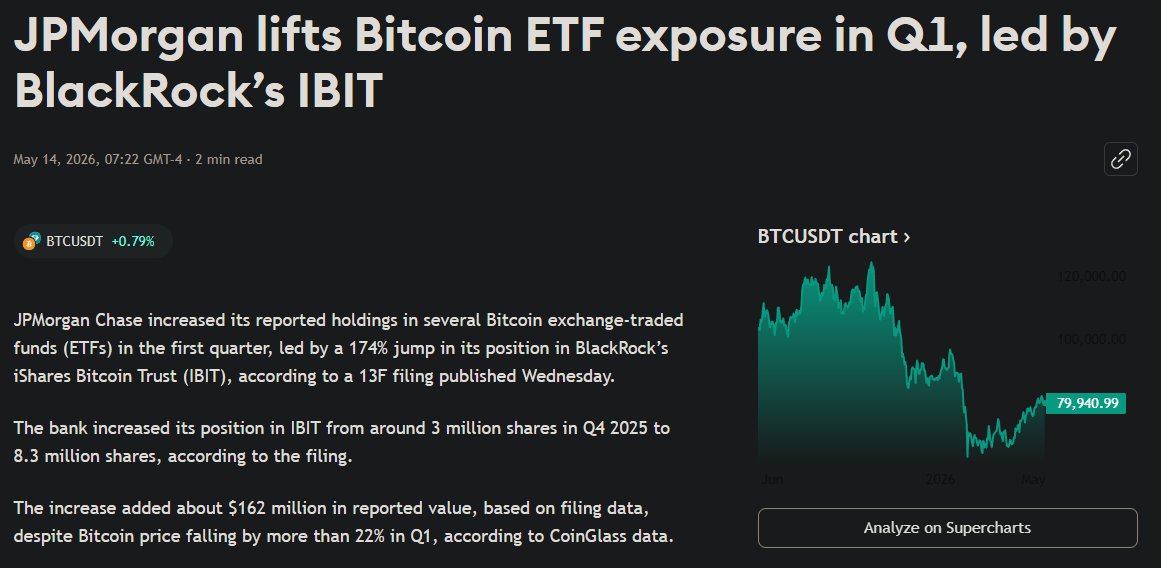
JPMorgan Chase grew its BlackRock IBIT holdings from 3 million to 8.3 million shares in Q1 2026.
That is a 174% increase in a single quarter. They did it while Bitcoin's price was down 22%. The bank that spent five straight years calling Bitcoin worthless, a fraud, a Ponzi scheme, a tulip mania, and a money laundering vehicle is now sitting on the largest concentrated IBIT position any commercial bank has ever filed.
Jamie Dimon told you Bitcoin was a fraud in 2017. He told you it had no intrinsic value in 2019. He told you he would shut it down if he were the government in 2023. JPMorgan's Q1 2026 13F filing says JPMorgan bought 174% more of it.
There is no philosophical contradiction here. JPMorgan just figured out how to clip a basis point off the institutional flow into BlackRock's wrapper, and the decade of public denial became a decade of private accumulation strategy.
This is what reflexivity looks like in slow motion. The firms that told you to wait are now charging you for access.
You never needed their approval. You just need your own wallet.


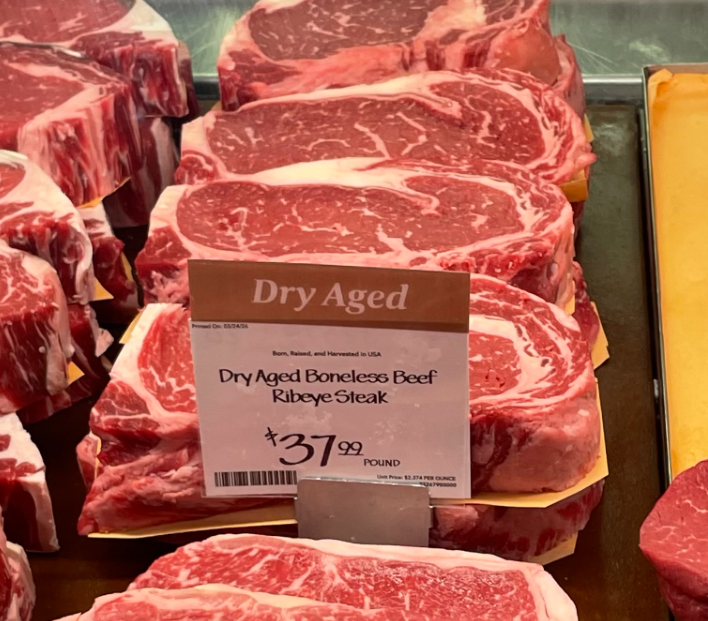
A ribeye costs $37.99 a pound today.
In 2020, the same ribeye, same store, was $19.99.
Parker Lewis has been tracking this one specific cut at this one specific store for six years. The methodology is the point. The number is up 90% cumulative. Eleven percent compounded annually. Seventeen percent annualized since October.
The Fed told you inflation was transitory. The Fed told you it peaked in 2022. The Fed told you the print was cooling. The ribeye does not consult the Fed. The ribeye consults the price the supplier charges, which consults the cost of feed, which consults the cost of fuel, which consults the dollar.
Six percent PPI yesterday means the producer is still bleeding. Ninety percent cumulative ribeye means the bleed has been flowing to checkout since 2020. The 3.8% CPI you read yesterday is the number the government is comfortable publishing. Parker's grocery receipt is the number the supply chain actually quoted.
Bitcoin currently issues 0.83% new supply per year, and falling. The ribeye is averaging 11% per year. The Bitcoin is averaging 40%.


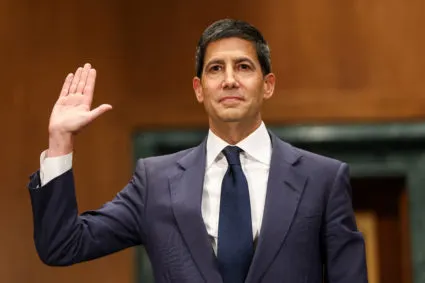
Kevin Warsh just got confirmed as Federal Reserve Chair.
Warsh is the only Fed Chair in history publicly on record naming Bitcoin as a legitimate monetary alternative. His 2024 Group of Thirty speech called gold and Bitcoin "neutral reserve assets" while Powell was still calling Bitcoin a "speculative store of value."
Powell took eight years to acknowledge what Warsh is starting Day 1 already saying out loud.
He inherits a 3.8% CPI print, a 6.0% PPI print thirty hours old, and a $37 trillion debt load. The first thing on his new desk is a producer-price chart confirming the inflation everyone called "transitory" three years ago compounded into 90% real-world ribeye inflation since 2020. Parker Lewis dropped that print yesterday.
The thing that changed today is not what the Fed will do. It is whether the Fed still gets to decide what money is all.
Strategy holds 818,869 BTC. Metaplanet is up 1,000% in Bitcoin terms. Morgan Stanley is now selling 2-4% Bitcoin allocations to $9 trillion in client assets.
The Fed Chair used to be the only bidder. Now he is one of many.


Price Volatility is Noise, Growth is Signal: Q1 2026 Results
The April PPI just printed 6.0% year-over-year. That's the hottest producer inflation since March 2022.
Monthly PPI jumped 1.4%, nearly three times the 0.5% forecast. Core PPI hit 5.2%. The rate-cut trade Kevin Warsh inherited yesterday died this morning before he poured his first coffee.
Watch the language. CPI at 3.8% is what you pay at the store. PPI at 6.0% is what the store pays the producer. The 2.2% gap is the margin compression that hasn't hit you yet. It will. It always does. Producer prices lead consumer prices by about six months, and right now the producer is bleeding.
The thirty-year rule the Fed told you to trust says PPI prints near 2% in a healthy economy. Six percent is what we got after a year of supposedly cooling inflation, while energy is up 65% in six months and the world's largest oil chokepoint is still contested.
Bitcoin issues 0.83% new supply per year. That number is locked in code, not in a press conference. You can save in a unit that prints 6% to its producers, or you can save in a unit that prints 0.83% to nobody.
The math chooses itself.


The seed phrase isn't the end of your security stack. It's the beginning.
Next Tuesday at noon ET, Bitcoin Well Infinite hosts Becca Rubenfeld and Rob Hamilton from AnchorWatch for a Lunch and Learn on why insurance actually matters for Bitcoin holders.
We'll get into the attack surface most stackers ignore: wrench risk, custody failures, miner exposure, E&O and D&O lines for businesses and institutions holding Bitcoin on the balance sheet and how AnchorWatch builds policy around the things a hardware wallet can't fix.
Open Q&A at the end. Bring the questions that have been keeping you up.
ποΈ Tuesday May 19 Β· 12:00 PM ET Β· Free Register β


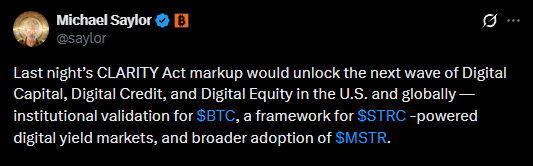
Buried in the CLARITY Act markup the Senate is voting on Thursday: a line that bans the Fed from issuing CBDC directly to consumers.
That's not a small detail. That's the door to programmable central-bank money being nailed shut from the inside.
The Act splits oversight between the SEC and CFTC, protects software developers from money transmitter rules, and writes a framework for stablecoin yield markets that compete with checking accounts paying 0.04%. Tim Scott calls it innovation and certainty. Elizabeth Warren calls it a risk to investors.
They call it "comprehensive regulation." The piece that matters is the piece they're not advertising. The Fed loses the direct-issuance lane to your wallet. Permissioned money lost a battle most people didn't know was being fought.
Self-custody wins by attrition every time the state tries to draw a new line. Every law that names Bitcoin without controlling it is a law that confirms Bitcoin can't be controlled by law.
Thursday's vote is the next checkpoint. Either way the vote goes, your seed phrase still works.
Not your keys, not your coins is gospel because the gospel doesn't need a markup hearing.


If you secure your Coinbase account with SMS 2FA, your net worth is protected by a $15 an-hour Verizon employee.
Watch the language. They call it "two-factor authentication." There's only one factor that matters here and it lives at the phone company.
SIM swap attacks drained over $250M from crypto holders last year. The bug isn't your password. It's your phone number.
A YubiKey costs $35. Multisig costs zero. Neither can be SIM-swapped.
Stop renting your security from a telecom.


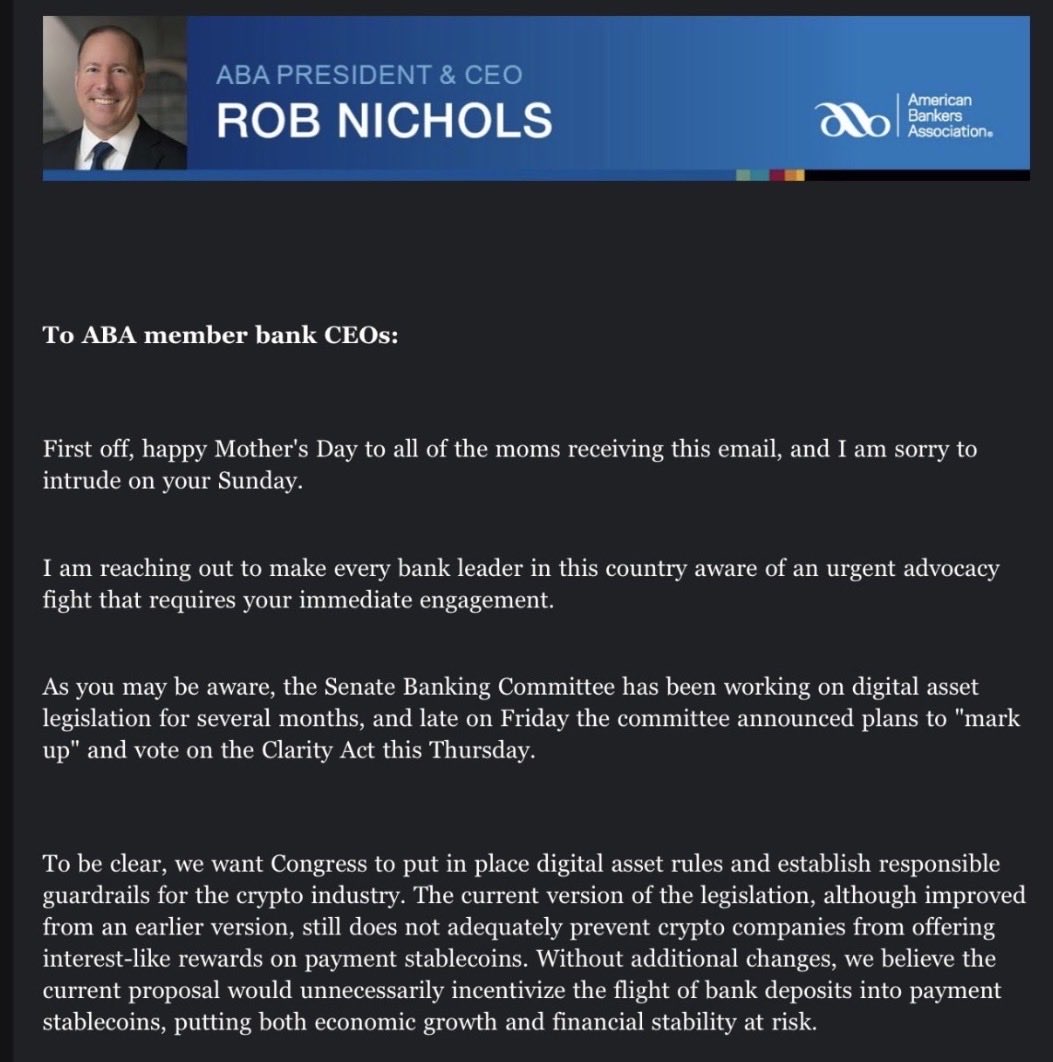
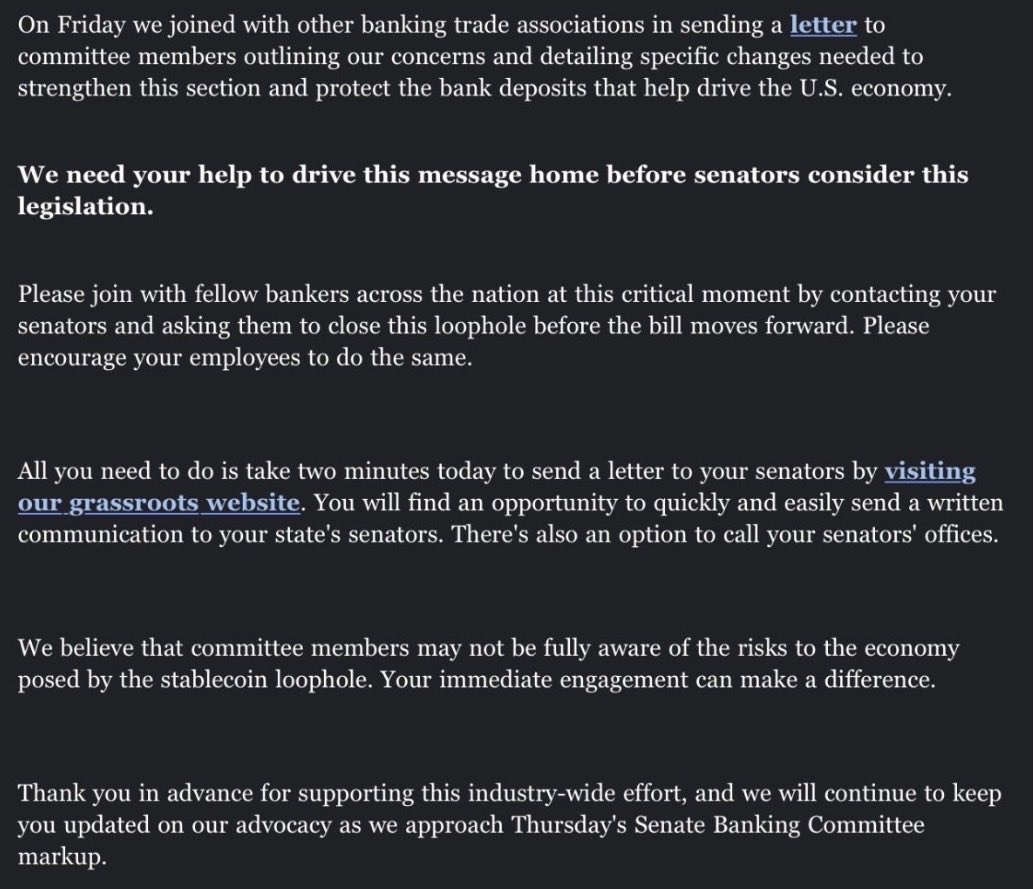
The American Bankers Association sent a panicked email to every bank CEO in America on Mother's Day.
Their problem? The Clarity Act might let Americans earn real yield on stablecoins instead of the 0.04% your checking account pays.
They called it a "loophole." Watch the language. They mean "competition."
Here's what nobody fighting this is saying out loud: both sides want you on permissioned money. Banks want your deposits trapped at zero. Stablecoin issuers want them trapped at five. Either way, your money lives in someone else's database, subject to someone else's terms, frozen by someone else's keystroke.
Bitcoin doesn't have a deposit. Bitcoin doesn't have an issuer. Bitcoin doesn't have a CEO writing panicked Mother's Day emails.
The fight neither side is having: the right to hold your own savings.
Self-custody is the only exit from the current game.


JPMorgan analysts just told you Bitcoin is winning the debasement trade against gold.
Eighteen months ago, the same bank called it a "joke asset." Yesterday, the same bank posted a $260,000 job listing for a Senior Lead Software Engineer on its Digital Assets Team. Today, JPMorgan's research desk admits on the record that spot Bitcoin ETFs pulled in $2 billion in April, their best month yet, while gold ETFs bled.
That's the entire institutional history of Bitcoin in three sentences. Joke asset β $260K job posting β $2 billion in ETF inflows.
They didn't reverse course because the analysts had an awakening. They reversed because $2 billion in April flow doesn't lie, and gold ETF outflows in the same month don't either.
The debasement trade was always Bitcoin. Gold has 150 years of central-bank buyers and zero verifiability. Bitcoin has 21 million coins, a fixed schedule, and an auditable ledger.
Stack on the institutional flip, but always hold your own keys.


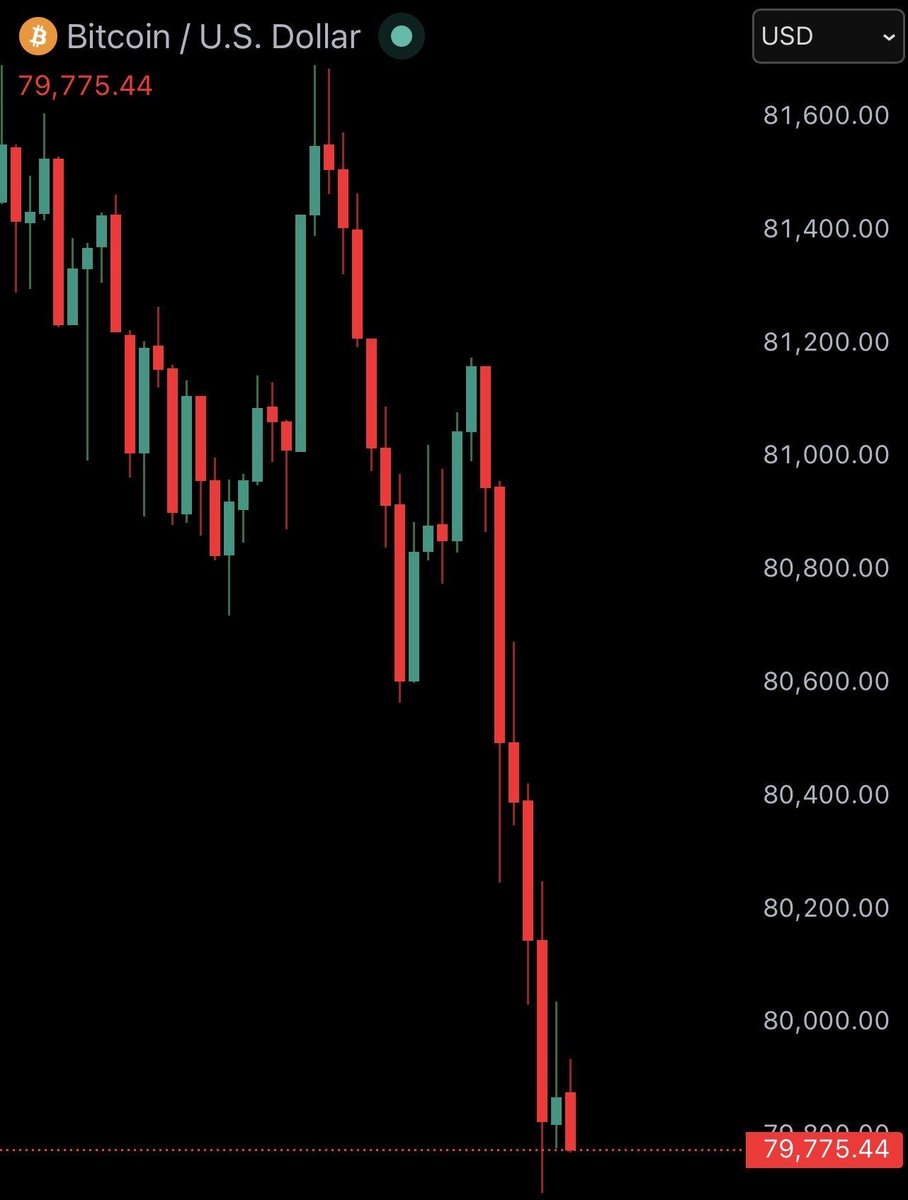
Bitcoin just crashed below 80,000, the S&P 500 and the Nasdaq closed at all-time highs and $100 million in longs got liquidated in two hours.
Before you panic, remember that volatility is a symptom of fiat. Not a flaw in Bitcoin.
You see, the entire market is a casino now and not because traders chose it. Because they were forced into it.
When the dollar loses purchasing power faster than any yield can keep up, the only way to preserve wealth is to take risk. So everyone takes risk. Everyone gambles. Equities, crypto, options, leverage - same scramble, different tickers.
Bitcoin is 35x smaller market than the S&P. The same flow that twitches the indexes 0.5% rips Bitcoin 5%.
So, don't let them convince you its Bitcoin's fault. It's a thermometer reading on a fever the Fed gave you.


JUST NOW: π―π΅ Japan announced tokenized government bonds "on a blockchain," and crypto Twitter is calling it adoption, but this a classic case of the emperor having no clothes.
Bitcoin is the innovation. Blockchain is the costume.
This isn't Bitcoin. It's the country with 250% debt-to-GDP, the textbook fiat endgame, putting that same debt on a faster rail because "blockchain" still polls well.
Blockchain without proof-of-work and a fixed supply is a permissioned database with extra steps. Bitcoin is the only one that ever mattered; 21 million coins, no issuer, no off switch.
The state didn't fall in love with decentralization. It fell in love with the brand recognition. Watch the language: "tokenized," "on-chain," "24/7 settlement." Not "fixed supply." Not "self-custody." Not "censorship-resistant." Because that part isn't on offer.
Don't confuse the empire reaching for the network effect with the empire surrendering to it.
Not your keys, not your coins.
Not Bitcoin's blockchain, not your sovereignty.


Reid Hoffman bought Bitcoin in 2014. He hasn't sold a single sat in twelve years.
When asked what his exit price was, the LinkedIn co-founder said: "Is there such a thing as an exit price?"
You see, "exit price" is fiat-brain. It assumes Bitcoin is the trade and dollars are the destination. Hoffman flipped the script: he's already in the destination. The 12 years of holding aren't conviction. They're literacy. He understands what most people still won't admit. The thing you "exit into" is the thing being debased on purpose.
Rothbard called it correctly fifty years ago: paper money is not a savings vehicle, it's a managed loss. Hoffman ran the math in 2014 and never looked back.
You don't need a billionaire to validate self-custody. But it helps when the market keeps producing them.
Buy bitcoin. Hold your own keys. Stop asking when to leave. There's no exit from sound money.


The Netherlands just told you why self-custody matters.
Today the Dutch government advanced a 36% tax on UNREALIZED gains, money you haven't made yet, on assets you haven't sold, in accounts they can see and you can't move. 61,000 people signed a petition asking them to stop. Parliament shrugged and pushed it through anyway. Rollout: January 1, 2028.
You see, when a state runs out of real productivity, it doesn't shrink. It expands the legal definition of what it can take. First it taxes income. Then it taxes wealth. Then it taxes the appreciation of wealth before you've even touched it. That's not taxation. That's pre-confiscation.
Here's what they cannot tax this way: 12 words you keep in your head.
A bitcoin held in self-custody has no paper profit on a Dutch broker's quarterly statement. It has no AUM line for the tax authority to point at. It exists in a wallet only the holder can open. That's not a loophole. That's the whole design.


Rome's silver coin went from 95% silver to 5% silver.
The dollar went from 100 cents of 1913 purchasing power to 3.
History doesn't repeat. It mathematically rhymes.
Not your keys. Not your coins. Not your sovereignty.


Escaping the Altcoin Mirage
The fall of the Roman Empire didn't start with a barbarian invasion.
It started with a central planner clipping a coin.
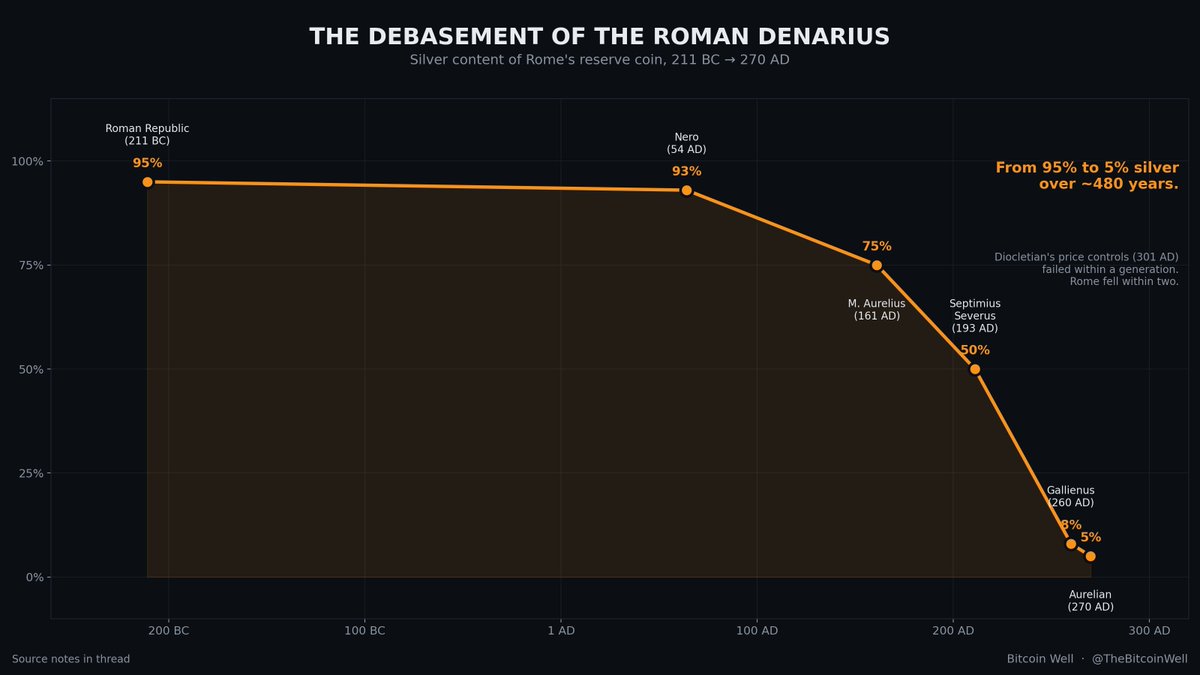
You see, in 211 BC, a single Roman Denarius was 4.5 grams of nearly pure silver. 95%+ purity. A day's wage for a skilled laborer. A loaf of bread for a working man. The most trusted unit of account in the ancient world.
Then Rome started fighting wars it couldn't afford.
Forty-plus major conflicts in 480 years. The Punic Wars to keep Carthage out of the Mediterranean. The Macedonian Wars to break the Hellenistic kingdoms. The Gallic Wars to claim the north. The civil wars between Marius and Sulla. Caesar against Pompey. Augustus against Antony. Then frontier defense - Germanic tribes, Parthian rivals, Jewish revolts. And by the third century, war had turned inward. Six emperors in a single year. Breakaway empires. Generals fighting generals across the same provinces they were supposed to be defending.
Wars cost money. And the easiest way for a state to "find" money is to put less of it into each coin.
By Nero's reign in 54 AD, the silver content was already down to 93%. Sounds small. Wasn't. Marcus Aurelius pushed it to 75%. Septimius Severus to 50%. Each emperor needed to pay the legions, and each emperor took a little more silver out of the same coin.
Then came Caracalla.
In 215 AD, Caracalla didn't just clip the existing Denarius. He minted an entirely new coin, the antoninianus, and stamped it as worth two Denarii. The catch: it contained only about 1.5 Denarii's worth of silver. He rebranded the unit of account to disguise the dilution.
Sound familiar?
By 270 AD under Aurelian, the "silver" Denarius was 5% silver. The other 95% was bronze with a thin silver wash that flaked off in your pocket. Romans weren't fools. They knew. They started hoarding the old coins, melting them down, refusing to accept the new ones at face value. Gresham's Law, discovered the hard way: bad money drives out good.
Diocletian's response in 301 AD was the Edict on Maximum Prices. Wage and price controls. Death penalty for charging "too much" for bread.
You cannot legislate away inflation. You can only legislate away the market that exposes it.
The Edict failed within a generation. Rome fell within two.
Now look at the dollar.
In 1913, the Federal Reserve was created. One dollar then has the purchasing power of about three cents today. A 97% debasement. Almost exactly the silver lost from the Denarius between 211 BC and 270 AD.
History doesn't repeat. It mathematically rhymes.
Mises wrote it cleanly: "Inflation is not an act of God. Inflation is a policy."
It is a deliberate, engineered tax on anyone who holds the currency. The state needs revenue. Direct taxation has political limits. Debasement does not. This is not a bug in the system. This is the system.
And here's the part that should make every working person furious.
You can save your entire life in dollars and still get poorer. The number on your statement goes up. The bread on the shelf goes up faster. You ran the marathon. The finish line moved.
That was the Roman farmer in 270 AD. That's you in 2026.
This week, Apple's market cap passed silver's. $4.17 trillion to $4.14 trillion.
A 49-year-old phone company is now worth more than a monetary metal humans have used for 5,000 years. The market is voting. Industrial scarcity is losing. The next vote is between gold and something built for this century.
Rothbard saw this coming decades ago. Most people will never learn what the Romans learned the hard way. They'll find out the same way the Romans did, when the bread costs three times what it did last year, and the men in robes blame "speculators."
Bitcoin is the first money in human history with a mathematically fixed supply.
21 million. Forever.
No emperor can clip it.
No central bank can dilute it.
No legislature can vote it away.
No army can confiscate what it cannot access.
That's not a feature. That's a civilizational reset.
The Roman who held silver coins instead of imperial paper made it through.
The Roman who held imperial paper got buried with it.
Your generation gets to make the same choice. Same physics. Better tools.
You don't need to predict the fall. You don't need to time the collapse.
You just need to step off the dying empire's ledger.
Run a node. Hold your keys. Stack with intention.
History doesn't repeat. It mathematically rhymes.
You see, in 211 BC, a single Roman Denarius was 4.5 grams of nearly pure silver. 95%+ purity. A day's wage for a skilled laborer. A loaf of bread for a working man. The most trusted unit of account in the ancient world.
Then Rome started fighting wars it couldn't afford.
Forty-plus major conflicts in 480 years. The Punic Wars to keep Carthage out of the Mediterranean. The Macedonian Wars to break the Hellenistic kingdoms. The Gallic Wars to claim the north. The civil wars between Marius and Sulla. Caesar against Pompey. Augustus against Antony. Then frontier defense - Germanic tribes, Parthian rivals, Jewish revolts. And by the third century, war had turned inward. Six emperors in a single year. Breakaway empires. Generals fighting generals across the same provinces they were supposed to be defending.
Wars cost money. And the easiest way for a state to "find" money is to put less of it into each coin.
By Nero's reign in 54 AD, the silver content was already down to 93%. Sounds small. Wasn't. Marcus Aurelius pushed it to 75%. Septimius Severus to 50%. Each emperor needed to pay the legions, and each emperor took a little more silver out of the same coin.
Then came Caracalla.
In 215 AD, Caracalla didn't just clip the existing Denarius. He minted an entirely new coin, the antoninianus, and stamped it as worth two Denarii. The catch: it contained only about 1.5 Denarii's worth of silver. He rebranded the unit of account to disguise the dilution.
Sound familiar?
By 270 AD under Aurelian, the "silver" Denarius was 5% silver. The other 95% was bronze with a thin silver wash that flaked off in your pocket. Romans weren't fools. They knew. They started hoarding the old coins, melting them down, refusing to accept the new ones at face value. Gresham's Law, discovered the hard way: bad money drives out good.
Diocletian's response in 301 AD was the Edict on Maximum Prices. Wage and price controls. Death penalty for charging "too much" for bread.
You cannot legislate away inflation. You can only legislate away the market that exposes it.
The Edict failed within a generation. Rome fell within two.
Now look at the dollar.
In 1913, the Federal Reserve was created. One dollar then has the purchasing power of about three cents today. A 97% debasement. Almost exactly the silver lost from the Denarius between 211 BC and 270 AD.
History doesn't repeat. It mathematically rhymes.
Mises wrote it cleanly: "Inflation is not an act of God. Inflation is a policy."
It is a deliberate, engineered tax on anyone who holds the currency. The state needs revenue. Direct taxation has political limits. Debasement does not. This is not a bug in the system. This is the system.
And here's the part that should make every working person furious.
You can save your entire life in dollars and still get poorer. The number on your statement goes up. The bread on the shelf goes up faster. You ran the marathon. The finish line moved.
That was the Roman farmer in 270 AD. That's you in 2026.
This week, Apple's market cap passed silver's. $4.17 trillion to $4.14 trillion.
A 49-year-old phone company is now worth more than a monetary metal humans have used for 5,000 years. The market is voting. Industrial scarcity is losing. The next vote is between gold and something built for this century.
Rothbard saw this coming decades ago. Most people will never learn what the Romans learned the hard way. They'll find out the same way the Romans did, when the bread costs three times what it did last year, and the men in robes blame "speculators."
Bitcoin is the first money in human history with a mathematically fixed supply.
21 million. Forever.
No emperor can clip it.
No central bank can dilute it.
No legislature can vote it away.
No army can confiscate what it cannot access.
That's not a feature. That's a civilizational reset.
The Roman who held silver coins instead of imperial paper made it through.
The Roman who held imperial paper got buried with it.
Your generation gets to make the same choice. Same physics. Better tools.
You don't need to predict the fall. You don't need to time the collapse.
You just need to step off the dying empire's ledger.
Run a node. Hold your keys. Stack with intention.
History doesn't repeat. It mathematically rhymes.Oil just crashed 8%.
Markets are celebrating a US-Iran peace deal.
Gold is up 3%.
Gold doesn't believe the story. Neither should you.
Peace can unwind a war premium on oil. It cannot unwind $36 trillion in debt. It cannot un-print the money that funded the last four years of conflict. The incentive to inflate didn't go away, the most recent excuse did.
They signed a peace deal. They didn't sign a balanced budget. Stack accordingly.