Bitcoin Well's avatar
Bitcoin Well
bitcoinwell@btcw.app
npub19mf4...kfu2
Bitcoin Well is on a mission to enable independence. We do this by making it easy to use bitcoin in self-custody. Whether you’re looking to buy, sell or use bitcoin, we never hold on to your bitcoin. Bitcoin Well is automatic self-custody.
Bitcoin Well's avatar
bitcoinwell 1 week ago
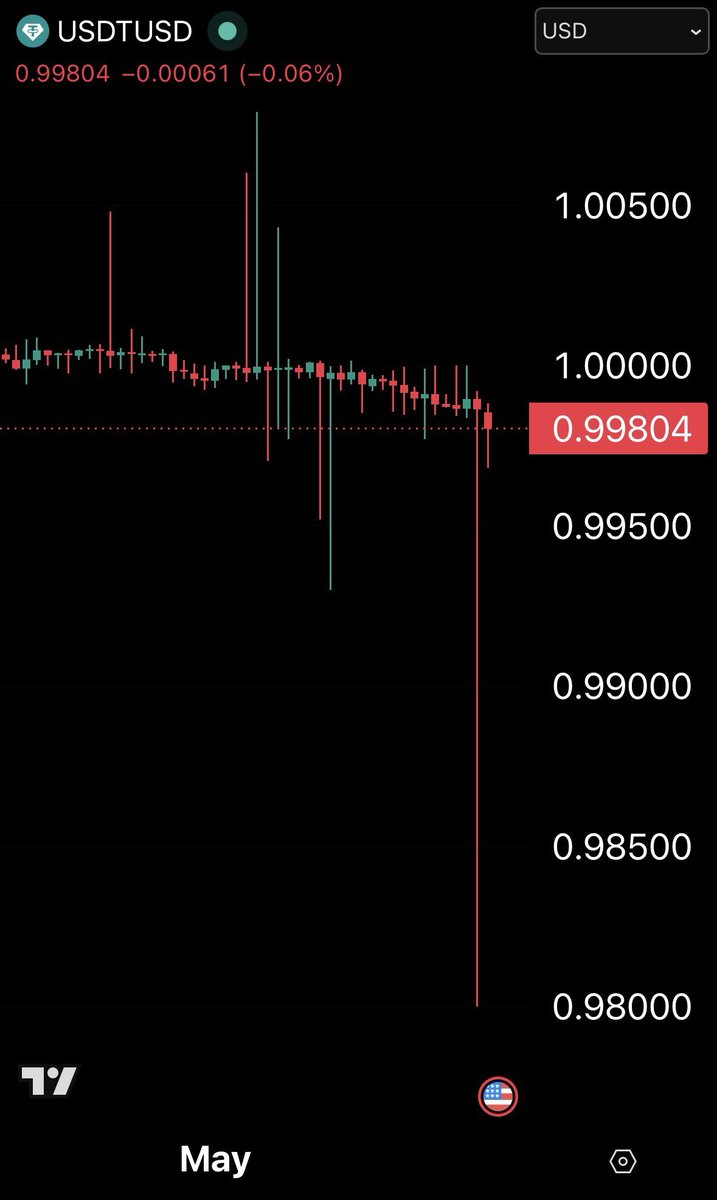
Tether traded at 99.8 cents on Coinbase overnight. Kraken showed 99.83. Bitfinex got dragged with them. The peg is back already, but what can we learn from this? A stablecoin is a promise that one unit is always worth one dollar. The promise is collateralized by Treasuries, commercial paper, and the willingness of an arbitrage desk to buy below par when the spread opens. The collateral works most of the time. The arbitrage works most of the time. But what is "most" of the time worth, especially when the thing your pegged to is already losing value every day? Bitcoin made no such promise. The protocol does not target a price. It targets a supply. It produces a block every ten minutes whether the dollar is 1.00 or 0.97 or 1.04 against another currency. The chain has no peg to defend. Stablecoins stabilize against the dollar. They do not stabilize against the conditions that move the dollar. When the conditions move hard enough, the peg slips, the arbitrage opens, the spread closes, and the chart looks normal again two hours later. The thing the spread was telling you about the system underneath is the part you are supposed to remember. Bitcoin does not chase a price. 1 BTC = 1 BTC always. image
Bitcoin Well's avatar
bitcoinwell 1 week ago
How the Bitcoin ETFs Have Affected Bitcoin Companies
Bitcoin Well's avatar
bitcoinwell 1 week ago
Robinhood launched a feature this morning that lets you connect an AI agent to your brokerage account. The agent reviews your portfolio, reads analyst notes, and places trades for you while you sleep. The CEO called it "extending our mission of democratizing finance to AI agents."Which, is just a weird way to word that. Not enabling its users to use new AI tools, but democratizing finance to software that runs on a server you do not control, attached to a brokerage you do not custody, executing trades on a schedule you did not write.You handed them your custody. Now you are handing AI your decisions, most of which are just run by other corporations that could be telling their AIs to run certain trades without your permission.Wild times!Bitcoin runs on a different stack. You hold the keys. You sign the transactions. You decide when to send and when to wait. There is no agent on a Robinhood server placing your stack into a rebalancing trade at three in the morning because a prompt hallucinated or an AI CEO wanted to push the market a certain way.Self-custody is not just about who holds the coin. It is about who decides what happens to it.A Bitcoin transaction is a sentence you wrote. A Robinhood agentic trade is a sentence someone else's model wrote in your name.Your free will choices are worth holding onto; just as much as your keys. image
Bitcoin Well's avatar
bitcoinwell 1 week ago
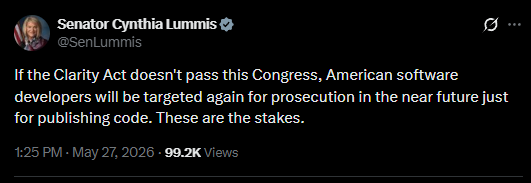
Senator Lummis posted a few hours ago that if the CLARITY Act fails this Congress, American software developers will be prosecuted again for the crime of publishing code. She is not exaggerating. The Samourai Wallet developers were arrested in 2024 for writing privacy software. The Tornado Cash developers were charged for shipping open-source contracts. The BitcoinFog operator went to prison for running a tool that other people chose to use. The pattern is established. Bitcoin runs on code that anyone in the world can read, fork, and ship. The same legal theory that puts a Samourai developer in handcuffs puts every Bitcoin Core contributor inside the same dotted line. Code is speech. In 2026, speech can be a felony. The CLARITY Act is not a Bitcoin bill. It is a free-press bill for the digital century. It draws the line between writing a program and running someone else's money. If that line is not drawn, the law treats every git push like a money-transmission offense. Hal Finney published the running-Bitcoin tweet from his living room in 2009. In a world without CLARITY, that tweet is a probable-cause affidavit. The cypherpunks were not paranoid. They were early. image
Bitcoin Well's avatar
bitcoinwell 1 week ago
The headline this morning is that Bitcoin apparent demand has fallen to a five month low. The chart is real. CryptoQuant's net-buying signal is at the lowest reading since December. Cable news will run this clip for the next 48 hours claiming the sky is falling. Here is the part the chart doesn't show. Apparent demand is a measure of public-market vehicle buying. ETF inflows, treasury company allocations, exchange net flows. It's a slice of the demand picture. It is not the demand picture. And it moves in cycles. It was at a five month high in December. It will be at a five month high again. Demand fluctuates. It always has. Supply does not. Every ten minutes, the Bitcoin network issues roughly 3.125 fresh coins to a miner who solved a block. Roughly four hundred and fifty new coins enter circulation per day. That number falls again in 2028. It falls again in 2032. It keeps falling on a schedule written in 2009 by someone who never read a CryptoQuant chart. Apparent demand can fall. Apparent supply cannot rise. The vehicles got tired. The chain did not. image
Bitcoin Well's avatar
bitcoinwell 1 week ago
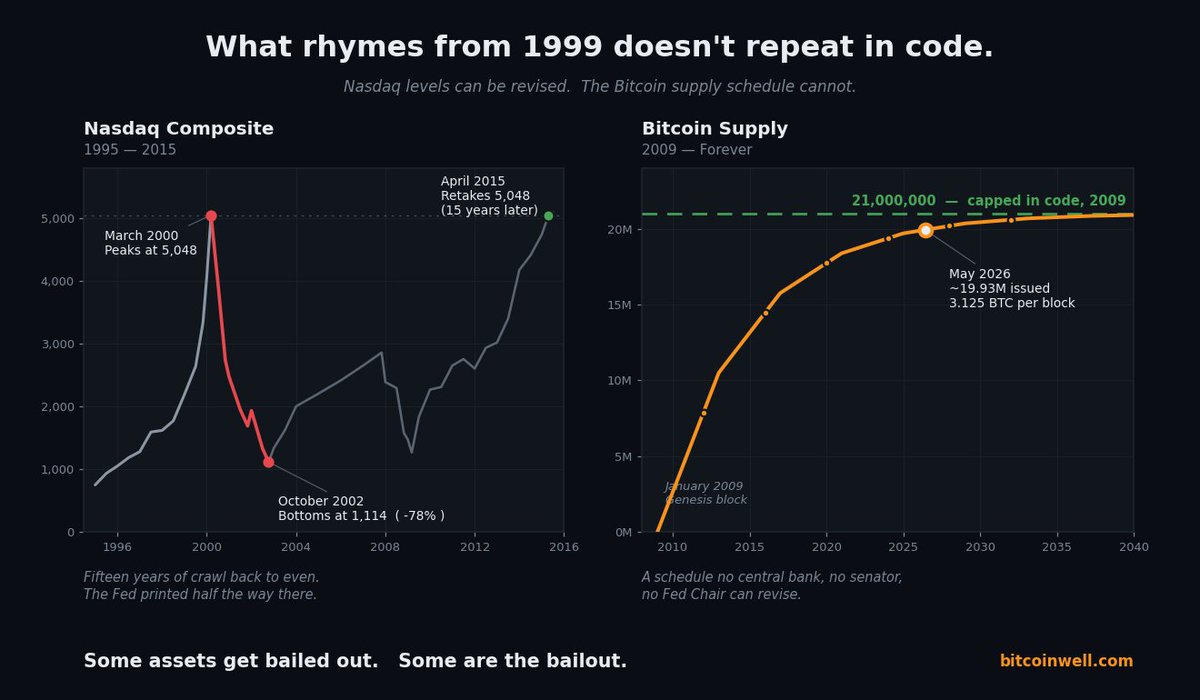
The Nasdaq is printing 1999 valuation metrics. The S&P is printing 2000 valuation metrics. Cisco hit $80 a share in March of 2000 and then spent the next eight years getting back to a third of that. The chart that has every macro account talking this week is the same chart, 26 years later. Mises wrote this story before anyone alive on this app was born. Easy credit pushes capital into the riskiest end of the risk curve. The riskiest end gets bid past any cash-flow story the underlying asset can support. The cash-flow story eventually arrives. The bid does not survive it. Bitcoin is on the same chart as Cisco was in 2000 in one sense, and on the exact opposite chart in another. Both go up when the dollar weakens. Only one has a supply that cannot expand to meet the buying. The supply of stocks went up forever. The supply of Bitcoin will not. When the Nasdaq corrected from 5,000 to 1,100, the Federal Reserve printed its way out of the hole. There is no Federal Reserve for the Bitcoin supply schedule. Some assets get bailed out. Some are the bailout. image
Bitcoin Well's avatar
bitcoinwell 1 week ago
Bitcoin is below $76,000 this morning. Stocks are at all-time highs. Gold is climbing in the same chart frame. Half of crypto Twitter is calling capitulation. The other half is calling manipulation. Both halves are looking at the wrong picture. Yesterday the Federal Reserve added another sliver to the balance sheet. The Treasury rolled another tranche of maturing debt at a higher coupon. The dollar lost a little more purchasing power against every asset that has not yet been issued, allocated, or printed. Stocks at all-time highs are not a strong-economy signal. They are a soft-currency signal denominated in the asset everyone has the most of. Gold runs because the same dollar is buying less of it. Stocks run because the same dollar is buying less of them. Bitcoin runs harder over a longer horizon than either, for the same reason and one additional one. The supply schedule is in the code. The other two assets do not have a code. Stocks are not at all-time highs. The dollar is at an all-time low against stocks. Bitcoin isn't lagging, its readying the next face melting bull market. image
Bitcoin Well's avatar
bitcoinwell 1 week ago
In sixty minutes we go live with @reardencode for The Deep Dive on Bitcoin and quantum computing. Most coverage of this topic gets one thing badly wrong. The threat is not the day quantum machines turn on. The threat is the gap between when those machines reach the cryptographic threshold and when Bitcoin's signature scheme upgrades to a post-quantum standard. That gap has a name. The vulnerable set is roughly five million Bitcoin sitting in addresses that have ever exposed a public key on the chain. Satoshi's stash is in there. So is every coin in a reused address. Brandon Black has spent the last two years inside this problem. Tonight he walks through BIP-360, the soft-fork timeline cryptographers actually argue about, and the self-custody hygiene every Bitcoiner should already be running. The math is not at the threshold yet. The hygiene is the part you can fix today. 7 PM ET. May 26.
Bitcoin Well's avatar
bitcoinwell 1 week ago
Roughly twenty four million Americans qualify as millionaires today. Roughly one point nine million Bitcoin sit in addresses that have moved in the last year. If one in twenty of those millionaires asked their advisor for a single coin tomorrow, the order book breaks before noon. This is the math BlackRock has been quietly pointing at for two years. Larry Fink has compared Bitcoin to scarce real estate, scarce art, and scarce gold in the same breath, on cable news. The man whose firm runs eleven trillion dollars can see the supply schedule from his office. He's not a Bitcoiner. He's an accountant looking at the same chart you are. Most asset managers now publish six percent allocation models. Most pension funds publish one percent floors. Most central banks have started asking the question internally. None of them have run the experiment of all of them trying to buy at once. The supply is in the protocol. The demand is in the wealth survey. The middle is the only thing that can move. Bitcoin's supply was set in 2009. The demand schedule is still loading.
Bitcoin Well's avatar
bitcoinwell 1 week ago
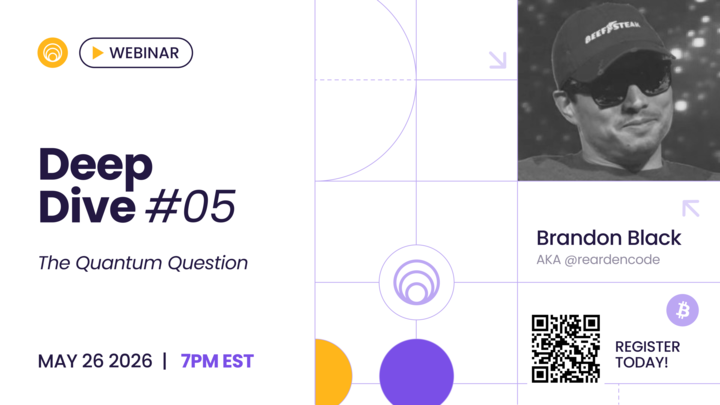
Someone just destroyed 107 Bitcoin on purpose (we think). Five transactions to the canonical burn address. Roughly $8.3 million gone. Not lost. Not frozen. Destroyed. There are now 107 fewer coins competing for the 21 million ceiling. Voluntary scarcity or a major mistake? Here is the harder question. There are also roughly five million BTC sitting in addresses that have ever exposed a public key. Including Satoshi's. Those coins are not gone. They are vulnerable on a long enough timeline to the kind of math problem cable news has been over-selling for a decade. One person took 107 coins off the supply ledger by choice. A quantum computer could take millions from their rightful-owner right off the ledger... or could it? Tonight at 7 PM ET we sit down with @reardencode for The Deep Dive on quantum computing and Bitcoin. Brandon Black walks through BIP-360, the soft-fork path to post-quantum signatures, and the self-custody hygiene that matters before the math tips. May 26th. 7 PM ET. image
Bitcoin Well's avatar
bitcoinwell 1 week ago
By the Time They Let You In, the Money's Already Made
Bitcoin Well's avatar
bitcoinwell 1 week ago
Memorial Day exists because a proposition was paid for. The proposition was simple. A government can't tell a free person what they may own, where they may travel, who they may speak to, or with whom they may trade. People died holding this line. The cost was very real. The line was paid for in blood. It has been kept for two centuries by paper. The paper is increasingly negotiable. Your dollar can be debased without a vote. Your bank account can be frozen on a list you didn't know existed. Every layer between you and your money is a layer that can be coerced. Bitcoin is the first asset that holds the line in code. Twenty-one million. Air-gapped. No senator can sign it away. No central banker can debase it. No court can reverse a confirmed block. The men and women remembered today didn't die so you could trust an intermediary. Bitcoin is a real way you can hold the line yourself. image
Bitcoin Well's avatar
bitcoinwell 2 weeks ago
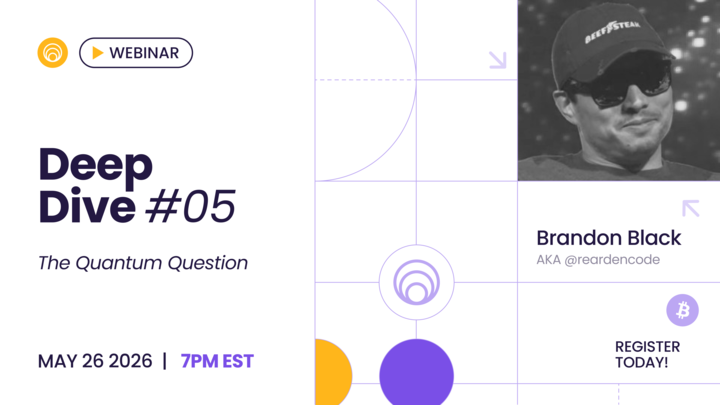
Your seed phrase isn't at risk from a quantum computer today. The harder question is the one nobody is answering cleanly. Ten years from now? Twenty? When does the math actually tip, and what should you be doing in the meantime? Tuesday at 7 PM ET we sit down with @reardencode for The Deep Dive on quantum computing and Bitcoin. The threat model people aren't using because the cable-news version is louder. The timeline that actually matters. BIP-360 and the path toward post-quantum cryptography via soft fork. What you can do to harden your stack now, not later. Brandon Black is one of the most knowledgeable people on the topic and we've got him for an hour. Bring the question you've been afraid to ask. May 26th. 7 PM ET. image
Bitcoin Well's avatar
bitcoinwell 2 weeks ago
Three different parties tried to redefine Bitcoin this week. Iran proved it could move $7.7 billion past every Western bank without permission. A bipartisan U.S. Congress introduced a bill to lock 200,000 bitcoin into an air-gapped Treasury reserve for twenty years. Mark Cuban sold most of his and called it a failed hedge. Three completely different politics. Three completely different motives. One protocol. Bitcoin kept making blocks. The same network that protects a sanctioned regime protects a Canadian trucker. The same network the U.S. Treasury is preparing to hold air-gapped is the network Cuban left because he never understood what he was holding. A billionaire can sell his coins. A regime can move billions of them. A treasury can sign for a million. The supply schedule doesn't care which. Twenty-one million. image
Bitcoin Well's avatar
bitcoinwell 2 weeks ago
The conditions that created Bitcoin are gone forever. A pseudonymous creator. A fair launch. A period when nobody knew what it was and there was nothing to be gained by getting in early except belief. That window closed in 2009. You can't manufacture a fair launch once everyone knows what one is worth. Every coin since has been a derivative of the only one that mattered. image
Bitcoin Well's avatar
bitcoinwell 2 weeks ago
Roughly 144 Bitcoin blocks will confirm today. Each one represents 10 minutes the network kept its promise. 600 seconds of math being math. 600 seconds of a supply schedule that nobody can change. Saturday doesn't matter to the protocol. Neither does Sunday. Neither does the day the Fed cuts. Neither does the day a billionaire sells. 144 blocks. Same as yesterday. Same as tomorrow. Same as ten years from now. Predictability is the asset.
Bitcoin Well's avatar
bitcoinwell 2 weeks ago
Ross Ulbricht and his wife Caroline are expecting their first child. Eleven years in federal prison. A double life sentence plus forty years. Arrested in a public library in 2013, sentenced in 2015, pardoned January 23, 2025. Today: a baby on the way. You don't have to agree with everything Silk Road was to feel something when a man who lost a third of his life to a cage gets to hear his child's first word. The state took the years. The state can't give them back. What it can do is stop standing in the way of the next chapter. Bitcoin runs underneath this story. Ross was prosecuted for building a marketplace whose settlement rails the state hadn't yet approved. That same network now sits in the U.S. Treasury reserve, signed for by the same administration that pardoned him. Contraband and infrastructure inside a single decade. Freedom isn't an abstraction. It's the cell door opening. It's a wedding ring. It's a sonogram. Welcome to the world, little one. Welcome home, Ross. @RealRossU
Bitcoin Well's avatar
bitcoinwell 2 weeks ago
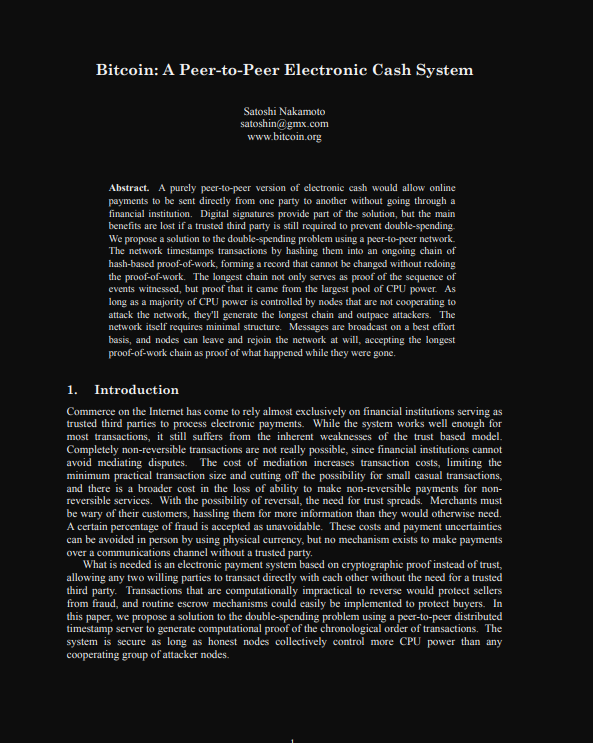
Ten years before Satoshi published the Bitcoin whitepaper, a Chinese-American cryptographer wrote a short essay describing an anonymous, distributed electronic cash system. His name is Wei Dai. The system is called b-money. The year was 1998. b-money never shipped. The protocol was theoretical. The system needed a way to enforce its own rules without a trusted referee, and Wei Dai didn't have a solution to the double-spend problem. Satoshi did. Months before the whitepaper went out, Satoshi emailed Wei Dai directly. The note included a line Bitcoiners now know by heart: "I'm getting ready to release a paper that expands on your ideas into a complete working system." Wei Dai responded. The whitepaper cited him as reference one. Sovereignty is a stack and Bitcoin is the money layer. b-money was the draft. The Satoshi didn't write Bitcoin in a vacuum. He wrote it in a conversation that started a decade earlier and never stopped. Every line of code that lets you hold your own keys today was preceded by ten years of people trying to solve a problem the state preferred you not solve. Reference one in the whitepaper is still reference one in the protocol.
Bitcoin Well's avatar
bitcoinwell 2 weeks ago
What is Nostr? The Decentralized Social Media Protocol
Bitcoin Well's avatar
bitcoinwell 2 weeks ago
Right now, somewhere in the world, two strangers are about to settle a Bitcoin transaction. Neither of them knows who the other is. Neither needs to. The trade will clear in roughly ten minutes. No card network will charge a fee. No court can reverse it. This happens millions of times a day now, but sixteen years ago today, it happened for the first time. Laszlo Hanyecz sent ten thousand bitcoins to a stranger for two pizzas, and the block confirmed. The meme is that he overpaid for pizza. The reality is that he proved a property the entire global financial system spends billions of dollars per year trying to manufacture and still cannot. Settlement without intermediaries. Pizza Day is not an anniversary. It is the day proof-of-work shipped to production. The trade was final the instant the block confirmed. The trade is still final. image