It's Saturday. Bitcoin is down for the week. And the people who will still be here in ten years are not looking at a chart.
They're at a kid's soccer game. Walking the dog. Making coffee without checking the price before the first sip.
Here is the quiet thing nobody tells you about self-custody. It isn't only safer. It's calmer. When your coins sit on a key only you hold, there's no exchange to log into at midnight, no withdrawal queue to refresh, no counterparty whose solvency is suddenly your problem. The setup is done. You can close the app and go live your life.
The trader can't look away, because his position needs him watching. The saver can look away for a year, because his Bitcoin doesn't need him at all. It just needs to be held.
Down weeks are loud. Sovereignty is quiet.
Go enjoy your weekend. Your sats will be exactly where you left them.
- Zach π§ββοΈ
Bitcoin Well
bitcoinwell@btcw.app
npub19mf4...kfu2
Bitcoin Well is on a mission to enable independence. We do this by making it easy to use bitcoin in self-custody.
Whether youβre looking to buy, sell or use bitcoin, we never hold on to your bitcoin.
Bitcoin Well is automatic self-custody.
Strategy is sitting on a 13 billion dollar unrealized loss this week as Bitcoin's price drops. The options desks have started betting against them.
Here's the part worth your attention. The saver who holds the same Bitcoin in a cold wallet is down the exact same percentage this week. Same asset. Same price. Same red number.
One of them can be forced to sell. The other can't.
That's the whole difference, and it's the difference self-custody was built to create. A company that holds Bitcoin through layers of financing has stakeholders, instruments, and obligations stacked on top of the coins. When the price moves, all of that machinery moves too, and at some point the machinery can decide for you.
Coins on a key you control have no machinery. No preferred holders. No options chain pricing your pain. No quarter to answer for. A 30% drawdown is a feeling, not a forced event.
The price falling tests everyone the same way. What it can't do is reach into a cold wallet and pull the trigger.
Down bad is survivable. Forced to sell is not. Hold the version nobody can liquidate but you.


Look at what this week was actually about.
A famous investor told you to sell your Bitcoin for gold. A card network announced it can move dollars on weekends now, if it feels like it. Wall Street decided how to package Bitcoin for you and hold it on your behalf. A Senate committee kept drafting the definition of the thing you already own.
Every one of those is a story about someone else's permission.
Self-custody is the one financial decision nobody gets a vote on.
Freedom isn't a feeling. Freedom is a setup. It's the boring, specific, technical fact that the asset is yours, the keys are yours, and the next move is yours.
Most people never build that setup. Not because it's hard, but because nobody ever showed them how.
So we will. Today at noon ET we're running Bitcoin for Beginners: why Bitcoin is a savings tool, how self-custody actually keeps your coins safe, and a walkthrough of setting up your first wallet, sending and receiving your first sats, and storing them for the long haul.
Stop waiting for permission. Come build the setup.
12:00 PM ET today. Register here:
- Zach π§ββοΈ

StreamYard
Bitcoin for Beginners
Bitcoin for Beginners teaches the basics of why bitcoin is a powerful savings tool, how Bitcoin self-custody is incredibly safe, and how you can st...
You can buy a house with your Bitcoin now without selling it, but there is a catch, and the catch is the whole story.
Coinbase just funded the first Fannie Mae-insured mortgage backed by Bitcoin. You pledge your stack as collateral, keep it on paper, and get the down payment. It goes nationwide this summer.
Now read what actually happens to the coins. To pledge Bitcoin as collateral, you hand the keys to a custodian. Your stack sits on Coinbase's books, under Coinbase's control, against a margin call you did not write the terms of. Bitcoin is down 13% this week. A collateralized lender does not wait for your conviction to recover. They sell the asset you were trying not to sell.
"Don't sell your Bitcoin" quietly becomes "let someone else hold it and decide when you sell."
The headline is adoption, and the adoption is real. Wall Street is pricing Bitcoin as pristine collateral because that is exactly what it is.
Just price the trade honestly. Bitcoin you control is sovereignty. Bitcoin you pledge is someone else's leverage with your name on the loan.
Keep the keys. Borrow against a dollar if you have to.


Mastercard is going to let its partners settle in a stablecoin. Weekends, holidays, around the clock.
The headline is that the card networks are finally embracing crypto.
But a stablecoin settlement rail is just a faster dollar. It clears on weekends because the issuer wants it to. It settles on holidays because the network currently allows it. Every one of those decisions belongs to someone who is not you.
A faster dollar is still a dollar that answers to its issuer.
Mastercard moving to weekend settlement is Mastercard catching up to something Bitcoin has done every ten minutes since 2009.
The card network gets to choose its hours. Bitcoin processes every ten minutes forever.
Tether can mint over a weekend. Circle can mint over a weekend. Now a card network can move them over a weekend too. The convenience is real. So is the issuer who sits behind every token.
Bitcoin is the only one in this story with no issuer to call.
Settle in a dollar if you want permissioned speed, but hold the asset that settles to a key only you control.


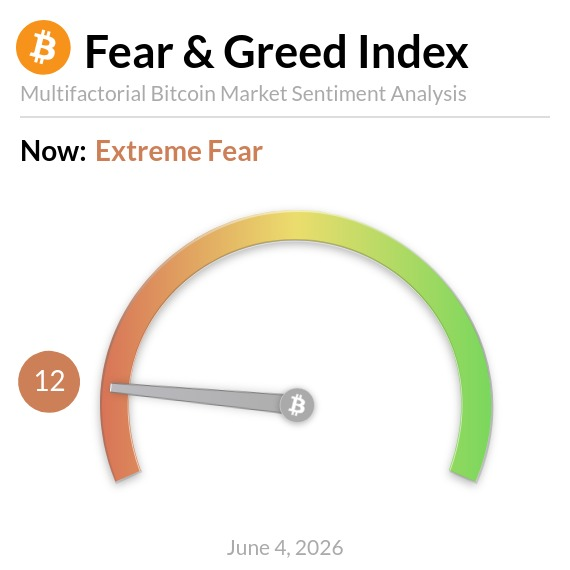
The Fear and Greed Index just hit 12. Extreme Fear. One of the sharpest sentiment collapses of the year.
Bitcoin is near cycle lows. Down from $73k Monday to the low $60s this morning.
The index measures how people feel. It does not measure what they do.
Here is what they are actually doing on our exchange. 76% of transactions on our exchange this week have been buys. The number of buys doubled from last week and the $ amount spent has tripled.
A fear index is a survey of emotions. But what are people actually doing? The two have been pointing in opposite directions all week.
The saver who bought this morning didn't check the gauge first. The saver doesn't need a sentiment reading to know that a fixed-supply asset on sale means more sats for his dollar.
Extreme fear is what the chart looks like to a trader with a stop loss. To a saver with a cold wallet and a plan, extreme fear is just a discount.
The people selling into the fear are selling someone else's keys.
The people buying into it are funding their own.


Michael Saylor's Strategy is sitting on a $8.5 billion unrealized loss on Bitcoin.
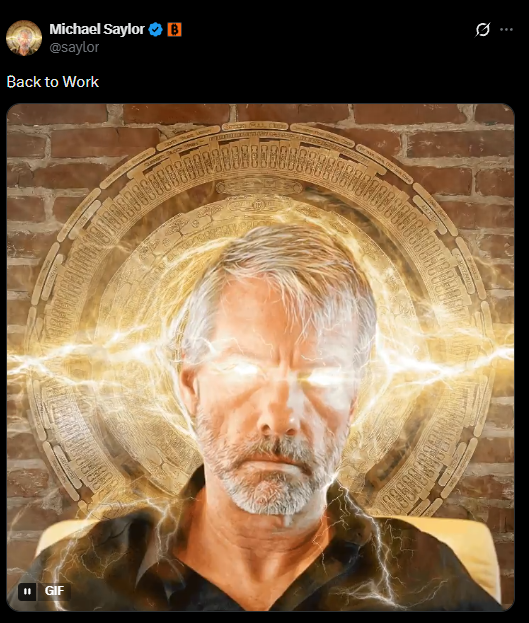
Strategy sold $2.5 million of Bitcoin two days ago. Bitcoin fell another five thousand in the two days since. Saylor posted "βΏack to Work" at 8 AM ET this morning. 898,000 views in seven hours.
A sovereign holder does not have an unrealized loss.
A sovereign holder has a stack and a price they don't watch. Your wallet doesn't report to shareholders. Your seed phrase doesn't file a 10-Q.
Strategy is a publicly traded corporate Bitcoin proxy. The price chart became a spectacle because the shares became a vehicle. The vehicle has investors. The investors need a tweet.
Sovereignty doesn't tweet "back to work."
Sovereignty doesn't ever stop working.
A self-custodied holder watching today's price chart is not waiting for Saylor's signal.
Bitcoin sent to your own wallet does something Strategy stock can't do. It clears in ten minutes and stops asking for your attention.
Stack the way the seed phrase stacks.
Quietly, without an audience.


The CLARITY Act passed the House 294-134. It cleared the Senate Banking Committee 15-9 with Democrats crossing the aisle. Its now queued for a full Senate floor vote.
Bitcoin Twitter is celebrating because the bill defines a Bitcoin as a commodity and ends regulation by enforcement.
A definition is a useful thing.
A definition is also a permission slip. A commodity classified by the United States is still a commodity that the United States can reclassify. The next administration writes the next definition. The next Congress writes the next floor vote.
Bitcoin existed before the CLARITY Act. Bitcoin will exist after it.
A self custodied holder will find it easy to be glad if the bill passes and also unbothered if it doesn't.
Regulatory clarity might be a gift to the price, but self custody is designed so you can ignore the rulings of governments.
Hold your own keys.


Peter Schiff says Bitcoin will fall under $20k and shake the conviction of long term HODLers, causing many to finally throw in the towel.
Schiff has predicted Bitcoin would crash to nothing in 2018, 2019, 2020, 2021, 2022, 2023, and 2024.
Bitcoin is currently $67k. Down from a $73k high earlier this week.
Schiff is calling the bottom the way he has always called the bottom. By predicting capitulation.
A capitulation event is what historically separates the holders who built generational positions from the ones who priced themselves out. Every prior Schiff bottom call has been a buy signal.
Those of us that know what Bitcoin is don't need Schiff's permission to keep holding. And his calls for Bitcoin's demise become more ridiculous every cycle.
Schiff has built a career convincing Americans to sell Bitcoin for gold. Anyone who took the trade in 2018 missed a 22x move.
Wonder what happens this time?


Three United States senators want the Labor Department to scrap a proposed rule that would let retirement savers put Bitcoin in a 401(k).
Elizabeth Warren. Bernie Sanders. Tim Scott. Two Democrats and a Republican.
The senators argue that Bitcoin is too risky for a retirement account.
Bitcoin is too risky for a retirement account because a retirement account is a structure where someone else holds the asset, someone else files the paperwork, someone else decides the redemption window, and someone else writes the rules for the day a saver wants the asset back.
The risk the senators are describing is not the risk of Bitcoin. It is the risk of the wrapper.
A retirement saver who buys Bitcoin and holds it in a self custody wallet doesn't need a Labor Department rule, a fund administrator, a custodian, or a Senate letter. The saver needs a seed phrase and a piece of paper.
Three senators are arguing about whether to let savers access Bitcoin through a system that takes the Bitcoin out of the saver's hands.
Hold the asset directly and the rule the senators are debating becomes a rule about other people's money.


Bitcoin fell under $67,000 at noon. Down five thousand in two days. One billion in liquidations across crypto. BlackRock's spot Bitcoin ETF sold four hundred forty million in a single session.
The tape is loud and bearish.
Here is what does not show up on that tape.
84.7% of the transactions on our exchange today are buys.
76% of transactions this week are buys.
The price chart is the redemption flow at BlackRock. The price chart is the Strategy filing. The price chart is the leveraged liquidation cascade.
The story the price chart misses is the saver who looked at the move this morning and bought another stack. The saver who bought yesterday. The saver who has been stacking every day this week on the exchange that lets them withdraw to their own keys.
A retail Bitcoin holder watching the price drop is not selling. A retail Bitcoin holder watching the price drop is filling the order they have been praying would hit.
The price chart shows volatility.
The buy tape shows conviction.


Warren Buffett is holding three hundred ninety seven billion dollars in cash. Largest pile in Berkshire's history. He famously believes Bitcoin is rat poison squared.
Watch his words and his actions.
Buffett's words say productive equities always beat inert commodities. Buffett's actions are holding the largest cash hoard ever recorded by a value investor, against an S&P 500 priced at the most expensive valuation in market history. More expensive than the dot com bubble. More expensive than the run up to the Great Depression. Buffett's actions are saying that the price of every productive equity on his radar is too high to buy.
Cash is a hedge against the price of markets potentially going down. Bitcoin is a hedge against the cash itself. Different tools for different problems.
A four hundred billion dollar cash pile is the loudest possible vote that the value investor cannot find a place to park it at current prices. The reason value cannot be found at current prices is that the markets measured in fiat are no longer trustworthy.
Buffett built a generational fortune by buying productive assets cheaply in honest money.
Honest money still exists, but it might require swallowing some rat poison and pride.


Bitcoin dominance just dropped below sixty percent.
The alt-season posts have started again. Capital rotates out of Bitcoin. Risk appetite returns. The chart looks like 2017. The chart looks like 2021. The chart looks like every cycle the lottery ticket lobby has tried to sell you.
Watch what the dominance chart actually measures.
Bitcoin dominance is the percentage of crypto market capitalization that is in real money. Everything below the line is in something else. Tokens that were premined. Tokens that were airdropped to insiders. Tokens that have a founder who can change the supply schedule by writing a blog post. Tokens that need a venture round to keep the lights on.
Dominance dropping is not a signal that capital is rotating. It is a signal that capital is being recruited.
The brand of the recruiter changes every cycle but the underlying recruitment does not.
A Bitcoin-only holder watches the dominance chart and reads it the way a Treasury holder reads a junk bond rally. Spreads narrow. Spreads widen. The risk-free asset does not move because the risk-free asset is the unit that everything else is priced against.
Forty two percent of the crypto market is now in lottery tickets.
Bitcoin still doesn't need one to win.


Bitcoin's biggest June conference is not in Miami. Not in Las Vegas. And not in Nashville.
It is in Nairobi.
Bitcoin Nairobi Conference runs at ASK Dome in Jamhuri Park this month. Bitcoin Plus Plus Nairobi runs June seventeen through nineteen, open source edition, with developers flying in to hack on Bitcoin protocol code. Bitcoin School Kenya is shipping a new student Bitcoin app every week through its VibeCode program.
The center of gravity in this industry moved while nobody was watching.
Miami sells real estate. Nairobi ships code.
Bitcoin started in a North American mailing list in 2008. It scaled in Salvadoran beach towns in 2019. Kenyan students are building it in 2026.
Sovereignty is contagious. The country that needs Bitcoin the most learns Bitcoin the fastest. Kenya is one of the largest mobile money markets in the world and one of the youngest tech populations on the planet, and the people closest to the problem are the ones doing the work.
A Bitcoin conference in Miami is a marketing event. A Bitcoin conference in Nairobi is a survival skill.
Real adoption looks for the people who need it.
β Zach π§


El Zonte was a fishing village in El Salvador. Most of the houses ran on candles. Most of the residents had never seen a bank account.
Six years ago a few cypherpunks held a Bitcoin class on a beach.
The classroom is now a boutique hotel.
Bitcoin Beach started in 2019 with a small handful of locals learning to install Wallet of Satoshi on a phone. By 2021 El Salvador had made Bitcoin legal tender. By 2026 the original meeting spot has been rebuilt as a working business that runs on Bitcoin.
No central bank approved this. No development agency funded it. No NGO white paper preceded it.
Volunteers showed up with a node and a printer for paper wallets. Locals showed up with phones. The rest of the work was just time on the chain.
Adoption looks slow until you look at it in years.
The same playbook is now running in Bitcoin Ekasi in South Africa, in Motiv Peru, in Bitcoin Lake Guatemala, and in fifteen other circular economies that nobody has heard of yet.
Real adoption does not look like a price chart.
It looks like a fishing village six years later running a Bitcoin hotel.
β Zach π§


May 2026: The Month the Bear Market Ended and the Sovereignty Fight Began
Most people stay out of Bitcoin because they think it's complicated.
It isn't.
One hour. One wallet. One set of keys you actually control.
Bitcoin for Beginners. June 5 at 12 PM ET. Free.
The hardest part is showing up.


StreamYard
Bitcoin for Beginners
Bitcoin for Beginners teaches the basics of why bitcoin is a powerful savings tool, how Bitcoin self-custody is incredibly safe, and how you can st...

Nick Szabo described bit gold in 1998.
Ten years before the Bitcoin whitepaper, Szabo had already sketched the structure. Proof of work for issuance. Cryptographic chaining for sequence. A public registry that did not require a bank to verify or a state to authorize.
The idea was complete. The protocol was unfinished.
Bit gold was never built into a working currency. It sat in academic papers and a personal blog. Then somebody ran the code.
Szabo did the hardest part of the work. He sat with the question of what money could be if a computer enforced its own scarcity. He answered it on paper. Someone else answered it in software.
Most of what gets called innovation in this space is a remix of an idea that was already written down almost three decades ago. Satoshi just happend to be the one that built the thing.
The cypherpunks were not theorists. They were architects who did not have the construction crew yet.
If you hold Bitcoin today, you are holding the running version of a thesis that took ten years to compile.
Read Szabo. Then check your seed phrase.


Your first wallet is your first act of monetary sovereignty.
Bitcoin for Beginners. June 5 at 12 PM ET.
We walk you through why Bitcoin works as savings, how self-custody actually works, and how to set up the wallet that nobody else can touch.
Free. Bring a notebook.


Earn Sats on Auto-Pilot: Meet the Bitcoin Well Referral Program