Bitcoin Well's avatar
Bitcoin Well
bitcoinwell@btcw.app
npub19mf4...kfu2
Bitcoin Well is on a mission to enable independence. We do this by making it easy to use bitcoin in self-custody. Whether you’re looking to buy, sell or use bitcoin, we never hold on to your bitcoin. Bitcoin Well is automatic self-custody.
Bitcoin Well's avatar
bitcoinwell 3 weeks ago
Strategy floats selling some Bitcoin and the timeline splits in two: half writing eulogies, half yelling "paper hands." Same news. Opposite feelings. That gap is the whole story right now, and most people are trading on it without realizing it. Today we read the market's real mood with Michael Sullivan (Sentiment Sully) @SullyMichaelvan. Not the price. The language. His data says this isn't capitulation or hype, it's apathy and anger. Bitcoin's identity crisis, the factions, "paper Bitcoin," and what's left of conviction when the easy stories break. The Deep Dive. June 30, 4:00 PM EST. image
Bitcoin Well's avatar
bitcoinwell 3 weeks ago
Strategy floats selling some Bitcoin and the timeline splits in two: half writing eulogies, half yelling "paper hands." Same news. Opposite feelings. That gap is the whole story right now, and most people are trading on it without realizing it. Tomorrow we read the market's real mood with Michael Sullivan (Sentiment Sully) @SullyMichaelvan. Not the price. The language. His data says this isn't capitulation or hype, it's apathy and anger. Bitcoin's identity crisis, the factions, "paper Bitcoin," and what's left of conviction when the easy stories break. The Deep Dive. June 30, 4:00 PM EST. image
Bitcoin Well's avatar
bitcoinwell 3 weeks ago
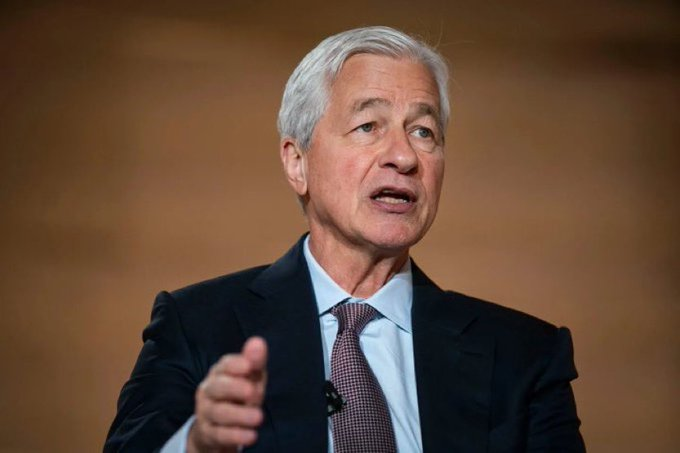
"A fraud." "A pet rock." "I'd close it down." That was JPMorgan on Bitcoin for years. This week the same bank says digital assets are "moving into the core" of the financial system. Don't act surprised. He wanted it cheaper while he loaded up. Talk the price down, accumulate quietly, then announce you were early. Oldest move on Wall Street. And it's a preview. The people calling Bitcoin worthless today are the ones who'll sell it hardest a decade from now, once they own enough to sell. Their words follow their bags. They always have. So stop trading on what they say. A man calling it worthless while his firm builds the rails to hold it isn't handing you analysis. He's managing his entry. Study the asset. Use your own brain. The only conviction that survives a cycle is the kind you built yourself.
Bitcoin Well's avatar
bitcoinwell 3 weeks ago
Strategy just gave itself room to sell Bitcoin, and the timeline is melting down. So what? Today the company authorized a program to sell some of its Bitcoin when it chooses to, to cover dividends and buy back its own stock. Cue the betrayal posts. But the whole point of Bitcoin is that you can do whatever you want with it. Hold it for forty years. Sell it tomorrow. Spend it on coffee. The network doesn't check your reasons. It doesn't care whether you're a true believer or a treasury company managing a balance sheet. It settles the transaction and moves on. Yes, Saylor spent years saying never sell. He's a salesman. That's the job. He doesn't owe you a diamond-hand vow, and you were never supposed to take your conviction from a hype man. He gets to use Bitcoin on his own terms, exactly like you do. Strategy could sell every coin it holds and Bitcoin would still issue the next block on schedule, still cap the supply, still settle for anyone, still answer to no one. That's the freedom, not a loophole in it. Bitcoin doesn't need you to hold forever. It just needs to be yours while you do. image
Bitcoin Well's avatar
bitcoinwell 3 weeks ago
Here's a self-custody habit almost nobody does, and the one that matters most: test your recovery before you need it. Most people set up a wallet, write down the recovery words, and never touch them again. Then years later something breaks, and they find out the hard way that they wrote a word wrong, skipped one, or can't read their own handwriting. The fix takes twenty minutes. Set up a fresh wallet on a spare device and restore it from your written words. If your balance shows up, your backup works. If it doesn't, you just found out while you still have time to fix it. Self-custody isn't only about holding your keys. It's about knowing, for certain, that you can recover them. The whole point of holding your own coins is that the responsibility is yours, so make sure the backup actually does what you think it does. Test it this weekend. Future you will be grateful.
Bitcoin Well's avatar
bitcoinwell 3 weeks ago
Open any Bitcoin timeline this week and you can feel it. Not fear. Something flatter. People tired, annoyed, picking sides over the same red chart. That mood is data. June 30, we're sitting down with Michael Sullivan @SullyMichaelvan (Sentiment Sully), who reads the market's real emotional state through language, not price. His take is counterintuitive: the opposite of euphoria isn't panic. It's apathy and anger. That's where conviction gets tested, long before the chart says anything. Bitcoin's identity crisis, the factions forming, Saylor, MSTR, "paper Bitcoin." All of it as conversation, not gospel. Everyone's staring at the same chart and feeling something different. Michael measures the difference. The Deep Dive: How is Bitcoin Feeling. June 30, 4:00 PM EST image
Bitcoin Well's avatar
bitcoinwell 3 weeks ago
Every currency in history started hard and got softened. Rome clipped silver out of the denarius until it was a copper slug with a wash. The dollar was redeemable for gold until it wasn't. The pattern never changes, because the people who issue money can always issue a little more, and a little more is always tempting when the bill comes due. Mises called it the inevitable end of every government money: expansion until trust breaks. He wasn't predicting one country. He was describing a temptation no committee has ever resisted for long. Bitcoin removes the temptation. 21 million, enforced by every node, changeable by no one with a printer and a deadline. The supply cap isn't a marketing number. It's the first money in history where "we'll just make more" is not an option anyone has. You can't soften what nobody controls. That's the whole case. image
Bitcoin Well's avatar
bitcoinwell 3 weeks ago
Somebody told me this week they finally moved their bitcoin off the exchange after three years. Three years of meaning to. Three years of "I'll do it this weekend." Then one afternoon they wrote down twelve words, sent a test amount, watched it land, and sent the rest. They said the strangest part was how quiet it was. No confirmation email from a company. No support line. No permission. Just their coins, in a wallet only they can open, answering to nobody. That quiet is the whole thing. We are so used to money that lives inside someone else's building that holding it yourself feels like it should be harder, or scarier, or need approval from somebody. It doesn't. It takes about ten minutes and a piece of paper you keep somewhere safe. If you've been meaning to do it for three years, this is the weekend. Your keys, your coins. image
Bitcoin Well's avatar
bitcoinwell 3 weeks ago
A dollar just became the second most valuable asset in all of crypto. This week Tether's USDT passed Ethereum by market cap. Around $186 billion in dollar tokens, now worth more than the network that was supposed to replace the financial system. The most-used asset in crypto is the exact thing crypto was built to route around. Stablecoins are useful, no argument. Peruvian onion exporters are now settling customs in USDT instantly, no correspondent bank, no three-day wire. That part is real. But a stablecoin is still a dollar, and a dollar still loses value on a schedule set by people you never voted for. Tether can also freeze any address it wants, and it has done it many times over. Convenient money you can be locked out of is still money you can be locked out of. Bitcoin is the one asset on these rails nobody can print and nobody can freeze. Not a faster dollar. A different kind of money entirely. Hold the one with no off switch. image
Bitcoin Well's avatar
bitcoinwell 3 weeks ago
Adam Back didn't invent proof of work. We should say so plainly, because the real history is better than the myth. The idea came first from two cryptographers you've probably never heard of. In 1992, Cynthia Dwork and Moni Naor proposed making a computer do a small, hard piece of work to send an email, as a way to price out spammers. That was proof of work, five years before Hashcash. Back's contribution: In 1997 he built Hashcash, the working version that turned the idea into something you could actually run. The term "proof of work" itself was coined later, in 1999, by Markus Jakobsson and Ari Juels. Hal Finney made it reusable in 2004. Then Satoshi cited Hashcash by name and wired it into Bitcoin, turning an anti-spam trick into the heartbeat of sound money. No single genius. A relay run across sixteen years by people who mostly never met. Bitcoin wasn't handed down by one founder you have to trust. It was assembled in the open, checkable by anyone. The money you can verify yourself was built the same way. image
Bitcoin Well's avatar
bitcoinwell 3 weeks ago
The Family Office Was Always for the Other Guy. Until Now.
Bitcoin Well's avatar
bitcoinwell 3 weeks ago
Freedom Friday, Calgary edition. Tonight you can buy a steak and pay for it in bitcoin, and the rancher who raised it gets the sats directly. No processor approving the sale. No bank deciding the farmer is allowed to be paid. Just two people and good money changing hands. The Sat Market @BTCSatMarket is on tonight, 4 to 9pm, at the Platform Innovation Centre, 407 9 Ave SE. Coen Farm, Sunny Pines Homestead @Bitcoin_JeffM, the Bitcoin Well table, and a room full of vendors who would rather hold sats than dollars. Bringing your bitcoin to a market and walking out with dinner is the most normal thing in the world. It only feels radical because we were taught money needs a gatekeeper. It doesn't. Come prove it tonight. ✊ — Zach 🟧 image
Bitcoin Well's avatar
bitcoinwell 3 weeks ago
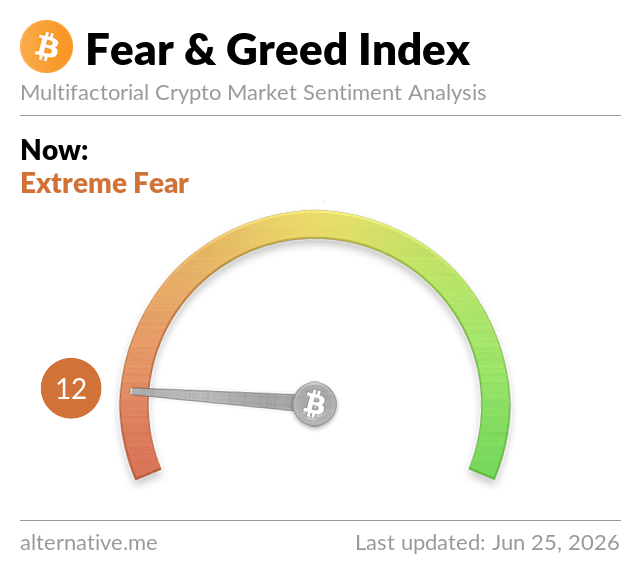
A drawdown like this isn't a crisis for Bitcoin. It's the entrance fee. A lot of people are finding out tonight they can't afford it. Bitcoin near $58,000, down hard, and the loudest voices from three weeks ago have gone quiet or flipped. Notice what actually changed today. Not the protocol. Not the supply. Not a single rule any node enforces. The only thing that moved is the price, and the price has a way of writing people's convictions for them in real time. This is what low time preference actually costs. Not a clever entry. The discipline to keep holding something you understand while the chart screams at you to do something, anything, to make the feeling stop. The fiat system spent your whole life training you to flinch. To want a hand on the dial. To trust the man who promises he'll steady things. Every red day is a quiet test of whether you traded that reflex for ownership, or just rented it until it got uncomfortable. The market can't take your Bitcoin from you. It can only talk you into handing it over. Don't. image
Bitcoin Well's avatar
bitcoinwell 3 weeks ago
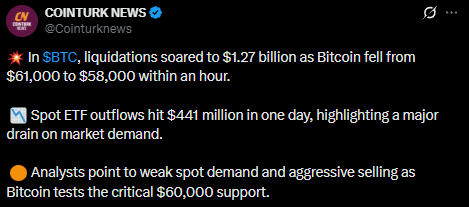
$1.27 billion in Bitcoin got liquidated in about an hour today. Not one satoshi of it was in cold storage. Bitcoin fell from $61,000 to $58,000, a 21-month low, and over a billion dollars in leveraged long positions were wiped out. Not Bitcoin. Leverage. Those were traders who borrowed to bet on the price, posted collateral they couldn't cover, and got force-sold by an exchange the second the number moved against them. The coins sitting in a wallet you control did not get a margin call. They were not force-sold. They sat exactly where you left them, answering to no one. That is the entire difference between owning Bitcoin and renting exposure to its price with money that isn't yours. A drawdown tests two things: your conviction and your custody. Leverage fails the first one for you, automatically, at the worst possible moment. Self-custody never takes the test, because there is no counterparty left to pull the rug. The price will do what it does. What you actually hold is the only part you control. Keep it somewhere only you can reach. image
Bitcoin Well's avatar
bitcoinwell 3 weeks ago
Everyone asking if Bitcoin is "going to zero" is making the same mistake. They're staring at the price. And the price is the one part of Bitcoin that's still fiat. Bitcoin is the hardest money ever built. 21 million, no printer, no board, no government that can dilute it. But it was born into a world that is still 100% fiat, and that world sets its price. So its number gets shoved around by the same casino that props up everything else: leverage, liquidations, funds chasing quarterly returns, and a decade of cheap money floating defense contractors, AI darlings, and tech giants that live and die on government contracts. When Bitcoin soars or crashes, Bitcoin didn't change. The protocol didn't move. 21 million didn't move. A block still arrived every ten minutes. What moved is how a fiat world, playing fiat games, decided to price it this week. That's the lens problem. Dave Portnoy looks at $59,000 and sees something dying. Jack Mallers, who watched it get buried after Silk Road, Mt. Gox, the bans, and FTX, sees the same asset he's held since it was $50. One is pricing the antidote in units of the poison. The other stopped asking the fiat world for its opinion. The fiat world gets a vote on Bitcoin's price, but if your vote is for something different than the fiat world entirely, Bitcoin is still the only real option. image
Bitcoin Well's avatar
bitcoinwell 3 weeks ago
Most wealth management starts by taking your money out of your hands. This one doesn't. A "family office" has traditionally meant a private team the ultra-wealthy use to run everything in one place: investments, taxes, estate, lawyers; all coordinated by people who actually talk to each other. For decades you had to be in the top 1% to get it. The Bitcoin Family Office Group changes that. Five independent, Bitcoin-native firms, covering wealth, tax, legal, mining, and us, working as one team for serious holders instead of only nine-figure dynasties. Bitcoin Well Infinite is the official Bitcoin partner. We handle the buying, selling, and settlement. Here's the part that matters: the bitcoin goes straight to your own wallet. Not an account we control. Not an IOU on our books. Your keys. That's the whole point. You can bring in the best advisors on earth and still hold your own coins. Serious help. Your keys. Finally in the same room. image
Bitcoin Well's avatar
bitcoinwell 3 weeks ago
Bitcoin just dropped under $60,000 and the prediction markets are giving roughly 80% odds it breaks $55,000. Open any timeline and you can feel it. Panic, anger, people picking sides and turning on each other. Here's the strange part. The data says this isn't capitulation. It's something quieter and weirder: apathy and anger, not fear and surrender. The opposite of euphoria. On June 30 we're sitting down with Michael Sullivan, @SullyMichaelvan to read the market's actual emotional state. Not through price. Through language. Michael measures what Bitcoiners are really feeling underneath the chart, and right now those feelings are splintering. We'll get into Bitcoin's identity crisis, why the community is fracturing into factions, why the same news makes one camp cheer and another rage. Saylor, MSTR, "paper Bitcoin," and what happens to conviction when the easy narratives break. Everyone's staring at the same red chart and feeling something completely different. Michael actually measures the difference. The Deep Dive: How is Bitcoin Feeling, with Michael Sullivan. June 30, 4:00 PM EST. Bring your questions. image
Bitcoin Well's avatar
bitcoinwell 3 weeks ago
Everyone is cheering the price of oil falling but the bigger story isn't about the oil, its about the money. As part of the deal to reopen the Strait of Hormuz, the US agreed to release billions in frozen Iranian funds. A reported $24 billion. The part worth understanding: that was Iran's money to begin with. Oil and gas revenue, earned from real sales, parked in foreign accounts that US sanctions then froze in place. Not a gift. Not aid. Their own earnings, locked by decree. And the "release" comes with a leash. The funds stay under US control and can only be spent buying corn and wheat from American farmers. A nation's own money, handed back on the condition that someone else decides what it buys. Now ask what the war actually changed. The strait reopens, with no charge for 60 days. Sanctions ease as soon as they "behave." We're roughly back where we started, because the missiles were never the real weapon. The real power of the US was never the bombs, it was the ability to control the rails of the global economy. The power to switch a country's money on and off. The war just provided the excuse and the bombs just provided the smoke screen to obfuscate what was really going on. And quietly Bitcoin continues to mint new blocks every 10 minutes without anyone's permission; continuing to win the ongoing war for freedom without any bombs or violence. Tick-Tock next block. image
Bitcoin Well's avatar
bitcoinwell 3 weeks ago
Apple almost killed a Bitcoin wallet on its platform last week. Not by hacking it, but by deleting a developer account. Craig Raw built Sparrow, one of the most trusted self-custody wallets on earth. Open source. Free. His mistake was trying to warn people about fake Sparrow clones scamming users on the App Store. For that, Apple flagged his developer account for termination. The stated reason was "dishonest activity." Set a deadline of June 30. After that, every new install of Sparrow on a Mac would have simply failed. Twenty-four hours of public pressure later, Apple reversed it. However, the scam clones stayed up. The honest developer nearly got cut. And a single company in Cupertino held a kill switch over how millions of people reach their own keys. That's the real lesson, and it cuts deeper than "not your keys, not your coins." These were people trying to do the right thing. They wanted their Bitcoin in their own hands, and a single gatekeeper nearly took away the tool they chose to do it with. Self-custody isn't only about holding keys. It's about reaching them through software no one can switch off. A closed app store can throttle the on-ramp. Slow you down, frustrate you, quietly push you back toward the custodian who never gets flagged. What it can't touch is open code. Sparrow is open source. You can build it, run it, and pass it on without Apple's blessing. That's why this ended in a reversal and not a dead wallet. Hold your own keys. And reach for the tools no gatekeeper gets to approve. image
Bitcoin Well's avatar
bitcoinwell 0 months ago
I worked for a bank. Then I protested one and I lost my house for it. That's where this starts. Where it ends is realizing the money is broken, and doing everything right still feels like falling behind because it is. My whole story, and how it led me to the one place left to save that no one can print away. — Zach 🧙‍♂️