Why Nobody Trusts the Bitcoin Rebound (And Why That Is the Point)
Bitcoin Well
bitcoinwell@btcw.app
npub19mf4...kfu2
Bitcoin Well is on a mission to enable independence. We do this by making it easy to use bitcoin in self-custody.
Whether you’re looking to buy, sell or use bitcoin, we never hold on to your bitcoin.
Bitcoin Well is automatic self-custody.
America: freezes Russia's reserves
Russia: you know you can't freeze Bitcoin, right?
America: no, you can't just opt out of the dollar
Russia: oh yeah? hold my vodka
Everything humans make gets easier to make over time. Faster chips. Cheaper energy. More dollars, always more dollars.
Bitcoin is the one exception ever engineered. The harder people work to produce it, the harder it becomes to produce. The supply is capped at 21 million and the issuance schedule answers to no one.
That isn't a tech feature. It's the first time in history money got harder to make instead of easier.
Everything around you is being quietly inflated. One thing can't be.
Store your work in the thing no one can print more of.


Prefer audio? Every episode of the Bitcoin Well Podcast is on Spotify and Apple Podcasts too: same conversations, no screen required.
This week's episode: Bitcoin's split-screen market, Japan's regulatory overhaul, and a China story everyone's about to be talking about.
Subscribe now so it's already in your feed Thursday morning.


Nobody posts about it, but there's a quiet kind of peace in holding your own keys.
The market can be red. The headlines can be loud. Some exchange can be melting down on your timeline. And none of it reaches what's yours, because there's no one in the middle who can freeze it, lend it out, or lose it on your behalf.
You stop refreshing. You stop worrying about someone else's balance sheet. What you hold is simply yours, verified by you, answerable to no one.
That's the part the price charts never show. Self-custody isn't only safer. It's calmer.


Last week we asked whether Saylor was panicking or playing the long game. Not the kind of conversation you get from a headline.
Full episodes, including that one, are on our YouTube channel. No clickbait cuts, just the actual discussion.
New episode drops Wednesday, 2pm EST. Worth catching up first.


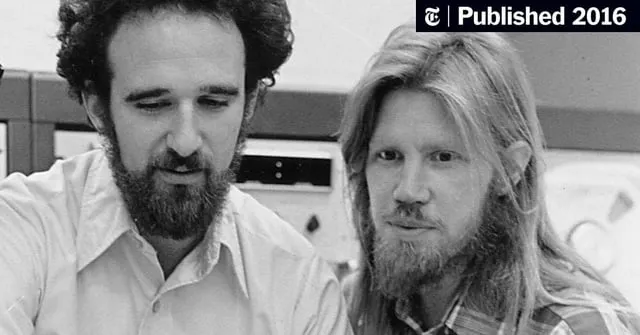
In 1976, two Stanford researchers solved a problem that had stumped cryptographers for centuries. Their fix is the reason you can own bitcoin at all.
Before Whitfield Diffie and Martin Hellman, secret communication had a catch. To send someone a coded message, you both had to agree on the same secret key first. That meant meeting in person, or trusting a courier, or a bank, or some middleman to carry the secret for you. There was always a someone in the middle.
Their paper, "New Directions in Cryptography," broke it open. They split the key in two. A public key you can hand to the entire world, and a private key you never share with anyone. One locks, the other unlocks. No prior meeting. No trusted middleman.
That single idea is your bitcoin wallet. Your public key receives. Your private key signs. Nobody can forge it, and nobody has to vouch for you.
Here's the lesson. The tools that end up protecting your freedom usually arrive as pure math, decades before anyone builds the thing that needs them.
Diffie and Hellman weren't building money. They were making it possible to trust no one. Thirty-two years later, Satoshi proved that was the same thing.


It's dangerous to go alone in a world that prints money forever.
Take this. 🟧


The ultra-wealthy have always had a team. A family office quietly coordinating their wealth, taxes, legal, and estate so nothing slips through the cracks.
Bitcoiners never had that. Until now.
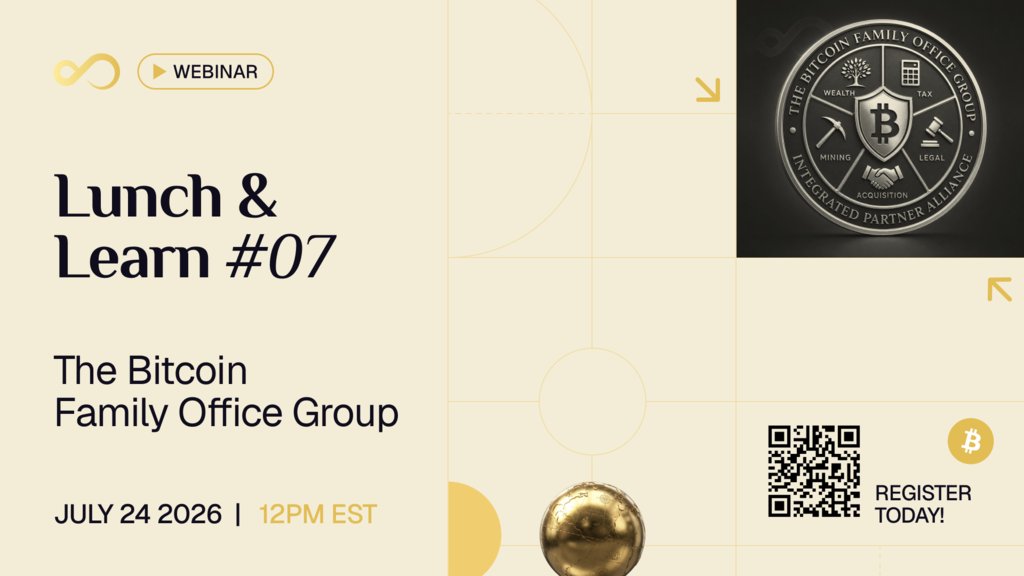
On July 24 we're introducing The Bitcoin Family Office Group: five independent, bitcoin-native firms working as one across wealth, tax, legal, acquisition, and mining. One coordinated team, and you still hold your own keys.
Joining us: Wyatt O'Rourke, Basilic Financial
Kyle Lawrence, Falcon Rappaport & Berkman
Jordan Guess CPA, Satoshi Pacioli
Beau Turner, Abundant Mines
Chantel Lillycrop-Kostiuk, Bitcoin Well VP of Operations
We'll cover how it came together, introduce each firm, and walk through what the client experience actually looks like, from first call to a team working in sync on your behalf. Bring your questions. There's a full Q&A.
Bitcoin Well Infinite: Lunch and Learn. July 24, 12:00 PM. Register:

The ultra-wealthy have always had a team. A family office quietly coordinating their wealth, taxes, legal, and estate so nothing slips through the cracks.
Bitcoiners never had that. Until now.
On July 24 we're introducing The Bitcoin Family Office Group: five independent, bitcoin-native firms working as one across wealth, tax, legal, acquisition, and mining. One coordinated team, and you still hold your own keys.
Joining us: Wyatt O'Rourke, Basilic Financial
Kyle Lawrence, Falcon Rappaport & Berkman
Jordan Guess CPA, Satoshi Pacioli
Beau Turner, Abundant Mines
Chantel Lillycrop-Kostiuk, Bitcoin Well VP of Operations
We'll cover how it came together, introduce each firm, and walk through what the client experience actually looks like, from first call to a team working in sync on your behalf. Bring your questions. There's a full Q&A.
Bitcoin Well Infinite: Lunch and Learn. July 24, 12:00 PM. Register:

They Knew the Strait Would Close. That Was the Point.
A gold analyst just made the best case for bitcoin I've heard all year. By accident.
His whole thesis: "the beauty of gold is it's not used for anything." Send gold to $1,000,000 and nobody gets hurt. Send corn to $1,000 a bushel and people starve. Send oil there and the economy collapses. A reserve asset has to be useless, because money that doubles as something people need to consume punishes everyone the moment it goes up.
He's right. He just stopped one step short.
Gold still has day jobs. Jewelry, electronics, dentistry. Bitcoin is used for even less. It was built to be money and nothing else. No industrial demand fighting its monetary demand, nothing to melt down, no factory waiting on the supply.
Gold is useless enough to be great money. Bitcoin is useless at everything except being money. Same principle, taken to its logical end.
The purest reserve asset isn't the one with the fewest uses. It's the one with none.
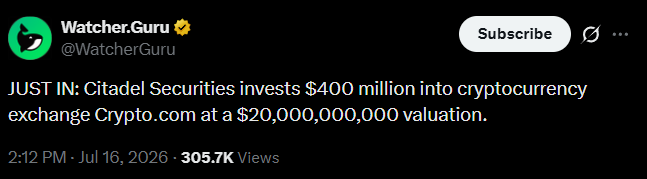
Citadel Securities just paid $400 million for a piece of the exchange holding "your" crypto. CryptoDOTcom is now worth $20 billion. Sit with who just became your counterparty.
You see, Citadel isn't a Bitcoin company. It's the market maker that stands between you and the price of almost everything you trade. The same firm at the center of the payment-for-order-flow fight, the one retail spent 2021 screaming about, now owns a slice of the on-ramp millions of people trust with their coins.
This is the pattern, not the exception. The plumbing of "crypto" keeps getting bought by exactly the institutions Bitcoin was built to route around. First the ETF custodians. Now the exchange cap tables. Every layer between you and your keys is being consolidated by people who make money on the layer itself.
Here's the part they can't buy. A coin in a wallet only you control has no cap table. No strategic investor. No market maker taking a spread on your sovereignty. Citadel can own the casino. It cannot own the money you took home.
The whole point was never a better middleman. It was no middleman at all.


Your bitcoin isn't in your hardware wallet. It never was.
Your coins live on a public ledger that thousands of computers each keep a full copy of. Your hardware wallet holds the keys, the secret that proves the coins are yours and lets you move them. The device is a keychain, not a vault.
This is why "I lost my wallet" doesn't have to mean "I lost my bitcoin." Your twelve or twenty-four words can rebuild those keys on any device on earth.
And it's why those words matter more than the gadget ever could. Protect the phrase, not the plastic.
https://t.co/f4EaNJVSuP
How the West is Being Priced Out of the Starter Life
What Happens to Bitcoin If Saylor Gets Forced to Sell 
X (formerly Twitter)
Bitcoin Well
What Happens to Bitcoin If Saylor Gets Forced to Sell
We're live. Episode 2 of the Bitcoin Well Podcast — the sell-off, the "never sell" reversal, and what it actually means for Bitcoin's biggest corporate bet, with @JoeConsorti and @ChrisAlaimo6.
https://youtube.com/live/ryYKA9anKsg?feature=share
Michael Saylor made the biggest corporate bitcoin bet in history. Now the charts are red, and the question nobody wants to say out loud is getting louder: what happens if he's forced to sell?
Today, 2 PM EST on the Bitcoin Well Podcast, we put it to two people who at least seem like they know what's going on! @ChrisAlaimo6 (Strategic Advisor at Simple Bitcoin) and @JoeConsorti (Horizon) dig into what's really going on with Saylor's position, whether the "forced seller" fear is real or overblown, and what it would mean for the rest of the market if it played out.
No panic. No hopium. Just the mechanics, straight. No chaser.
Watch live at 2 PM EST on this channel!


Two governments just agreed to build money you can track across an ocean. They're calling it innovation. But they certainly aren't innovating for freedom.
The US and UK announced a joint plan for cross-border tokenized assets and stablecoins. Tokenized, not decentralized. A dollar or a bond wrapped on a ledger the issuer still controls, that still reports, that can still be paused or reversed or geofenced the moment someone decides your transaction is a problem. Surveillance money with a blockchain sticker on the box.
States don't coordinate international plans around technology they find harmless. They're building a programmable, trackable, permissioned version of the exact thing Bitcoin was designed to route around. That's the anti-Bitcoin, shipped by committee, with a press release.
Here's the part that matters for you. A tokenized dollar moves the moment two governments agree it should, and freezes the moment they agree it shouldn't. The bitcoin in your own custody asks no treaty for permission. It crosses a border because you decided to move it, and nobody on either side of that ocean gets a vote.
They can tokenize the dollar. They can't tokenize your consent. Although God knows they'll try...


We missed you all 🥹