Bitcoin Well's avatar
Bitcoin Well
bitcoinwell@btcw.app
npub19mf4...kfu2
Bitcoin Well is on a mission to enable independence. We do this by making it easy to use bitcoin in self-custody. Whether you’re looking to buy, sell or use bitcoin, we never hold on to your bitcoin. Bitcoin Well is automatic self-custody.
Bitcoin Well's avatar
bitcoinwell 3 weeks ago
Under 1% a year. That is how fast new bitcoin enters the world now. In 2028 the rate gets cut in half again, on a schedule written in 2009 that nobody since has had the authority to change.
Bitcoin Well's avatar
bitcoinwell 3 weeks ago
In 1993 the US government proposed putting an encryption chip in every telephone. Strong encryption, genuinely good, with one extra feature. The government would keep a spare key. They called it the Clipper Chip. The pitch was that you could have real privacy and they could still listen when they had a good reason. Both at once. In 1994 a researcher at Bell Labs named Matt Blaze @mattblaze published a short paper showing you could use the chip's encryption and make the government's spare key useless at the same time. The backdoor had a hole in it. One person found it by reading the spec carefully. The program never recovered. Nobody voted the Clipper Chip down. It died because someone checked in public and published what he found. Every backdoor proposed since has arrived with the same promise, that only the right people will ever hold the spare key. Your bank holds one. Your exchange holds one. A private key you generated yourself is a rare thing. It was never issued with a spare. image
Bitcoin Well's avatar
bitcoinwell 3 weeks ago
Two weeks of Bitcoin security news, and the lesson most people took from it is backwards. A wallet generated weak seeds. Strangers with no boss and no mandate found it, published it, and got people's coins out before the attackers finished. Another group put 501 open-source projects through an audit and posted every finding in public. You know all of this because there was nowhere to put it except in the open. Now name the last time a bank told you about a hole in its systems before it cost you anything. Not after the settlement. Before. You did not watch self-custody fail this month. You watched it work in the only way that counts, which is out loud and early enough to act. The alternative you're being sold has the same bugs. It just never has to mention them. image
Bitcoin Well's avatar
bitcoinwell 3 weeks ago
Miners usually show up in this niche as the villain. Last week they were the escape hatch. When the ColdCard entropy bug broke, a rescue transaction could not touch the public mempool without showing attackers the public keys they needed to race it. So the transactions went straight to a miner and got confirmed without ever being seen. No vendor could have offered that. The open network did. @PortlandHODL of Bitcoin Red Team built the tool. Live now with @q_liketheletter.
Bitcoin Well's avatar
bitcoinwell 3 weeks ago
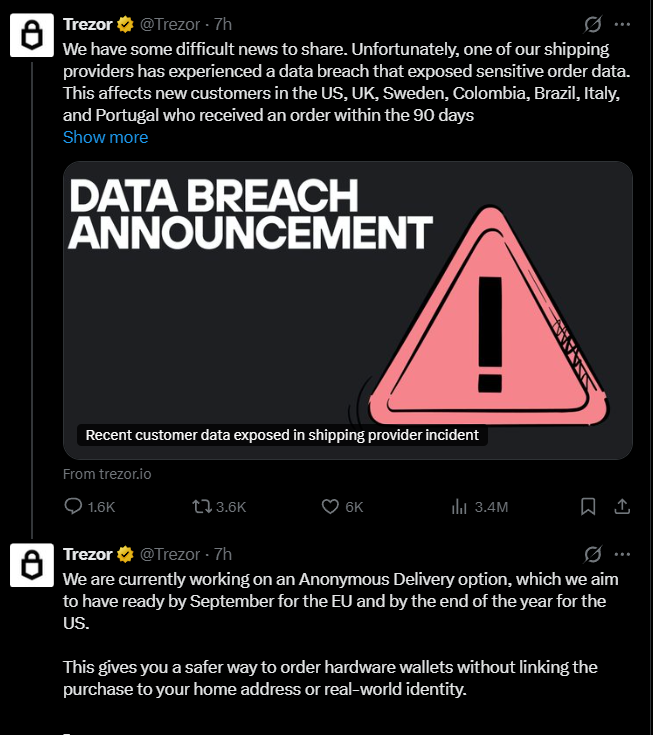
"Trezor got hacked." That's making the rounds today, and it's wrong. Trezor wasn't hacked. A shipping provider they use, ShipMonk, had a system breached, and customer order data leaked: names, emails, phone numbers, and home addresses for roughly 13,700 people who ordered between May and early August. No keys. No seeds. No coins. The devices and firmware were never touched. Credit to Trezor for saying so quickly and in plain language. So how worried should you be? Aware, not panicked. Your Bitcoin is safe. But your name on a list that basically reads "just bought Bitcoin cold storage" is worth respecting. It's fuel for phishing texts posing as support, and in rare cases, for someone who'd rather knock on your door. I've seen this one before. I was in the Ledger breach back in 2020, when 270,000 owners had their home addresses dumped online. I honestly never noticed any extra fishing attempts beyond the thousands I already felt like I get on a regular basis, but you should be on guard and read every email that claims to be from Trezor with suspicion. The takeaway isn't "self-custody is dangerous." It's that privacy is part of the stack. Buy privately when you can, never link your name to your holdings, and treat any urgent message about your wallet as a scam until proven otherwise. Guard your keys. Then guard the fact that you hold them. image
Bitcoin Well's avatar
bitcoinwell 3 weeks ago
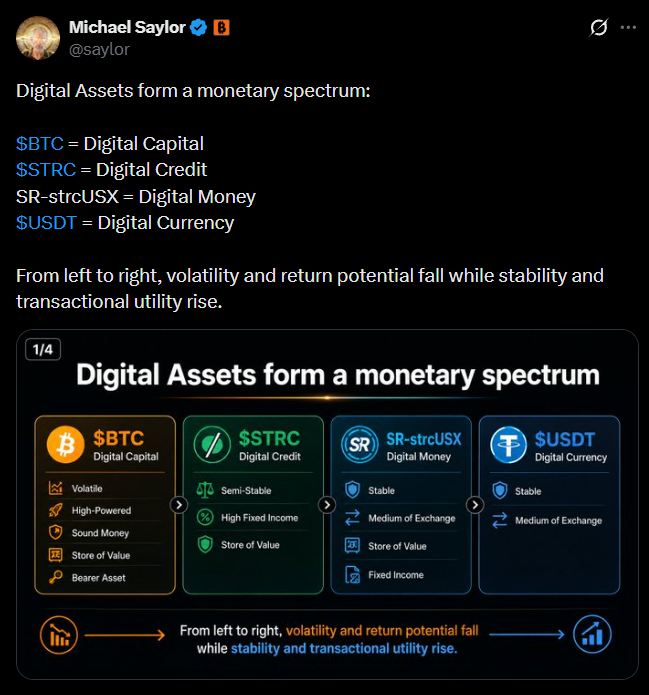
Give Saylor credit. He put Bitcoin at the top of his "monetary spectrum" and called it digital capital. He is right about that part. Here is the step he will not take. Everything to the right of pure Bitcoin on that chart is a layer of someone else's promise. Digital credit is money you are owed. Digital money is money someone issues. Digital currency is money you rent. Only the first rung is actually yours. That is not a ladder of stability. It is a ladder of counterparty risk. And this is Wall Street doing exactly what Wall Street was always going to do with Bitcoin. Wrap it, tranche it, stack layers on top until they've built something else that behaves like the system Bitcoin was built to escape. None of those layers are Bitcoin. They are the middleman, reintroduced with a ticker symbol. Bitcoin is still the one thing you can hold without asking anyone. Their spectrum sells that back to you one permission slip at a time. image
Bitcoin Well's avatar
bitcoinwell 3 weeks ago
The Deep Dive starts in 2 hours. Entropy and randomness are not the same thing, and the whole thing confuses the hell out of me! Let's get some actual clarity! Bitcoin researcher and filmmaker Alex Waltz (@raw_avocado) joins us to break down what real entropy actually is, and why it decides whether your keys are secure or a sitting duck. 10 AM EST. Last chance to register:
Bitcoin Well's avatar
bitcoinwell 3 weeks ago
Entropy and randomness sound like the same word. In Bitcoin, mixing them up can cost you everything. That gap is exactly what just bit some ColdCard users. Tomorrow on The Deep Dive, researcher and filmmaker Alex Waltz (@raw_avocado) breaks down what real entropy is, why weak randomness makes a hardware wallet a decoration, and what the ColdCard story actually revealed. Tomorrow, 8/13 @ 10am EST (yes its an early one!) Register: image
Bitcoin Well's avatar
bitcoinwell 3 weeks ago
$116 million vanished from self-custody wallets this month. A ColdCard firmware bug quietly broke wallet randomness for five years, and the coins behind those weak keys got swept. Here's the twist almost nobody predicted: that same week, $853 million flowed INTO Bitcoin ETFs. The most custodial option on the board. A bug in the hardware wallet, and the money runs to the bank. Today on the podcast, Eric Yakes (author of The 7th Property) and Trey Sellers (Fire BTC) join us for a two-part conversation on the week that tested what "owning Bitcoin" actually means: - What really happened with ColdCard, and what to do about it - Why those ETF flows might be Bitcoin's most interesting contradiction right now - The BIP-110 fork that died in two blocks, and what it proves about who governs Bitcoin - The CLARITY Act's September 15 Senate vote Eric's case for Bitcoin's 7th property: absolute scarcity The ColdCard story isn't an argument against self-custody. It's an argument for understanding what you hold and how it's made. That's the whole conversation. Follow today's guests: @ericyakes and @ts_hodl image
Bitcoin Well's avatar
bitcoinwell 3 weeks ago
Inflation "cooled" to 3.4%, they say. The target was never zero. The Fed aims to devalue your money about 2% every year on purpose. That is not stability, it is a slow melt you are not supposed to notice. And it compounds: by their own index, the dollar has lost more than 22% of its purchasing power since 2020. What cost $100 then costs about $129 now. Their math, not mine. That is the flattering version. Inflation was never the price of eggs going up. It is the supply of money going up, and the shelf price is just the symptom. Between 2020 and 2022 the money supply grew 41%, from $15.4 trillion to $21.8 trillion. More than $6 trillion conjured in about two years. You can massage a basket of goods. You cannot un-print $6 trillion. Bitcoin's supply grows less than 1% a year, toward zero, set by no committee and no election. One of these two moneys can be diluted while you sleep. It's not the one without a printer.
Bitcoin Well's avatar
bitcoinwell 3 weeks ago
Japan has not been allowed to price its own money since the war. The yen sliding today is not a fresh problem. It is the bottom of a very deep stack. In 1949 an American banker named Joseph Dodge, working for the occupation, fixed the yen at 360 to the dollar by decree. Japan was slotted into Bretton Woods at that number and held there until Washington broke the system in 1971. Then in 1985 the US and its allies signed the Plaza Accord and pushed the yen from 240 to 120 in three years. It gutted Japan's exporters, so Tokyo answered the pain the only way a central bank knows how: cheap money, everywhere. That blew the largest asset bubble in modern history. When it burst, Japan got the Lost Decades. And every decade since has been another layer laid over the last one. Zero rates. Quantitative easing. Yield curve control. Negative rates. Each intervention prescribed to treat the damage of the one before it. This is what a managed economy looks like at the end. Not one bad decision. Seventy years of overruling the market, foreign hands and domestic ones alike, until nobody can tell what anything's real value is. This summer two governments spent real reserves to set the yen level again. The market erased half of it within a week. Bitcoin has no Dodge, no Plaza, no committee. No one sets its price and no one can. That is the entire point. image
Bitcoin Well's avatar
bitcoinwell 3 weeks ago
You cannot secretly hard fork a network by changing nothing. That is the tell in the whole "the miners did a secret hardfork" story. A hard fork means changing the rules your node enforces. The miners changed nothing. They kept validating the same Bitcoin they always have. The side that wanted a new restriction didn't get consensus, so now it's calling the side that stood still the "forkers." That is completely backwards. A proof-of-work change does not fire the miners. Bitcoin's miners keep mining Bitcoin, same chain, same hash function, same rules. Swap the proof of work and you haven't fired anyone. You've built a different coin and walked off with it. That isn't a coup against the network. It's taking your ball and going home, then insisting the empty court is the real game. image
Bitcoin Well's avatar
bitcoinwell 3 weeks ago
BIP-110 Is Dead. What Its Two-Block Fork Proved About Who Really Controls Bitcoin
Bitcoin Well's avatar
bitcoinwell 3 weeks ago
Friday's BIP-110 Spaces turned into one of the biggest conversations we've ever hosted. So we're bringing it back for a proper autopsy. After the weekend, the dust is settling so we're getting everyone back in the room to unpack what actually happened. What it changed, and where Bitcoin goes from here. @knutsvanholm and @w_s_bitcoin are locked in, with plenty more guests joining them. You'll want to be in the room for this one.
Bitcoin Well's avatar
bitcoinwell 0 months ago
"Random" and "random enough" are not the same word. With your Bitcoin keys, the gap between them is everything. Every private key you hold is really just one enormous, unguessable number. If the randomness behind it isn't truly random, nobody has to steal your keys. They can just guess them. Wednesday we get into it. Bitcoin researcher and filmmaker Alex Waltz [@raw_avocado] joins The Deep Dive to break down what entropy actually is, how it differs from randomness, and why that difference sits underneath every wallet you'll ever trust. Starts technical, ends personal. Aug 13, 10 AM ET. Free to join: image
Bitcoin Well's avatar
bitcoinwell 0 months ago
In 1990, a programmer named John Gilmore helped found the Electronic Frontier Foundation. Two years later he helped start a mailing list called the Cypherpunks. His most famous line is one sentence: "The Net interprets censorship as damage and routes around it." Meaning, try to block information on a distributed network and it simply flows another way. No central switch to flip. No single door to lock. Gilmore was talking about speech. But the same design is exactly what makes Bitcoin work. There's no headquarters to raid, no server to seize, no CEO to lean on. Try to censor a transaction and the network routes around the block, literally. The cypherpunks understood something early. Freedom that depends on permission isn't freedom. It's a privilege, and privileges get revoked. So they built tools that don't ask. Bitcoin is that idea applied to money. It treats censorship as damage, and routes your value around it. image
Bitcoin Well's avatar
bitcoinwell 0 months ago
In 1976, an economist most people had already written off did something quietly radical. He argued the government should lose its monopoly on money entirely. His name was Friedrich Hayek, and the book was "Denationalisation of Money." His case was blunt. "Practically all governments of history," he wrote, "have used their exclusive power to issue money in order to defraud and plunder the people." Not an accident. The whole point of the monopoly. His fix sounded impossible at the time: let money compete. Strip the state of its exclusive printing press and let people freely choose the money that best held its value. Good money would win the way good anything wins, by being chosen, not mandated. For decades it stayed a thought experiment. There was simply no way to run a money outside a government. Then, 33 years after Hayek wrote it down, a network switched on that no state could issue, inflate, or shut off. Nobody needed permission to use it. People just started choosing it. Hayek didn't predict Bitcoin. He described the hole Bitcoin fills: a money the government can't debase, because the government doesn't run it. The competition he wanted is finally here. You get to choose which money holds your life's work. image
Bitcoin Well's avatar
bitcoinwell 0 months ago
Soft fork that we all knew was going to make another chain. All so predictable!
Bitcoin Well's avatar
bitcoinwell 0 months ago
Self-custody shouldn't feel like defusing a bomb with the wires unlabeled. This week, Bitcoin Guidance is free. A private, one-on-one call with a real Bitcoin expert who walks you through it live: setting up your own wallet, moving your coins safely, and backing up your keys so a lost phone never means a lost fortune. No sales pitch. No jargon wall. Just a human who stays on the line until it's done and it actually makes sense to you. After the couple of weeks Bitcoin holders just had, nobody should be guessing with their savings. Free for a few more days. Book a call: