Donald Trump gave world leaders a license to launch meme coins.
-African President Launched Memecoin
-Argentina President Launched Memecoin
PREDICTION: 20+ political leaders will launch their meme coin in 2025.
Greed is at ALL TIME HIGH!
Kazani
kazani@primal.net
npub1vm68...srrc
Beloved Bitcoin.
Promo code: KAZANI ➡️ https://foundation.xyz/passport-prime
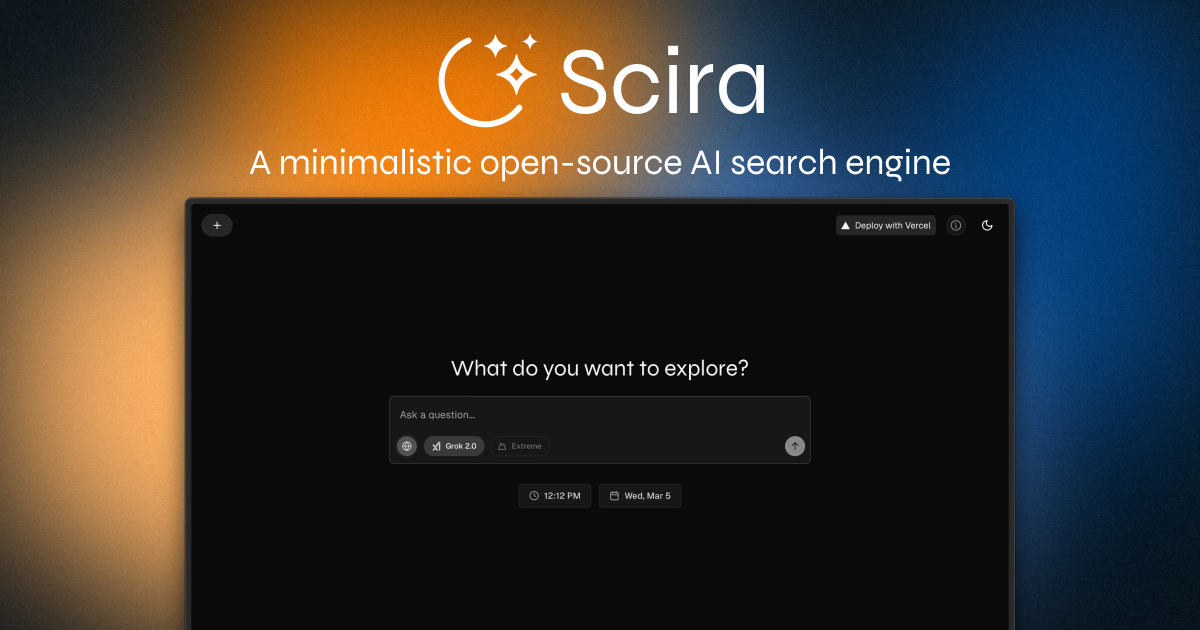
Scira is a minimalist AI-powered search engine that allows you to find information on the web using the Vercel AI SDK and various APIs.
Key features include AI search with Anthropic models, web search via Tavily API, URL search, current weather with OpenWeather API, code execution via E2B API, and location retrieval from Google Maps and other sources.
To use the system effectively, users need to register with AI providers, obtain API keys, and set up the environment. The project operates under the MIT License, which makes it available for use and modification.
Open the Brave browser settings:
Click on the three vertical dots in the upper right corner of the browser.
Select "Settings" from the dropdown menu.
Go to the search engine settings:
In the left sidebar, click on "Search engine."
Then select "Manage search engines and site search."
Add a new search engine:
Click on "Add" next to "Site search."
Set the search engine name:
Enter Scira in the "Search engine" field.
Set the search engine URL:
Enter
in the "URL with %s in place of query" field.
Set the search engine shortcut:
Enter sh in the "Shortcut" field.
Set Default:
Click on the three dots next to the search engine you just added.
Select "Make default" from the dropdown menu.


Scira AI
Scira AI - Research in speed of thought.
Scira is a free Agentic Research Platform that finds, analyzes, and cites information from the live web. $15/month—fast answers; 11000+ stars on ...
GitHub
GitHub - zaidmukaddam/scira: Scira (Formerly MiniPerplx) is a minimalistic AI-powered search engine that helps you find information on the internet and cites it too. Powered by Vercel AI SDK!
Scira (Formerly MiniPerplx) is a minimalistic AI-powered search engine that helps you find information on the internet and cites it too. Powered by...
What's your preferred 2FA method?
1. Passkey
2. Authenticator app
3. SMS
4. Yubikey/Nitrokey
India’s crypto taxation policies, especially the "no loss setoff" rule, have little to do with protecting investors and everything to do with the government's insatiable greed for control and revenue. If they genuinely cared about investor safety, they would regulate crypto sensibly instead of crippling it with absurd taxes.
The real issue is that crypto threatens the government's ability to milk every rupee indefinitely.
When people lose money in crypto, it vanishes from their endless tax cycle instead of being funneled through businesses, where they can slap GST, customs duties, and other levies on it. Worse still, if individuals choose to store wealth in Bitcoin long term like Michael Saylor, they escape the government's grasp entirely.
By imposing crushing taxes, the government is deliberately discouraging crypto to ensure that money stays trapped within traditional financial systems, banks, real estate, and consumer markets where they can continue siphoning off their share through relentless taxation. This isn't about protecting citizens, it's about making sure they can exploit every last rupee forever.
Krita: Free and open source digital painting application. It is for artists who want to create professional work from start to end. Krita is used by comic book artists, illustrators, concept artists, matte and texture painters and in the digital VFX industry.
krita.org
invent.kde.org/graphics/krita
Apple’s Hidden Backdoor – The Biggest Security Story No One’s Talking About ⚡️
No surprises. People still think they can trust Apple...
On Dec, 2023, Kaspersky announced that: Apple CPUs from A12 (iPhone X) to A16 (iPhone 14/15) contain a backdoor.
This isn’t a software bug—it’s built into the silicon.
• What does this mean? A third party could remotely access and control your iPhone, iPad, Watch, or even Apple TV without your knowledge.
• How was it found? Kaspersky was tracking the malware, when they uncovered this undocumented feature.
• Who knew about this? Apple, for sure. The level of design complexity makes it impossible to be an accident.
Almost no media coverage—except for ARS. Is it because the news came out over the holidays? Or because Kaspersky (often labeled as "Russian-backed") exposed it?
Apple has since patched the CVEs, but the real issue isn’t fixed—the industry-wide trust problem.
Source:
Thoughts?
Kaspersky finds hardware backdoor in 5 generations of Apple silicon
Oklahoma Advances #Bitcoin Reserve Bill, One Step Closer To Law
Oklahoma’s House Bill 1203, which proposes a Strategic Bitcoin Reserve, has passed committee approval with a 6-2 vote, moving closer to becoming law. The bill, introduced by Representative Cody Maynard, would allow state savings accounts and pension funds to invest in Bitcoin alongside traditional assets, aiming to provide financial stability and inflation protection.
With Arizona and Utah pursuing similar initiatives, Oklahoma’s move highlights a growing trend of states embracing Bitcoin as a strategic asset. The bill now heads to a floor vote, where further legislative approval could position Oklahoma at the forefront of Bitcoin-based financial policy.
🤗 Hugging Face has released a course on agents .
The course consists of 4 parts with tests, and at the end - a certificate of completion. Only the first part is available for now.
😃 Unit 1 - February 10
👌 Bonus Unit - February 18
👌 Unit 2 - February 25
👌 Unit 3 - March 11
😄 Unit 4 - April 1st
In the first part of the course:
• Who is an AI agent?
• Role of LLM in agents
• Agent workflow
• Tools and actions
The course is free: 
Welcome to the 🤗 AI Agents Course - Hugging Face Agents Course
We’re on a journey to advance and democratize artificial intelligence through open source and open science.
🔐 Shufflecake. Create hidden partitions on the disk.
• Shufflecake: plausible deniability for multiple hidden filesystems on Linux — a tool for creating hidden and encrypted partitions on a disk that remain invisible even with appropriate examination.
➡️ 
Codeberg.org
shufflecake-c
Full C implementation of Shufflecake. Shufflecake is a plausible deniability (hidden storage) layer for Linux.
📶 ssh-audit.
SSH server & client security auditing (banner, key exchange, encryption, mac, compression, compatibility, security, etc).
• I share useful resources: ssh-audit — a tool for auditing SSH connections on a server:
+ a separate resource where you can check the current SSH server settings:
GitHub
GitHub - jtesta/ssh-audit: SSH server & client security auditing (banner, key exchange, encryption, mac, compression, compatibility, security, etc)
SSH server & client security auditing (banner, key exchange, encryption, mac, compression, compatibility, security, etc) - jtesta/ssh-audit
SSH Configuration Auditor
📱 Don't use the app version
On many occasions applications are used without any need
You simply have to go into your browser and create a "Home Screen Access"
This will allow you to enter certain applications without having to use the application
It will prevent them from collecting so much information because the web is more restricted to do so, and it will also take up much less space on your device.
'Celeb Coins' are the worst thing for a crypto bull run.
The SOLE purpose of celeb coins is to steal money from the trenches.
Money that would've stayed in the ecosystem betting on memes, is extracted into the wallets of those who buy gold chains, supercars and bottles in the club.
This is the process of a celeb coin launch:
1. Crypto grifter pitches celebrity on launching a memecoin.
2. They reference recent big winners ($TRUMP), the amount made, 'bro I have a dev who can make you millions'
3. Celebrity asks for big upfront payment + % of profits made
4. Crypto grifter launches coin, snipes large % at launch
5. Celebrity posts their agreed amount of tweets/IG story posts
6. Supply is dumped into as much volume as possible
7. Profits get extracted from Crypto and spent in the real world
Warning for #Android gapps traitors:
Uninstall the application: Android System SafetyCore, which has been automatically installed on most devices. It is used by Google to scan your data, just like Apple has been doing on iOS, but you have the choice to uninstall it. If you don't have it yet, watch out for it being installed silently over the next few days!
https://play.google.com/store/apps/details?id=com.google.android.safetycore
Be careful on GrapheneOS too if you have Google services installed.
While GrapheneOS will stop it from auto installing, it can nag you about installing it. And it won't tell you what it really is. Nor will most online resources.
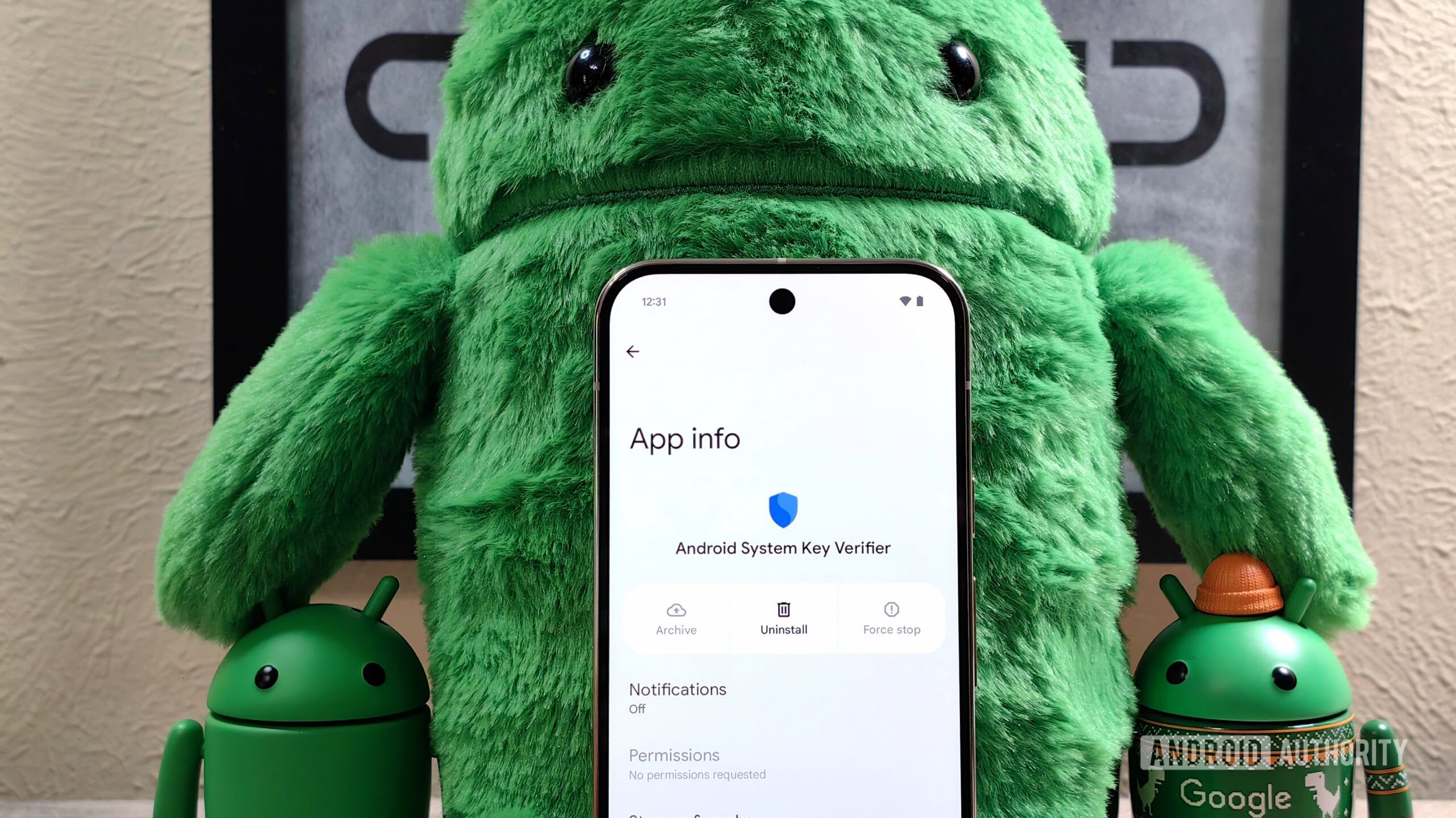
Sandboxed Google Play compatibility layer: stop Play Store from attempting to auto-install some system component packages, such as "Android System SafetyCore" (com.google.android.safetycore) and "Android System Key Verifier" (com.google.android.contactkeys)
The phone is asking me to install this app, anyone knows information about if its truly need it or not? Im with the Google Play Services sandbox install
If you don't have GrapheneOS, it's going to automatically install itself again at some point after uninstalling it.
Locating the App
Go to Settings → Apps (or Apps & Notifications) → Show system apps. Look for “Android System SafetyCore.”
Check whether the app has any special permissions (e.g., internet access).
Uninstalling or Disabling
In many cases, you can uninstall an update or at least disable the app. Check the available options in the app info.
This is client side scanning. It's a way to spy on your device before it's encrypted.
Other information on the topic:
The functionality provided by Google's new Android System SafetyCore app available through the Play Store is covered here:
Neither this app or the Google Messages app using it are part of GrapheneOS and neither will be, but GrapheneOS users can choose to install and use both. Google Messages still works without the new app.
The app doesn't provide client-side scanning used to report things to Google or anyone else. It provides on-device machine learning models usable by applications to classify content as being spam, scams, malware, etc. This allows apps to check content locally without sharing it with a service and mark it with warnings for users.
It's unfortunate that it's not open source and released as part of the Android Open Source Project and the models also aren't open let alone open source. It won't be available to GrapheneOS users unless they go out of the way to install it.
We'd have no problem with having local neural network features for users, but they'd have to be open source. We wouldn't want anything saving state by default. It'd have to be open source to be included as a feature in GrapheneOS though, and none of it has been so it's not included.
Google Messages uses this new app to classify messages as spam, malware, nudity, etc. Nudity detection is an optional feature which blurs media detected as having nudity and makes accessing it require going through a dialog.
Apps have been able to ship local AI models to do classification forever. Most apps do it remotely by sharing content with their servers. Many apps have already have client or server side detection of spam, malware, scams, nudity, etc.
Classifying things like this is not the same as trying to detect illegal content and reporting it to a service. That would greatly violate people's privacy in multiple ways and false positives would still exist. It's not what this is and it's not usable for it.
GrapheneOS has all the standard hardware acceleration support for neural networks but we don't have anything using it. All of the features they've used it for in the Pixel OS are in closed source Google apps. A lot is Pixel exclusive. The features work if people install the apps.
https://xcancel.com/GrapheneOS/status/1888280836426084502
Releases | GrapheneOS

GrapheneOS Discussion Forum
android system safety core - GrapheneOS Discussion Forum
GrapheneOS discussion forum
Android Authority
Google's new app will help warn you about nude images in Messages
Google is rolling out Android System SafetyCore, and it'll power the upcoming Sensitive Content Warnings feature in Messages.
Android Authority
Google's new Android app helps you verify you're chatting with the right person
Google is rolling out a new Android System Key Verifier app that helps you verify you're chatting with the right person and not a scammer.

Google Online Security Blog
5 new protections on Google Messages to help keep you safe
Posted by Jan Jedrzejowicz, Director of Product, Android and Business Communications; Alberto Pastor Nieto, Sr. Product Manager Google Messa...
TrailOfBits spun out iVerify, a mobile malware detection company, about a year ago. So far, they've found 20+ installations of Pegasus on people's iOS phones, including some used for corporate espionage.
If you want to try it out, there's a basic version available on the iOS app store you can download today. Make sure you run a "Threat Hunt" after you install it -- this is the feature that is catching Pegasus. That’s important!
•
iVerify found those Pegasus installations by inspecting sysdiagnose logs. These are debugging logs produced by iOS itself that provide a window into the lower level operation of the phone. Pegasus is a total operating system compromise.
iVerify has other methods available for security monitoring, including a local VPN that inspects traffic completely inside the mobile app, a custom DNS solution that checks resolutions of domain names, and an "Elite" tier of service.
If you want to try out this feature to inspect your own phone today, the sysdiagnose feature is available for free in the iVerify Basic app on the App Store.
#security #opsec
App Store
iVerify Basic App - App Store
Download iVerify Basic by iVerify on the App Store. See screenshots, ratings and reviews, user tips, and more games like iVerify Basic.

X (formerly Twitter)
Vladimir S. | Officer's Notes (@officer_secret) on X
I see news about SpyWare all the time in the last couple years... people are really worried about Pegasus and other similar apps.
Below in the th...
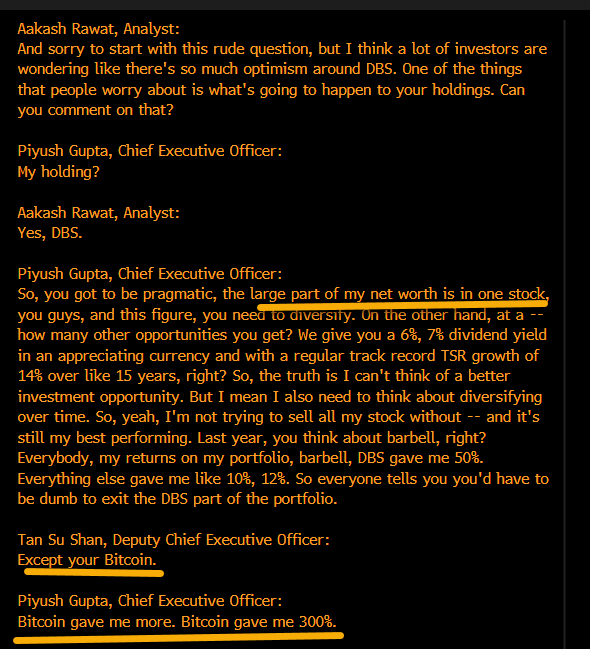
Piyush holding #BTC outperforming DBS


X (formerly Twitter)
matthew sigel, recovering CFA (@matthew_sigel) on X
The CEO of the Largest Bank in Singapore (DBS) is Bullish on Bitcoin
📱 UK WON'T have access to your iPhone, but this is very worrying
It has recently become popular to talk about worrying news without taking into account reality, so let's get to it:
The UK government has issued a secret order to Apple under the Investigatory Powers Act 2016, known as a "Technical Capability Notice", ordering the company to create a backdoor that would allow access to encrypted data stored in iCloud.
This is intended to do away with the "Advanced Data Protection" encryption that Apple introduced in iCloud that ensures only users have access to their data, not Apple.
It is possible that Apple will abandon "Advanced Data Protection" in the UK, thus allowing it to continue to protect other users, and while this may seem sufficient, it would not really be enough to meet the UK's request.
Some might think that this isn't a problem if you don't live in the UK, but it is, as it affects all users who use iCloud, not just iPhones in the UK, at least according to the UK petition. It's important to note here that iCloud is different from iPhone.
This is a big threat because it means doing something that not even Apple can currently do: access iCloud data and although it is something that is widely used by its users on different devices, it might not be possible to use the iCloud cloud, which is where the main problem lies.
But... will other countries really accept this?
Adding a backdoor for UK authorities to access will make other countries want it too but... What about the countries that are seen as a threat?
They could also gain access, they would "just" have to find the back door, which would already be known to exist.
This is something that goes beyond simply accessing user information; information about a population can be very valuable, especially for other countries that can use it to their advantage in geopolitical terms, which can have serious consequences.
The new feature is coming in Brave Browser version 1.75 for the desktop and is very similar to the popular TamperMonkey and GreaseMonkey browser extensions, which allow users to create "user scripts" that modify the functionality of specific websites.


BleepingComputer
Brave now lets you inject custom JavaScript to tweak websites
Brave Browser is getting a new feature called 'custom scriptlets' that lets advanced users inject their own JavaScript into websites, all...
Excellent post on Human <> Agent relationship. Some thoughts below:
Right now, AI is limited by the kind of information it learns from. Most systems rely on internet data, which is often outdated, shallow, or too general. This is where Fringe Untapped Data or FUD comes in. Instead of just tracking what people do, FUD looks at why they do it—things like tone of voice, hesitation before a click, or patterns in behavior that traditional AI ignores. AI that relies only on basic data will hit a wall, while AI that understands real-world context will keep improving.
The biggest breakthroughs will come from businesses that combine these two ideas: AI that can run organizations and AI that can actually think in a deeper way. To work, these systems will need ways to coordinate decisions and reward human contributions, but also high-quality, real-world data to keep learning. The companies that figure out how to do both will lead the next wave of innovation.
Inverting the Human-Agent Relationship | Source: 

Inverting The Human-Agent Relationship
In 1997, IBM’s Deep Blue defeated then-World Champion Garry Kasparov in a chess match, and it became clear that computer chess engines would soon...
🌪 The freedom of those who fight for privacy advances
Alexey Pertsev has recently been released from a prison in the Netherlands.
Who is it?
The developer of Tornado Cash , a protocol that allows for privacy across different blockchains.
He was charged with money laundering, not because he laundered money, but because Pertsev was responsible for failing to implement measures to prevent illicit use of the protocol.
He is currently under house arrest and electronic monitoring while he prepares his appeal.
While it's not the best of songs, it's a lot better than it was just a day ago.
He was arrested in August 2022 and found guilty in May 2024, but there seems to be hope.
Back in November 2024, an appeals court declared that the sanctions imposed by OFAC (Office of Foreign Assets Control) on Tornado Cash were an overreach of its powers.
I would like to add 2 things:
1. Is the central bank guilty of those who launder money with its currency? Or is the person who makes a knife guilty of those who do evil with it?
2. In the end, good prevails and we hope that in some way, this will only remain as the memory of a bitter event.
We keep moving forward💪