Daniel Batten's avatar
Daniel Batten
Dsbatten@nostrich.love
npub13lky...lpsy
I like turning waste into power. Landfill gas. Eroding currencies. The human potential. danielbatten.co
Daniel Batten's avatar
dsbatten 1 month ago
Nostr-only post follows. One thing I've been reflecting on this last week is that many of the people who changed the world worked deep hours, and remarkably few of them. I did some research and found 7 examples that might change how you think about your day, and the belief that grinding long hours is the best way to success image Charles Darwin worked two 90-minute blocks each morning, then a single hour later in the day. Between sessions: naps and long walks On this schedule he wrote 19 books (including On the Origin of Species) 4 hours a day, and he changed biology forever image Roald Dahl wrote from 10am-noon, then 4pm-6pm. 7 days a week. No exceptions He spent six months on a single short story. His words: "Writing is not inspiration. It's keeping your bottom on the seat" On 4 hours/day, he became one of the most beloved authors who ever lived image Henri Poincare worked 10am-noon, then 5pm-7pm He solved problems mentally in breaks, then committed them to paper A psychologist who studied his routine in 1910, found working longer achieved nothing extra 4 hrs/day, and he reshaped Topology, planetary physics and chaos theory Literatureimage Hemingway started at first light and stopped before noon. 500 to 1,000 words, standing up, pencil on paper He famously stopped mid-sentence so he'd have momentum the next morning ~5 hours a day and a Nobel Prize in Literature image Novelist Anthony Trollope paid a servant to wake him at 5:30am. He wrote from 5am to 8am with a watch in front of him - 250 words every 15 minutes. Then he went to his day job (at the Post Office) 3 hours a day, 47 novels over 35 years - all before breakfast ! image Tchaikovsky composed at his desk for about 4.5 hours split across morning and evening But he also took a daily two-hour walk, timed to the minute, composing in his head as he walked In ~4.5 hours at the desk he captured what the walk created The rest was letting the mind work image · "But what about Musk, he works 80-100 hr weeks?" Look closer He schedules his day in 5-minute blocks 90% of his time is meetings and design reviews. That's executive coordination (and he's brilliant at it) - a different kind of work from the deep creation these others did image "But what about Picasso, Balzac and others who worked big hours?" Picasso painted for long stretches. But he alternated intense work with long social meals and downtime within the day Balzac wrote 16 hours a day fuelled by industrial quantities of coffee (he also died at 51) I've seen this firsthand. One founder I coached was working 80-hour weeks, on the point of burnout. I shared 4 productivity strategies, got him to cut back to 50-hr weeks and go home to his family NPS scores, Q12 ratings, RPU all improved. The company exited 2 years later The pattern across all of these: short duration, consistent deep focus, real rest between sessions They protected the hours, protected the recovery, and they didn't confuse hours with output The lesson: Perhaps working more isn't the secret? Perhaps working deeper is?

Daniel Batten's avatar
dsbatten 1 month ago
Training impulse control (via meditation, coaching, habit cultivation etc.) is one of the most direct ways to lower your effective time preference
Daniel Batten's avatar
dsbatten 1 month ago
There has never been an industry whose success has been determined by so few variables as Bitcoin mining Hashrate Bitcoin Price Electricity Price ASICS Price Block reward (and fees) Ancillary revenue That's it 6 factors Not in-store-spend Not Customer conversion rates Not market penetration Not demographic data And no sales and marketing campaign or customer outreach campaign will change this You're at the mercy of 6 variables, 4 of which you have no control over, save a small bit of wiggle-room that you can create by negotiation in the case of ASICS price. The only variables you can control is electricity price and ancillary revenue source. (More about this later) For this reason, we can do something we've never been able to do for any industry ever We can read the future non-speculatively, because it already exists today In Europe, electricity prices are astronomically high. So much so, that it effectively simulates a future reality where the economics are similar to a US-based mining company one halving into the future (with half the block reward). Yet, Bitcoin mining thrives in Europe: the most hostile electricity-price environment, regulatory, environment and tax environment in the world towards Bitcoin mining. You'd never know it, because it happens mostly under the radar, and it is (legitimately) called "datacenters", "grid stabilization services", and "heat reuse" to avoid regulatory hostility and taxation hostility. Bitcoin mining thrives here because of one factor alone: their ancillary revenue is very high compared to the rest of the world. So high in fact that many European mining companies are more profitable than their US counterparts This is why I have no fear about the future of Bitcoin mining This is why discussions about security budget are redundant: Bitcoin doesn't need one This is why we don't need to have speculative discussions about the direction of Bitcoin mining. Europe already ran that simulation, and the data is in. The future of Bitcoin mining is that it seeks out stranded energy at near zero marginal cost. The future of Bitcoin mining is that it stabilizes grids and recycles heat as a primary revenue source, with the blockreward and fees being the by-product The future of Bitcoin mining is that it solves hard problems the world desparately needs - keeping our grid safe and stable, making AI load flexible, reducing harmful methane pollution, stopping the wasteful practice of renewable energy curtailment in ways that benefit whole communities The future of Bitcoin mining is that it is the usecase of Bitcoin that the world sees and embraces first.
Daniel Batten's avatar
dsbatten 1 month ago
AI power demand is in mainstream news right now. The IEA has published on grid stress. Data centres are in an arms race for power. European energy prices are major news. Grid instability is real and being increasingly commented on around the world. Renewable energy subsidies are ending. This is the perfect storm into which Bitcoin mining has just entered the fray.
Daniel Batten's avatar
dsbatten 1 month ago
Bitcoin solves a monetary problem and ... and energy problem Blackouts are visible Inflation is arguable Bitcoin is a solution to both But the world will understand how it solves the energy problem first
Daniel Batten's avatar
dsbatten 1 month ago
To date, the area of Bitcoin and energy has been a niche With AI power demands, European blackouts, stalled energy transitions, global grid stress, and 12 months of accumulating evidence, the world is now walking inexorably toward that niche
Daniel Batten's avatar
dsbatten 1 month ago
Reading a lot at the moment about people who are using AI to 1. stealman both sides of an idea 2. witness a debate from the perspective of a physicist, historian etc 3. Generate agents, including a first principles thinker, a contrarian, etc to exchange views on a topic ... This is a great way to create the illusion that you have arrived at truth. But it is not and will never be a proxy for thinking. If you want evidence of this, just ask the question "Is Bitcoin mining good or bad for the environment" and watch the method get the wrong answer every time.
Daniel Batten's avatar
dsbatten 1 month ago
Benefit #5 of meditation: It makes you non-reactive to volatility I cannot think of a Bitcoiner to whom this is not relevant and important! Neuroscience research comparing long-term meditators with non-meditators found that meditators displayed greater emotional stability and significantly less emotional volatility across all affect types. The mechanism: meditation trains what researchers call "equanimity" - the ability to observe an experience without reacting to it. MRI studies show that experienced meditators achieve a decoupling of sensory and affective processing. They still perceive the stimulus (a price pullback, some uninformed FUD, a new regulatory threat) but the emotional charge doesn't hijack the response. Source: PMC - Mindfulness, Cognition, and Long-Term Meditators People often ask me how I had such patience, replying to the same FUD 1000x over - now I know the answer, nothing unique about me... but I’d been unknowingly training my mind over time through meditation to treat negative Bitcoin comments as datapoints, not reasons to lose my calm.
Daniel Batten's avatar
dsbatten 1 month ago
When a financial system fails, it can be disguised for years. When a grid fails, everyone knows Therefore the world encounters visceral, undeniable proof of Bitcoin's value through energy before it encounters it through money
Daniel Batten's avatar
dsbatten 1 month ago
Reason to meditate #4: It trains the low time preference muscle: delayed gratification As Bitcoiners, we often talk about low time preference as a virtue. But historically, we’ve implied that this is something you either have or do not have. The research says that a low time-preference disposition can be built, and meditation is how you build it. Basically, there are the two capacities that underpin the ability to delay gratification: attentional control and cognitive flexibility. Meditation has been shown to strengthen each of them. A study published in Consciousness and Cognition found that participants who completed mindfulness training showed significantly improved self-regulation and reduced impulsive responding. The mechanism is straightforward: delayed gratification is fundamentally an attention management problem. You don't resist the marshmallow by trying harder, you resist it by redirecting your attention. That's exactly what meditation trains you to do, thousands of times per session. Source: Consciousness and Cognition - Mindfulness Training Improves Self-Regulation Every Bitcoiner understands the marshmallow test instinctively. The person who waits gets two. The person who buys Bitcoin and doesn’t look at the price chart for four years has never historically been disappointed. Simply treating and reading about patience as a moral virtue is ineffective. Building the neural hardware that makes patience possible through meditation is.
Daniel Batten's avatar
dsbatten 1 month ago
At the start of this year I asked “what else could I do to help bitcoin adoption?” One of the answers was “Prioritize appearing on non-bitcoin podcats that reach new audiences” Just jumped in a podcast run by 2 Aussies in the energy sector. Looking forward to more of these.
Daniel Batten's avatar
dsbatten 1 month ago
Reason to meditation #3: It eliminates the sunk-cost bias This one should matter to any Bitcoiner who's ever held an altcoin too long. Andrew Hafenbrack at INSEAD ran four studies - one correlational, three experimental. These studies showed that meditation reduces the tendency to let unrecoverable past costs influence current decisions. Fifteen minutes of focused-breathing meditation was enough to shift participants away from sunk-cost thinking. The mechanism: meditation reduces focus on the past and future, which reduces the negative emotion that drives the bias. Source: Hafenbrack et al. - Debiasing the Mind Through Meditation (Psychological Science, 2014) https://journals.sagepub.com/doi/10.1177/0956797613503853 What this means is, meditation doesn't just help you HODL, it helps you make the decision to HODL or DCA based on what's in front of you now, rather than what you've already spent.
Daniel Batten's avatar
dsbatten 1 month ago
The world's leading energy authority just said this about demand flexibility and guess what the world's most flexible demand is? Bitcoin mining's time has come. image
Daniel Batten's avatar
dsbatten 1 month ago
Reason to meditate #2: It improves your relationships - including with those closest to you Mindfulness-based parenting research using neural imaging found that parents who meditated showed increased activation in brain regions associated with empathy and emotional regulation. Their children - independently surveyed - reported the greatest improvements in the parent-child relationship.That’s important, because it’s not the parents filling out a survey subjectively appraising their parenting, it’s their kids evaluating them. Source: PMC - Mindful Parenting in Mental Health Care Separate research showed that couples where one or both partners meditate report higher marital satisfaction, more empathy, better communication, and lower conflict. A meta-analysis of 600 research papers on transcendental meditation showed that subjects with the highest anxiety levels experienced the greatest and most sustained reduction. Source: Journal of Couple & Relationship Therapy - Meditation, Marital Adjustment, and Relationship Quality https://www.tandfonline.com/doi/full/10.1080/15332691.2019.1661323 Probably nothing image
Daniel Batten's avatar
dsbatten 1 month ago
Here's an article I wrote yesterday on 13 little-known benefits of meditation, and how they apply specifically to Bitcoiners I wanted to take this a step further on Nostr though ... A common question I get "I've heard that meditation is something that would really benefit me, where should I start - try out an app?" Here's my take: an app is a better starting point than most people think, and ... a worse endpoint than most people realise ! Learning meditation from an app to learning to cook from YouTube. You'll produce edible meals and learn real techniques. Some people even become good cooks this way. But there are two things a video can never do - taste what you've made and tell you what's off. A teacher can read your experience in real time, adjust the instruction to what's actually happening for you, and introduce progression at the moment you're ready for it. An app delivers the same content to everyone regardless of where they are. My objective appraisal is that apps like Headspace and Waking Up have genuinely lowered the barrier to entry and that's something we should celebrate. Someone who meditates daily with an app is in a categorically better position than someone who intends to find a teacher and never starts. The risk isn't that apps teach badly (most teach the fundamentals accurately), the risk is that the early stages feel complete because you don't yet know what you're missing Three months in, the app feels like it's working. And it is. But a teacher doesn't just correct your posture - they recognise when you've hit a plateau you can't see from inside it, and they introduce the next thing at the right time. An app delivers the same content to everyone regardless of where they are. So, if the choice is app or nothing, then yes - the app wins every time If the choice is app or course, the course will take someone further, faster, with less risk of plateauing without knowing it
Daniel Batten's avatar
dsbatten 1 month ago
Take a look at these two insects. Pretty similar right? Both flying insects, both yellow and black. Both have stingers. But to a gardener they could not be more different. The image on the left is a honey-bee. They are critical to the pollination of many plants, especially those that produce nuts and fruits. In a world without the honey-bee we'd still have food because grains and other plant-based food is often wind/self pollinated. But we'd have less variety, growing food would be harder, and prices would be a lot more. The image on the right is a yellow-legged hornet. They stress your gardens: they chew bark, damage fruit and - most importantly - hunt other pollinators. A garden without them is a healthier garden. But the point is, if you don't know your insects, haven't researched how each impact the garden and have a "no flying insects" policy for your garden, your garden will grow more slowly, and garden by garden - you create a world where food is more expensive, and less bountiful. Lumping bees and hornets under "flying insects" is like lumping bitcoin mining operations and AI data centres under "data centres": technically accurate, useless for policy, and dangerous for the grid. Yet that is exactly what happened in Cedar Falls yesterday. The city council voted unanimously to block a Bitcoin mining facility from its 60% wind-powered industrial park - an operation that would have monetised surplus energy, and balanced the intermittency of that wind energy, without competing with a single resident for electricity. Source: They banned the bee. Because here is the nuance most people miss: the gardener who sprays pesticide on all flying insects does not get a pest-free garden. They get an unpollinated one. The fruit costs more. The garden grows more slowly. And the pests still find a way in. That's what Cedar Falls just did. A grid with flexible load has a shock absorber. When demand spikes, the miner steps aside in less than a second, freeing capacity without anyone building a new power plant. A grid without Bitcoin Mining has no buffer. No surplus buyer. No way to balance supply and demand in real time without firing up gas peaker plants that cost more and sit idle most of the year. The gardener who knows the difference between the bee and the hornet has a healthier, more balanced, more resilient garden. The grid operator who knows the difference between Bitcoin mining and AI datacenters has a healthier, more balanced, more resilient grid. The word 'data centre' is doing the same work as 'flying insect.' It collapses two fundamentally different things into one category so that people can avoid understanding the difference. The resilience of the grid suffers - and consumers get higher prices. image
Daniel Batten's avatar
dsbatten 1 month ago
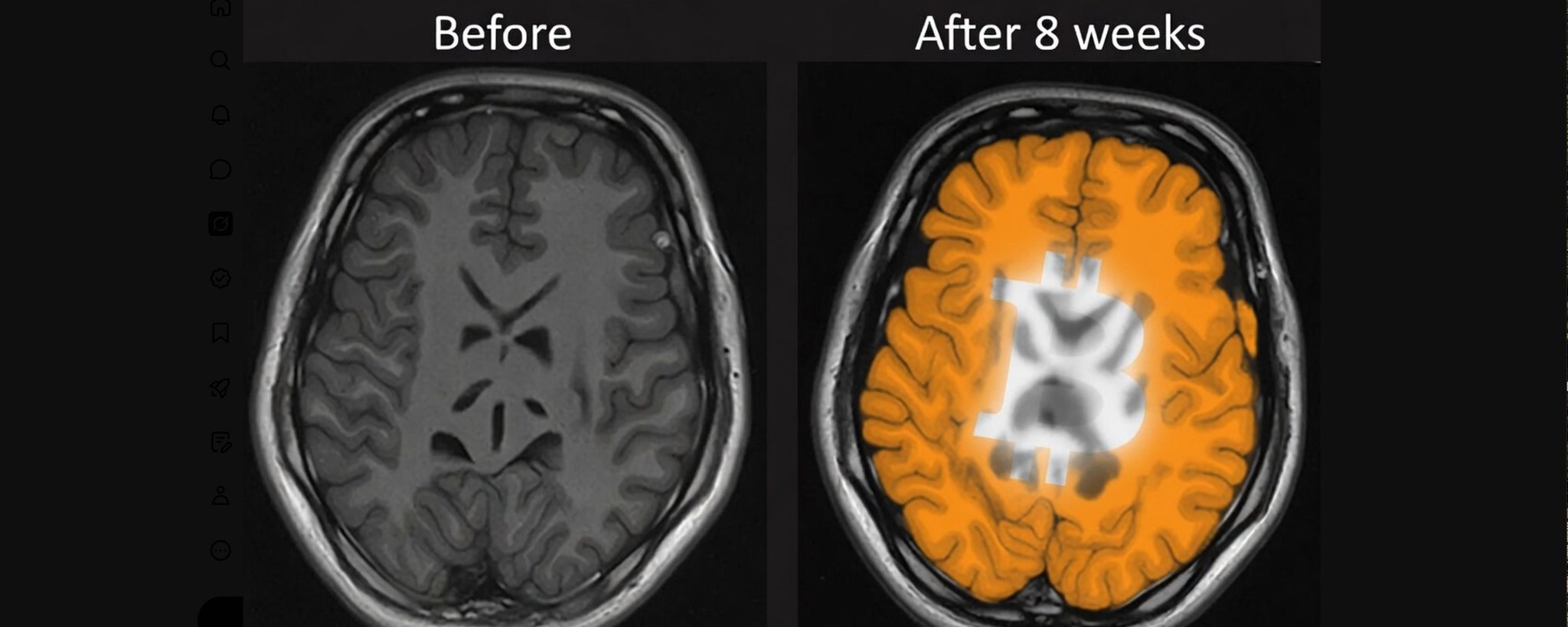
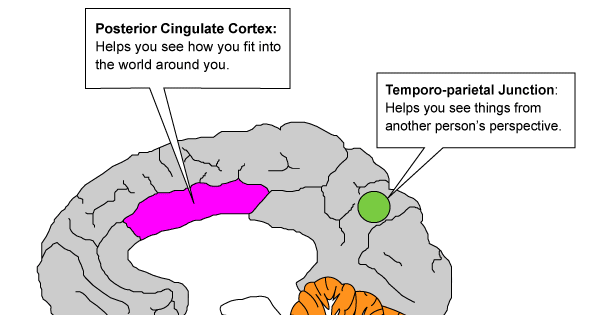
Meditation makes you smarter. Pass it on. Specifically, your brain physically changes (for the better) in 8 weeks. Harvard neuroscientist Sara Lazar put people with zero meditation experience through an 8-week program. MRI scans showed measurable increases in grey matter density in regions associated with learning, memory, and emotional regulation - and measurable shrinkage of the amygdala, the part of the brain responsible for fear, anxiety, and the fight-or-flight response. Eight weeks, not eight years. Seems like something worth doing/ Source: Harvard Gazette - Eight Weeks to a Better Brain Sara Lazar's work showed that even 8 weeks meditation measurably improved brain function across a variety of brain regions. image Source: One implication of this study is that in a bear market, the part of your brain that panics during a 50% drawdown is physically smaller. Probably nothing.
Daniel Batten's avatar
dsbatten 1 month ago
I just got back from the Bitcoin Energy Summit in Lisbon and I have a question that won't leave me alone. First some context: Bitcoin mining is now stabilizing the grids of 7 nations, 4 agencies (including the Spanish Govt and the World's largest energy policy association) just called for more flexible demand being critical to the resilience of the grids of the future - and Bitcoin mining is the world's most flexible load resource by an order of magnitude. So in light of this my question is this: why is 95% of the Bitcoin adoption conversation about Bitcoin-as-money when Bitcoin-as-energy is already deployed on grids across three continents? Is it possible that energy is the Bitcoin usecase that paves the road for mainstream acceptance of Bitcoin in the West? I've been in this space for four years now. When I started, the conversation was "bitcoin mining wastes energy." A group of Bitcoiners including Troy Cross changed that. Then it became "ok maybe it doesn't waste energy, but it's not useful." @gladstein , @jack and others changed that too. But here's what I noticed in Lisbon. Three separate European organisations - the European Bitcoin Energy Association, Free Madeira, and the Institut National de Bitcoin in France - are all independently converging on the same conclusion. Rachel Geyer, Chair of EBEA said energy is what will move the needle for Bitcoin in Europe. André Loja at Free Madeira said energy is the most topical issue in Europe right now. Bastien Desteuque, directeur général at INBi (Bitcoin Policy Insitute of France) said they're focusing on mining because France has spare nuclear capacity and that's where the biggest opportunity is. Three organisations. Same conclusion. And that's before you get to what's actually being built. In Sweden, a man I coach runs ASIC hardware that earns almost two-thirds of its revenue from frequency regulation - keeping the lights on, responding in seconds to the need of the grid operator, and helping to stabilize the grid an incredible11,247 times last year alone. (Yes, you read that sentence right). In Lisbon, I watched Kenji Tateiwa present a circular economy where bitcoin mining heat grows tropical fish and the CO2 gets converted to charcoal and micro diamonds. Bastian outlined how France's surplus nuclear energy could be absorbed by bitcoin mining by 2027. The conversation has quietly moved from "does bitcoin mining help grids?" to "how many services can one machine provide?" We've been thinking about this like monoculture - one machine, one function. What I saw in Lisbon is permaculture. The same hardware doing frequency regulation, heat capture, Sats-minting ... and potentially in the near future - voltage regulation (something that would have prevented the 28 April 2025 Iberian Peninsular Blackout. I talked to Bitcoin founders after the keynote who told me the energy thesis had opened their eyes. These are people who worked to advance Bitcoin payment infrastructure, and they hadn't fully grasped this. So here's my question. If energy is already Bitcoin's most mature real-world use case in the West - more deployed than payments, more proven than store-of-value at institutional scale - why are we still treating it as a footnote? What other Bitcoin use case is this far along ... at least in the West? Excited to see what happens next.
Daniel Batten's avatar
dsbatten 2 months ago
At the end of 2023 I met the person who ran GreenpeaceUSA's campaign against Bitcoin.

 I expected it to be tense. It wasn't.

 He told me he'd read every response to every post I'd made on Twitter.

"I wish we'd engaged with you and people like you from the outset," he said.
 Two months later he left Greenpeace. A few months after that they ended the campaign entirely. It was the most well-funded, yet the worst result in their history.

I keep coming back to that phrase. "People like you." Not me. A whole group. Troy Cross, Margot Paez, Elliot David, Susie Violet Ward and many others. We were working independently, with no budget and no coordination. We just shared data and conviction.

 It is a great story of a decentralized response beating a multi-million dollar centralized campaign, not by being louder but by a combination of being right and expressing that truth in such a way that reasonable people could see. And it is a recipe we can use again and again.
Daniel Batten's avatar
dsbatten 2 months ago
Why a high standard of clarity and communication is required when talking about Bitcoin: Misinformation travels 10x further than the truth, and gets 10x the coverage - so anyone articulating the truth need to state it 100x more clearly, just to reach parity.