Scott Wolfe's avatar
Scott Wolfe
scottwolfe@primal.net
npub15m9y...q643
Coordinator @FBCE / Board Member @TPBInc / I work at the intersection of political-economic analysis, disruptive technology, community development and social impact with emphasis on upstream action.
Scott Wolfe's avatar
Scott Wolfe 0 months ago
Could financial engineering of the AI boom become the next major financial crisis? Most people think the #AI story is simple: technology companies are buying massive amounts of chips and data center infrastructure to power the future. But what if the bigger story isn’t AI itself? What if the bigger story is how AI infrastructure is being financed? Michael Burry @michaeljburry, famous for identifying risks in the U.S. housing market before the 2008 financial crisis, has been raising concerns about the growing financialization of AI infrastructure and the possibility that risk is being quietly transferred throughout the financial system. The issue is not whether AI is valuable. It clearly is. The issue is whether Wall Street is creating increasingly complex financing structures around AI chips, data centers, and computing infrastructure that obscure where the underlying risk ultimately resides. In a traditional transaction, a company buys equipment and bears the associated risk. In today’s market, the process can involve special-purpose entities, private credit funds, securitized debt structures, insurance companies, and annuity providers. By the time the chain is complete, the ultimate source of capital may be ordinary savers and retirees who have no idea their retirement assets are helping finance speculative AI infrastructure expansion. This should sound familiar. In the years leading up to 2008, mortgages were transformed into layers of securities that dispersed risk so widely that few participants fully understood their exposure. The result was a system that appeared stable until it suddenly wasn’t. To be clear, this is not an argument that AI is a bubble or that AI has no future. The technology is real. The demand is real. The innovation is real. But history teaches us that transformative technologies and financial bubbles often coexist. Railroads. Telecom. The internet. The technology can change the world while investors simultaneously overbuild capacity, overextend leverage, and underestimate risk. The questions regulators, investors, pension funds, insurance companies, and annuity holders should be asking are straightforward: • How much leverage is supporting AI infrastructure expansion? • Who ultimately bears the risk if AI spending slows? • How much exposure do retirement and insurance portfolios have to these structures? • Are investors receiving sufficient transparency regarding the underlying assets and financing arrangements? Financial crises rarely emerge from the technology itself. They emerge when leverage, complexity, and opacity become embedded in the financial system. The AI buildout may ultimately create extraordinary value for society. But if the risks are being packaged, securitized, and distributed in ways that few people fully understand, regulators and investors should be paying close attention now—not after the consequences become visible. The lesson from every major financial crisis is the same: Pay attention to where the risk ends up, not just where the excitement begins. The question Burry is effectively asking regulators and investors is: If AI infrastructure turns out to be overbuilt, who ultimately absorbs the losses? Many people assume the answer is Nvidia shareholders, venture capitalists, or AI companies. Burry’s concern is that the answer may increasingly be: insurance companies, annuity portfolios, pension-like retirement products, and ultimately ordinary savers. ———- Further reading here: image

Scott Wolfe's avatar
Scott Wolfe 1 month ago
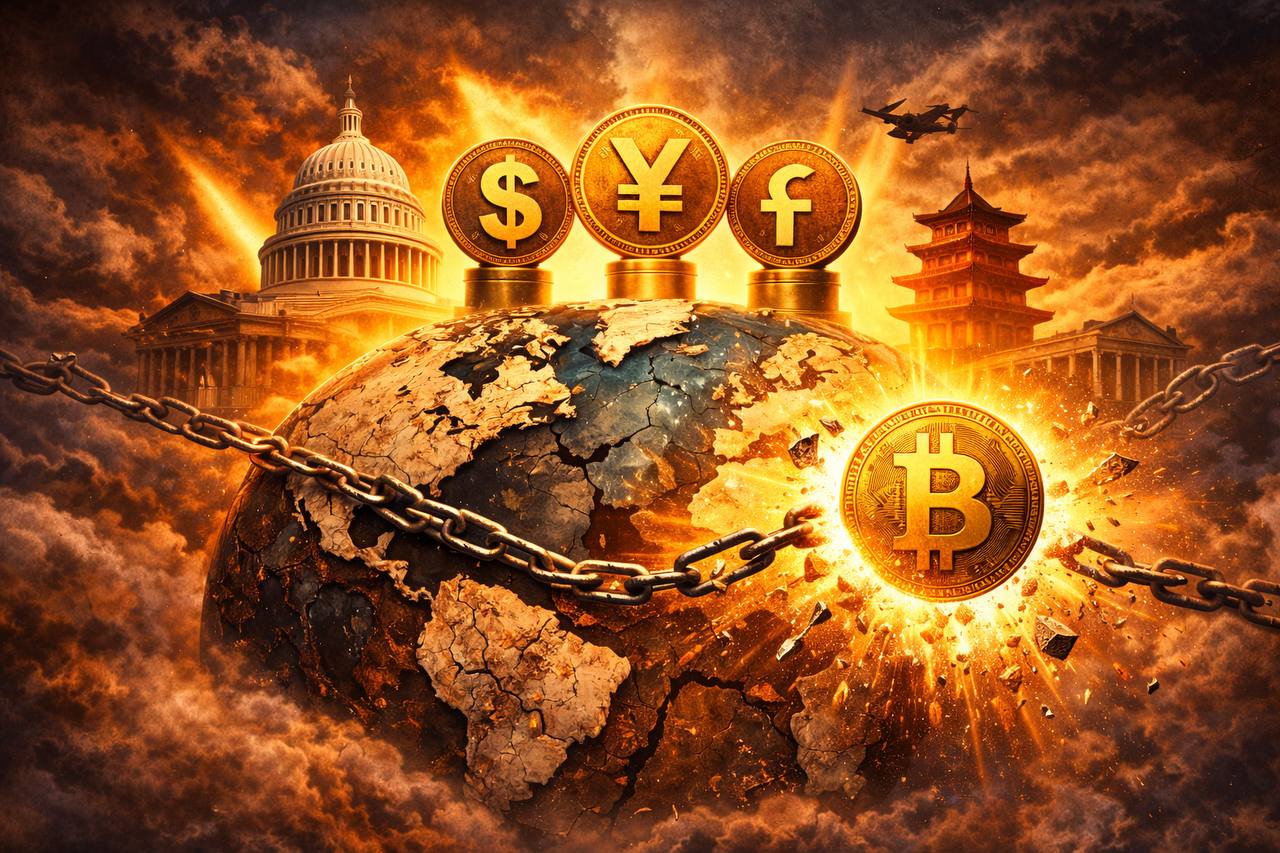
Banks and crypto are all part of the same edifice, and are increasingly merging. Bitcoin stands apart, as freedom tech and freedom money. Study Bitcoin. Choose humanity. image
Scott Wolfe's avatar
Scott Wolfe 1 month ago
The crypto vs banks “rivalry” that is playing out surrounding the U.S. Clarity Act is way too contrived. It is orchestrated theatre. It is fake competition, the stuff of willing partners in an evolving oligopoly. Banking and crypto are merging. The real rivalry is with YOU, with freedom, and truly “decentralized finance”. To use a sports analogy, the banking “league” has simply agreed to a league expansion. They are allowing new teams into the league, willing to dilute their market share because they have calculated that doing so grows the market and profit. Armstrong/Dimon = Knicks/Thunder. This evolving oligopoly will have defined rules for who’s in and out, centralizing power and control over a vast landscape of digital assets (including custodied BTC). The true rivalry is now with actual decentralized finance: you holding and spending self-custodied Bitcoin. image
Scott Wolfe's avatar
Scott Wolfe 2 months ago
Bonito…todo me parece bonito! 🙏🌞🧡
Scott Wolfe's avatar
Scott Wolfe 2 months ago
Powerful scene from “John Adams”, with parting words from King George III that are most somber and relevant in our age of toxic “democratic” politics. “I pray, Mr Adams, that the United States does not suffer unduly from its want for a monarchy”. 🤔
Scott Wolfe's avatar
Scott Wolfe 3 months ago
It’s remarkable the number of people who have opinions about #Bitcoin but don’t know what the “difficulty adjustment” is nor that you can transact $BTC over Lightning network instantly, anywhere in the world, at almost no fee, without an intermediary. Study Bitcoin.
Scott Wolfe's avatar
Scott Wolfe 3 months ago
“The Next Mantra: Spend and Replace”, my latest article via @The Progressive Bitcoiner. With Bitcoin payments set to go live on more than 4 million Square merchant payment terminals next week, thanks to @jack and team, it’s time for a new mantra to take hold! ⚡️🧡
Scott Wolfe's avatar
Scott Wolfe 3 months ago
As of early 2026, there are now more than 190 publicly-listed companies worldwide that hold Bitcoin in their treasuries, up from just 74 at the beginning of 2025. Still, this is just 0.35% of the roughly 100,000 publicly-listed companies worldwide. There will only ever be 21,000,000 Bitcoin and 20,000,000 of those have now been mined into supply, with the remaining 1,000,000 to be mined over the next 114 years. Each 1.0 Bitcoin is divisible into 100,000,000 smaller units (like dollars/cents) called “sats”. What happens to the value/price of Bitcoin when the number of publicly-listed companies holding some Bitcoin (any amount) as a reserve asset increases to 1%, 2%, 5% or more. What happens when the roughly 1% of the world’s 8 billion people who currently hold some Bitcoin increases to 2%, 5%, 10% or more. You do the math. Suffice to say, Bitcoin is a $10,000,000 (or more) asset currently on sale for $70,000. Have a nice day! 😊 image
Scott Wolfe's avatar
Scott Wolfe 5 months ago
For those tracking #Bitcoin exchange rate with top fiat currencies, we’re now at 40% from all time $BTC high, the last difficulty adjustment was down 3.28%, and we’re about to see another ~14% adjustment down. All of this suggests to me we saw some significant miner capitulation and exchange rate is bottoming. image
Scott Wolfe's avatar
Scott Wolfe 5 months ago
While far too many people are gazing at #Bitcoin charts, Bitcoin Circular Economies (BCEs) are building the global “peer-to-peer electronic cash” movement that Satoshi envisioned. If you’re not tuned into #GlobalBCESummit, #AfricaBCESummit, and #spedn this week, you’re missing the true signal!
Scott Wolfe's avatar
Scott Wolfe 5 months ago
“Stablecoins, which merely peg themselves to these fiat currencies, inherit their structural weakness. Stablecoins are not digital islands of stability; they are tethered to melting ice cubes, losing purchasing power at precisely the same rate as the fiat currencies they shadow… …And beyond this economic decay lies a more profound, sinister geopolitical danger: stablecoins do not merely inherit the debasement of their underlying fiat currencies—they also inherit and amplify the systems of monetary and political colonialism those currencies sustain. Whether through the U.S. dollar, the Chinese yuan, the CFA franc, or other hegemonic monetary regimes, stablecoins risk re-entrenching patterns of dependence and external control at precisely the moment when communities and nations around the world are seeking pathways to liberation and self-determination.” 📙
Scott Wolfe's avatar
Scott Wolfe 5 months ago
“We’re not even thinking of thinking of bringing this bad boy in on budget. How high could it get? Probably about this high?” image
Scott Wolfe's avatar
Scott Wolfe 5 months ago
CALL TO ACTION: “People and organizations committed to community empowerment, human rights, global development, and economic justice now face a defining choice. Will they continue to participate—actively or passively—in monetary systems that entrench dependency, extract value from the vulnerable, and reproduce neo-colonial power dynamics in digital form? Or will they choose a fundamentally different path?"… “Bitcoin offers that alternative.”… “The time for passive observation has passed. The responsibility now is to study Bitcoin seriously, to understand what is at stake, and to act accordingly.” ✅
Scott Wolfe's avatar
Scott Wolfe 5 months ago
“The world does not need more digital chains. It needs digital emancipation. Bitcoin is not merely a technology. It is a declaration—an assertion that a more sovereign, more just, and more humane global monetary order is possible. But that future is not inevitable. It must be chosen, defended, and built.”