Peter du Toit's avatar
Peter du Toit
peterdutoit@peterdutoit.com
npub144ed...urkq
I speak about climate futures, mitigation and adaptation in the face of the climate crisis. 🇿🇦
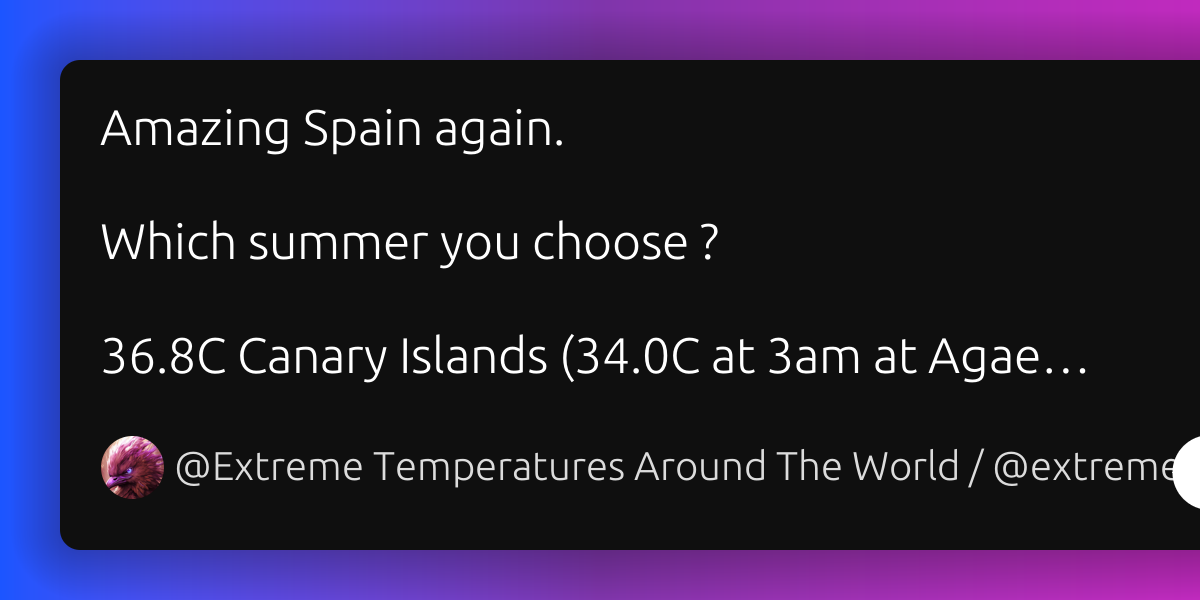
Don’t be caught off guard. The instruments we use to measure the natural world have been sending back data as pictured. As a result of these changes we are beginning to feel the impacts as projected by the models. For example, as the 2023 European summer gets underway: In southern European countries such as Portugal, Spain and Italy, the severe drought and scarce rain are forcing water restrictions. In these countries there is a call on citizens to limit water use to the bare minimum. In Italy, the government has declared a national drought emergency in several regions of the country. Drinking water in these regions is becoming scarce, forests are prone to burning and there has been observed glacier melt in the Dolomites (https://www.dw.com/en/water-scarcity-eu-countries-forced-to-restrict-drinking-water-access/a-62363819) In Germany, low water levels affected the inland shipping operations on the Upper and Middle Rhine in 2022. The German Farmers’ Association has issued a harvest warning for 2023, saying that without imminent rain, this year’s harvests could be severely affected by projected late-summer heat waves. In France, four departments are already subject to restrictions as of March 1, 2023: Ain, Isère, Bouches-du-Rhône and the Pyrénées-Orientales. Residents of these areas are forbidden to water their gardens, fill their pools or wash their cars. France’s nuclear power plants, which rely on water for cooling, had to reduce their output due to the heat last year and are projecting the same challenges this summer (See https://www.bloomberg.com/news/articles/2022-08-03/edf-to-curb-nuclear-output-as-french-energy-crisis-worsens) Adaptation to this “new normal” should be high on the agenda.
This from Shell in 1989. Shell was given an opportunity to respond to the reporting on this and did not deny the legitimacy of the document See And from the researcher who found the documents A classic tale of profits before people and planet. This one is particularly egregious as it effects everyone everywhere. image
The polar regions are some of the closest observed parts of the planet one reason being their direct impact on sea level rise. There is so much equipment trained on these areas it's insane. This paper on very important research concluded in the Antarctic was just released "Antarctic Overturning Slowdown — Melting ice set to transform our oceans" "This pattern of bottom water warming is already apparent in observations of change in the ocean's abyssal layers, as estimated by [Sarah Purkey] and [Dr Gregory C. Johnson] , although OBS are outpacing our model projections. So we are likely already 'mid slowdown' today."—Prof Matt England This has massive implications for the food chain sea life above depends on and also the speed of ice melting that is already taking place. Here is Prof Matt England's (one of the research authors) high level summary of the data: https://nitter.net/ProfMattEngland/status/1641096876429803521#m #ClimateLiteracy #Antartic image
We are completely unprepared. “We find that #India could become one of the first places in the world to experience heat waves that cross the survivability limit for a healthy human being sitting in the shade. Without targeted adaptation action, around 160-200 million people in India could annually bear a 5 percent chance of being exposed to a lethal heat wave as early as 2030, a ~40% cumulative likelihood over the decade centered on 2030.” — https://www.mckinsey.com/~/media/mckinsey/business%20functions/sustainability/our%20insights/will%20india%20get%20too%20hot%20to%20work/will-india-get%20too-hot-to-work-vf.pdf image
The instruments we use to track the changes happening to our physical world as we continue to heat are becoming more accurate. (ie satellites, floats, tidal stations, weather stations etc.) As a result our risk projections are getting smarter which is why we can now say with high confidence that approximately 3.3 to 3.6 billion people live in contexts that are highly vulnerable to climate change.
Did you know: Japan’s has had a long-standing fixation with sakura (cherry blossoms) in fact cherry blossom records date back to 812! This gives us a data set spanning 1211 years. This has proven to be a treasure trove for scientists because they have been able to use this data to track a heating planet. (Pictured) As a result cherry tree blossoms in Japan have been included in the “instrument dashboard” tracking our heating world. (Graph source: #ClimateLiteracy image
This from the latest IPCC synthesis report. They highlight the difference between the Fifth Assessment Reports (AR5 - 2014) and the Sixth Assessment Reports (AR6 - 2022) Due to 1) Current impact observations, 2) Improved understanding of the climate system and 2) New knowledge on our collective vulnerability They make this adjustment in their risk assessments: “Risk levels become high to very high 𝙖𝙩 𝙡𝙤𝙬𝙚𝙧 𝙡𝙚𝙫𝙚𝙡𝙨 𝙤𝙛 𝙜𝙡𝙤𝙗𝙖𝙡 𝙬𝙖𝙧𝙢𝙞𝙣𝙜.” Simply put this means greater impacts sooner than imagined. There should be no delay in our collective actions to mitigate against this getting a lot worse (ie being unable to keep warming well below 2°) and adapting to impacts we are already committed to. Climate literacy is now really a non negotiable. #futureofwork #climateliteracy #leadership #riskassessment image