Peter du Toit's avatar
Peter du Toit
peterdutoit@peterdutoit.com
npub144ed...urkq
I speak about climate futures, mitigation and adaptation in the face of the climate crisis. 🇿🇦
#ClimateLiteracy: The 1.5° limit applies to the average temperature over a year, and passing it would mean that the average will have been sustained for several years. That said, we have crossed the 1.5°C anomaly on hundreds of individual days, after which it has fallen back below 1.5° Most of these days occurred in 2016 & 2020. Now as the heat begins to load up as a result of the maturing El Niño we will see many individual days again cross 1.5° For example look at this. In 2023 we breached 1.5° on March 6-11 and again yesterday (June 9th) image
Precipitation records tumble in #Portugal Extreme precipitation events go hand-in-hand with our heating trajectory. The amount of water vapour in the atmosphere increases by about 7% for each 1° of warming. Current status: +1.27°C above pre-industrial image
Excessive heat events are now becoming so common that it’s hard to keep up. Some hardly get any coverage. Here is an Excessive Heat Warning in place for northwest #PuertoRico today. Heat range expected 42.2° to 47.7°C accompanied by high humidity (a wet bulb temperature event) May 2023: CO2 424 ppm Avg Global Temp: +1.27°C (above preindustrial) Data source: #ClimateCrisis #Heatwave image
Human migration on a heating planet. We know from the latest science that 100’s of millions of people will find themselves in physical environments where heat and humidity will be an existential threat as we continue to heat. There is no question that this will no doubt motivate migration. The sooner we understand the dynamics of this the better. So it’s really import that research like this is seeing the light of day. #ClimateCrisis #Heatwaves #Migration
#Japan has just experienced it’s warmest spring (MAM) since records began in 1898. Temps were 1.59°C higher than average this year. Source: Japan Meteorological Agency
As #ClimateChaos becomes a reality in many places we need robust #EarlyWarningSystems in place to help people stay safe. You HAVE to make an effort to understand what is projected for the area you are in and begin a conversation about what actions to take as a result. Here is the Four-Pillar Framework the WMO is working on and serves as an excellent template for your community and family. Source: https://public.wmo.int/en/resources/bulletin/overview-of-early-warnings-all-executive-action-plan-2023%E2%80%932027 #ClimateLiteracy #Adaptation image
Heat records are tumbling again in parts of China! “Today, 18 stations broke the highest record and 2 stations tied the record, mainly in Yunnan. 178 stations breaking the record in May, and 15 stations equaling the record. Among them, 61 stations in Guangdong, which is 71% of the stations in the province”—Xin Xin #China #Heatwave Source:
Cryosphere Early Warning - Reference glaciers (for which we have long-term observations) experienced an average thickness change of over −1.3 metres between October 2021 and October 2022. This loss is much larger than the average of the last decade. The cumulative thickness loss since 1970 amounts to almost 30 m. - The European Alps smashed records for glacier melt due to a combination of little winter snow. In Switzerland, 6% of the glacier ice volume was lost between 2021 and 2022 – and one third between 2001 and 2022. - The Greenland Ice Sheet ended with a negative total mass balance for the 26th year in a row. - Sea ice in Antarctica dropped to 1.92 million km2 on February 25, 2022, the lowest level on record and almost 1 million km2 below the long-term (1991-2020) mean. - Arctic sea ice in September at the end of the summer melt tied for the 11th lowest monthly minimum ice extent in the satellite record. - Global mean sea level reaching a new record high for the satellite altimeter record (1993-2022). The rate of global mean sea level rise has doubled between the first decade of the satellite record. Source: https://public.wmo.int/en/media/press-release/rapid-changes-cryosphere-demand-urgent-coordinated-action
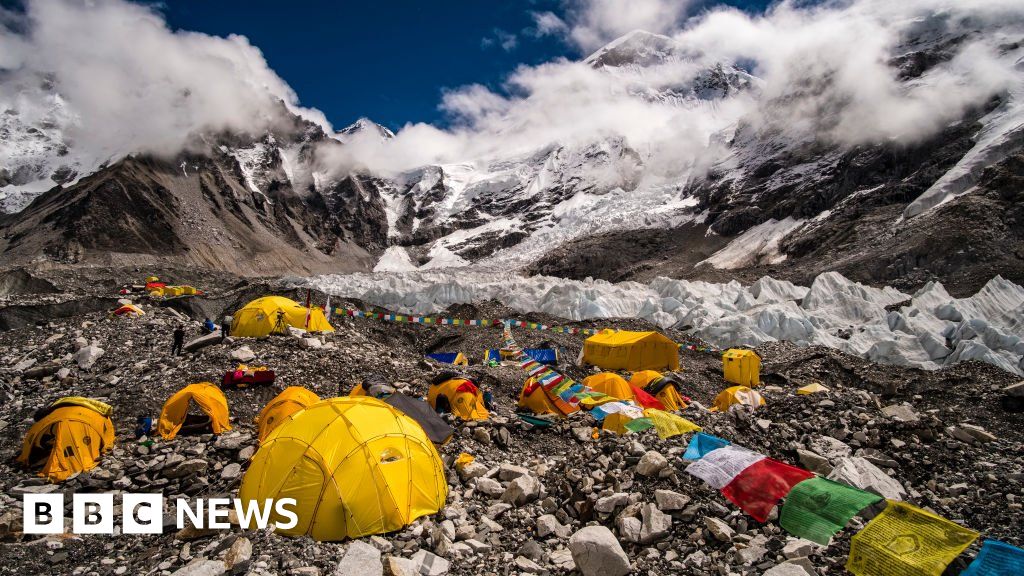
This story illustrates our general inability to recognise #climaterisk and adapt: Sherpas: "[Base Camp] has been there for the past 70 years, why should they move it now? And even if they wanted to, where is the study on a viable alternative?" Reality: “Mountaineers and officials say streams have now begun to flow right from the middle of the base camp and crevasses are widening dangerously and very quickly.”
Early Warnings In this peer-reviewed paper scientists looked at 12 locations around the Mediterranean and Middle East to determine when these locations would cross the regular occurrences of 45° and then 50°C days given our current trajectory. They look at the situation at present, Mid-Century (27 years away) and Late Century (77 years away) They conclude: “As the hottest European temperatures already verge on 50 °C, the question arises whether extreme climatic conditions similar to neighbouring regions like Northern Africa are migrating into Europe. Our work provides some evidence that this may indeed be the case, at least in areas with the largest warming trends like Southern Spain. Although this northward climate migration is perhaps an unsurprising scientific inference, its associated unprecedented impacts are of great importance to affected European countries.” Some of these places will become uninhabitable as a result of the life-threatening heat. Most of this is unavoidable given the amount of CO2 ALREADY in the atmosphere (423 ppm as of April 2023 and rising) The speed at which this arrives can of course change and is absolutely determined by our choices TODAY. What will the impacts be in the place you live? Do you know? Paper here: https://www.nature.com/articles/s41612-023-00377-4 #ClimateLiteracy #ClimateCrisis #Mitigation #Adaptation image
It’s good to see this topic being researched. Last year during the intense heat wave in #India they had this exact experience. Heat wave + dramatic increase in air conditioner use = major strain on grid = large area blackouts = vulnerability to heatstroke How Blackouts during Heat Waves Amplify Mortality and Morbidity Risk: https://pubs.acs.org/doi/10.1021/acs.est.2c09588 #ClimateCrisis #Heatwaves
France officially ends domestic flights when a train journey can reach a destination in less than 2h30. This decree notably has the immediate effect of prohibiting air links between Nantes, Bordeaux, Lyon and Paris-Orly. ✈️ fly-less May 21 CO2 423.75 ppm Global avg temperature +1.27°C #ClimateLiteracy #FlyLess
We *have* to talk about adaptation as a result of the warming we are *already* committed to. But we need to understand that we are already brushing up against the limits of adaptation. (See pic) Which is why we also *have* to talk about mitigation because if we don't slam the brakes on emissions our ability to adapt at all will fade into the rearview mirror. Graphic source material: https://www.ipcc.ch/report/ar6/wg2/downloads/report/IPCC_AR6_WGII_SummaryForPolicymakers.pdf #ClimateCrisis #ClimateLiteracy #Adaptation #Mitigation image