JL's avatar
JL
npub1cgmk...tnyr
I am not a number!
We’re Living Through a Monetary Regime Change & No One Is Paying Attention Most people expect monetary regime changes to look like a disaster or a profound shock. Much in the same way that the supposed Nixon shock was no shock whatsoever to those paying attention. Indeed, economist Paul Einzig recognised the clear intent to move towards the abandonment of the gold peg, arguing against the acceleration of academic and institutional support favouring the abandonment of the gold dollar peg. Why is this relevant to today? Well, we are seeing a very similar pattern play out once again. History doesn’t repeat, it rebrands. But what we are living through right now is not just a normal economic cycle. It is the slow dismantling of the post 1971 system and the gradual construction of a new one. _______________ 00:00 The Alleged Nixon "Shock" 02:27 A New Monetary Pipeline 02:59 Quantitative Tightening 04:31 The Yen Carry Trade 05:51 The Bond Market 06:36 Collateral: The Hidden Fragility 08:00 Genius Stablecoins & Tokenised Deposits 09:32 Know the Destination 10:39 Monetary Regime Change Miles Harris 08.12.25 #milesharris #digitalid
13...no...12 days to go!! 3I Atlas is doing crazy things! The countdown to 3I Atlas close approach is only 12 days away! And the latest photos are the craziest yet! We analyze these latest 3I Atlas images, and reveal surprises that NASA still won't mention! The Angry Astronaut 07.12.25 #angryastronaut #3iatlas
By Catherine Austin Fitts When I published The State of Our Currencies in the spring of 2020, I observed that we were in a global currency war, stating: “[I]t is essential to realize that we live and transact in a transition time between two systems.” The U.S. dollar as global reserve currency is the current system—the second system, I wrote, is “in the invention room.” In the intervening years, the currency wars have heated up, and Mr. Global’s invention room is spitting out more and more tools to implement programmable money on distributed ledgers and the digital IDs and local hardware to make the system go. This week, British entrepreneur, Bitcoin investor, and geofinancial analyst Simon Dixon helps us take stock of these fast-moving developments. Like me, Dixon has a long-standing interest in “missing money”—which arose after the dot-com crash of 2000 wiped out his father’s pension—and like me, he found that asking inconvenient questions about a “corrupt banking and financial industry” was not compatible with his prior career in investment banking. Given our mutual passion for freedom and building wealth, this is a conversation you will not want to miss. We start by discussing the rise of stablecoins, the passage of the GENIUS Act, and stablecoins’ potential impact on the dollar and Treasury Bill markets as well as on local economies. We also take a look at asset tokens and assess the implications of the not-yet-passed CLARITY Act. Wall Street leaders speak openly about their plans to use tokens to trade securities and assets—but the specifics of what they have in mind are far from clear. Other topics of discussion include the role of Bitcoin in the emerging financial system, the U.S. Bitcoin Strategic Reserve being funded with seizures, and the role of the “multiple CBDC” platform mBridge—a cross-border payment and foreign exchange transaction system initially piloted by the Bank for International Settlements (BIS) in collaboration with central banks in Hong Kong, Thailand, China, and the United Arab Emirates (UAE) and Saudi Arabia. We conclude with the question of the day: How do we stop the control grid? Dixon agrees about the dangers of programmable money. He continues to be a Bitcoin enthusiast in the face of Wall Street’s embrace of crypto and stresses the importance of self-custody and not leveraging Bitcoin positions. His website offers information about self-custody and a fascinating podcast, Bitcoin Hard Talk, that connects the dots between financial markets and geopolitics. This interview is public—Simon is publishing it at the same time we are, so do pass it on. @Simon Dixon 02.12.25 #solari #simondixon
Skripal and Novichok: What Didn't Happen Salisbury Dec 11 from 7:30pm to 10pm GMT Overview A critical analysis of the Dawn Sturgess Inquiry report and Skripal affair presented by Craig Murray, Patrick Henningsen and Tim Norman. There are still many unanswered questions surrounding the Skripal incident in Salisbury on 12 March 2018, and the subsequent death of Dawn Sturgess. Join us for an evening of presentations and questions, to review the events around Sergey and Yulia Skripal.
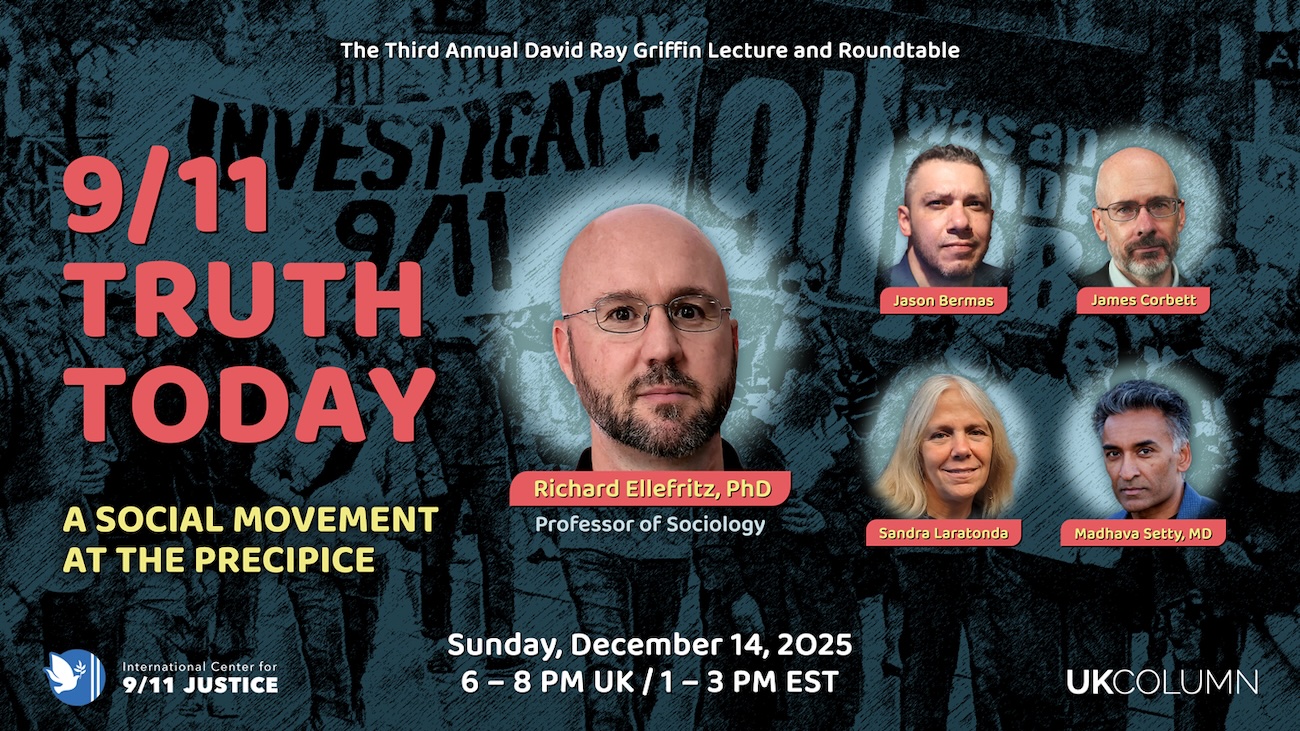
Welcome to the Third Annual David Ray Griffin Lecture, which is being held in honour of the late eminent 9/11 scholar, Dr. David Ray Griffin, who contributed immensely to the pursuit of truth and peace during his lifetime. The lecture will take place on Sunday, 14 December 2025, starting at 6:00 PM UK / 1:00 PM EST and will last approximately two and a half hours. An archived video will be available shortly after the conclusion of the event. This year’s lecture, entitled “9/11 Truth Today: A Social Movement at the Precipice,” will be given by Professor Richard G. Ellefritz. The lecture will be followed by a roundtable discussion with longtime 9/11 activists Jason Bermas, James Corbett, Sandra Laratonda, and Madhava Setty, MD. The lecture is hosted by the International Center for 9/11 Justice and UK Column. Audience Questions During Professor Ellefritz’s lecture, audience members are invited to submit questions to be discussed during the roundtable. Please email your question(s) to questions@ic911.org. About ‘9/11 Truth Today’ Questions that emerged on September 11, 2001, swelled into the 9/11 Truth movement in the early 2000s, and today, 9/11 Truth is turning the tide of public discourse, with more and more prominent voices joining those who have, for decades, called out the inconsistencies in the official narrative known as 9/11. Fighting against waves of anti-conspiracism from journalists, academics, and government voices — who’ve eagerly labeled it dead, dying, or a ‘degenerating research program’ — the 9/11 Truth movement is alive and driving toward a new investigation of 9/11. In this lecture, sociologist Richard G. Ellefritz explores the movement’ s current momentum and trajectory, unpacks the propaganda tactics of anti-conspiracists, and invites an open discussion of the facts beyond the stigma. Richard G. Ellefritz is an assistant professor of sociology at the University of The Bahamas. UKColumn #9/11
Nick Hudson on the Limitations of Binary Thinking Nick Hudson is PANDA's Chairman and an actuary with broad international experience in finance. He has settled into a career as a private equity investor. Jerm and Nick explore various themes and begin with how, through the nature of public discourse, fear and dogma impact societal beliefs. The pair delve into the complexities of health and immunity while they discuss the limitations of binary thought to understand these nuanced topics. They examine the role of propaganda to shape narratives and highlight how it influences public perception and decision-making processes. The conversation moves on to address the challenges posed by centralised control through frameworks like Sustainable Development Goals, and then explores inadequacies with models to understand complex systems. Nick and Jerm conclude with an examination of philosophical implications for health and mortality. They question conventional approaches to the fundamental aspects of human existence whilst they advocate for more sophisticated thought beyond simplistic binary frameworks. UKColumn / Nick Hudson / Jerm Warfare 04.12.25 #jermwarfare #nickhudson #ukcolumn
Kevin Bridges On English Vs Scottish Football | Universal Comedy The Scottish are not anti-English, they just actively support against them in everything. PLEASE NOTE - Be careful what you say in Glasgow when you're comparing English and Scottish football. Here (2018's biggest-selling comedian) Kevin Bridges in his 2nd special 'The Story Continues' compares football across the UK. 05.07.20