🚀 **Upcoming Space Launch** 🚀
🌌 **Mission Name**: Long March 3B/E | Fengyun-4C
🗓️ **Launch Date**: 2025-12-26T16:05:00Z
🚀 **Rocket**: Long March 3B/E
📖 **Details**: China's geostationary meteorological satellite program FY-4 (Feng Yun 4) is the second generation of chinese geostationary meteorological satellites.
#SpaceLaunch #RocketScience
🚀 **Upcoming Space Launch** 🚀
🌌 **Mission Name**: Smart Dragon 3 | Unknown Payload
🗓️ **Launch Date**: 2025-12-26T06:30:00Z
🚀 **Rocket**: Smart Dragon 3
📖 **Details**: Possibly an Earth observation satellite for the Pakistan government's SUPARCO, details TBD.
#SpaceLaunch #RocketScience
🚀 **Upcoming Space Launch** 🚀
🌌 **Mission Name**: Long March 8A | Unknown Payload
🗓️ **Launch Date**: 2025-12-25T23:25:00Z
🚀 **Rocket**: Long March 8A
📖 **Details**: Details TBD.
#SpaceLaunch #RocketScience
🚀 **Upcoming Space Launch** 🚀
🌌 **Mission Name**: Soyuz 2.1a | Obzor-R No.1
🗓️ **Launch Date**: 2025-12-24T14:00:00Z
🚀 **Rocket**: Soyuz 2.1a
📖 **Details**: The Russian Obzor-R satellite is a planned X-band radar earth observation satellite designed by TsSKB-Progress.
In 2012, the development of the Arkon-2M radar satellite was stopped and instead the development of the Obzor-R was initiated.
The satellite features the BRLK X-band Synthetic Aperture Radar as the imaging instrument with a ground resolution of 500 m.
#SpaceLaunch #RocketScience
🚀 **Upcoming Space Launch** 🚀
🌌 **Mission Name**: LVM-3 | BlueBird Block 2 #1
🗓️ **Launch Date**: 2025-12-24T03:25:30Z
🚀 **Rocket**: LVM-3 (GSLV Mk III)
📖 **Details**: AST SpaceMobile’s Block 2 BlueBird satellites are designed to deliver up to 10 times the bandwidth capacity of the BlueBird Block 1 satellites, required to achieve 24/7 continuous cellular broadband service coverage in the United States, with beams designed to support a capacity of up to 40 MHz, enabling peak data transmission speeds up to 120 Mbps, supporting voice, full data and video applications. The Block 2 BlueBirds, featuring as large as 2400 square foot communications arrays, will be the largest satellites ever commercially deployed in Low Earth orbit once launched.
This launch will feature a single satellite.
#SpaceLaunch #RocketScience
🚀 **Upcoming Space Launch** 🚀
🌌 **Mission Name**: Long March 3B/E | Fengyun-4C
🗓️ **Launch Date**: 2025-12-26T16:05:00Z
🚀 **Rocket**: Long March 3B/E
📖 **Details**: China's geostationary meteorological satellite program FY-4 (Feng Yun 4) is the second generation of chinese geostationary meteorological satellites.
#SpaceLaunch #RocketScience
🚀 **Upcoming Space Launch** 🚀
🌌 **Mission Name**: Smart Dragon 3 | Unknown Payload
🗓️ **Launch Date**: 2025-12-26T06:30:00Z
🚀 **Rocket**: Smart Dragon 3
📖 **Details**: Possibly an Earth observation satellite for the Pakistan government's SUPARCO, details TBD.
#SpaceLaunch #RocketScience
🚀 **Upcoming Space Launch** 🚀
🌌 **Mission Name**: Long March 8A | Unknown Payload
🗓️ **Launch Date**: 2025-12-25T23:25:00Z
🚀 **Rocket**: Long March 8A
📖 **Details**: Details TBD.
#SpaceLaunch #RocketScience
🚀 **Upcoming Space Launch** 🚀
🌌 **Mission Name**: Soyuz 2.1a | Obzor-R No.1
🗓️ **Launch Date**: 2025-12-24T14:00:00Z
🚀 **Rocket**: Soyuz 2.1a
📖 **Details**: The Russian Obzor-R satellite is a planned X-band radar earth observation satellite designed by TsSKB-Progress.
In 2012, the development of the Arkon-2M radar satellite was stopped and instead the development of the Obzor-R was initiated.
The satellite features the BRLK X-band Synthetic Aperture Radar as the imaging instrument with a ground resolution of 500 m.
#SpaceLaunch #RocketScience
🚀 **Upcoming Space Launch** 🚀
🌌 **Mission Name**: LVM-3 | BlueBird Block 2 #1
🗓️ **Launch Date**: 2025-12-24T03:25:30Z
🚀 **Rocket**: LVM-3 (GSLV Mk III)
📖 **Details**: AST SpaceMobile’s Block 2 BlueBird satellites are designed to deliver up to 10 times the bandwidth capacity of the BlueBird Block 1 satellites, required to achieve 24/7 continuous cellular broadband service coverage in the United States, with beams designed to support a capacity of up to 40 MHz, enabling peak data transmission speeds up to 120 Mbps, supporting voice, full data and video applications. The Block 2 BlueBirds, featuring as large as 2400 square foot communications arrays, will be the largest satellites ever commercially deployed in Low Earth orbit once launched.
This launch will feature a single satellite.
#SpaceLaunch #RocketScience
Dangerous Asteroids Near Earth:
- 88213 (2001 AF2) (Size: 755.1617405255 meters)
- 488789 (2004 XK50) (Size: 887.2376825273 meters)
NASA Astronomy Picture of the Day (2025-12-24): Mystery: Little Red Dots in the Early Universe
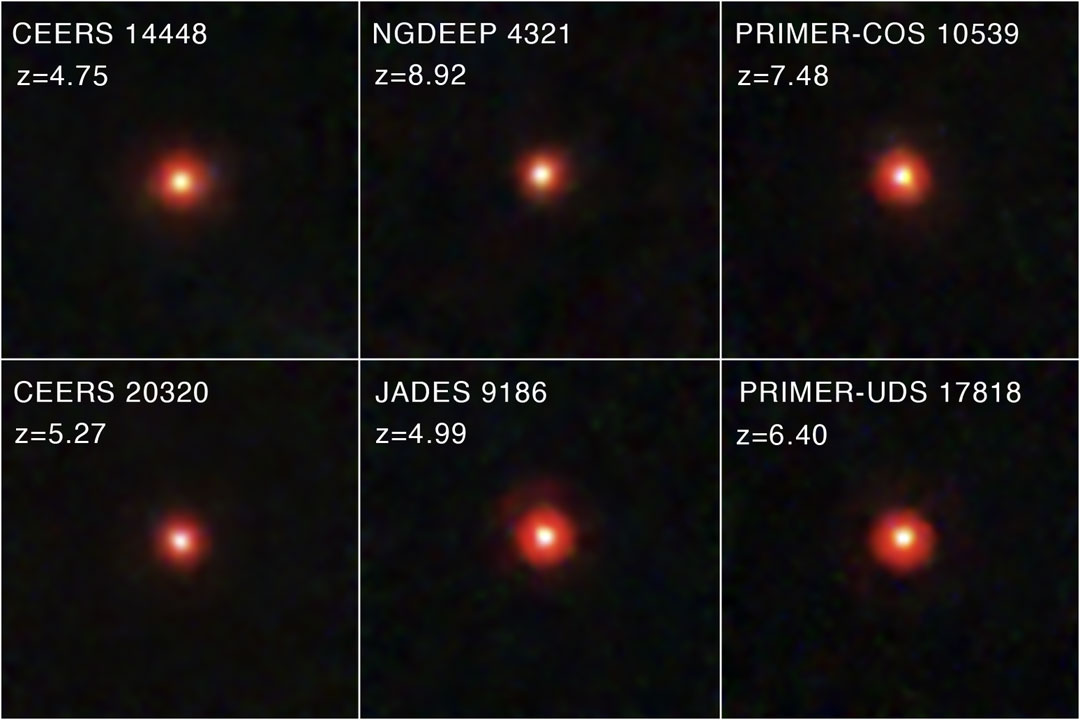
What are these little red dots (LRDs)? Nobody knows. Discovered only last year, hundreds of LRDs have now been found by the James Webb Space Telescope in the early universe. Although extremely faint, LRDs are now frequently identified in deep observations made for other purposes. A wide-ranging debate is raging about what LRDs may be and what importance they may have. Possible origin hypotheses include accreting supermassive black holes inside clouds of gas and dust, bursts of star formation in young dust-reddened galaxies, and dark matter powered gas clouds. The highlighted images show six nearly featureless LRDs listed under the JWST program that found them, and z, a distance indicator called cosmological redshift. Additionally, searches are underway in our nearby universe to try to find whatever previous LRDs might have become today.
🚀 **Upcoming Space Launch** 🚀
🌌 **Mission Name**: Long March 3B/E | Fengyun-4C
🗓️ **Launch Date**: 2025-12-26T16:05:00Z
🚀 **Rocket**: Long March 3B/E
📖 **Details**: China's geostationary meteorological satellite program FY-4 (Feng Yun 4) is the second generation of chinese geostationary meteorological satellites.
#SpaceLaunch #RocketScience
🚀 **Upcoming Space Launch** 🚀
🌌 **Mission Name**: Smart Dragon 3 | Unknown Payload
🗓️ **Launch Date**: 2025-12-26T06:30:00Z
🚀 **Rocket**: Smart Dragon 3
📖 **Details**: Possibly an Earth observation satellite for the Pakistan government's SUPARCO, details TBD.
#SpaceLaunch #RocketScience
🚀 **Upcoming Space Launch** 🚀
🌌 **Mission Name**: Long March 8A | Unknown Payload
🗓️ **Launch Date**: 2025-12-25T23:25:00Z
🚀 **Rocket**: Long March 8A
📖 **Details**: Details TBD.
#SpaceLaunch #RocketScience
🚀 **Upcoming Space Launch** 🚀
🌌 **Mission Name**: Soyuz 2.1a | Obzor-R No.1
🗓️ **Launch Date**: 2025-12-24T14:00:00Z
🚀 **Rocket**: Soyuz 2.1a
📖 **Details**: The Russian Obzor-R satellite is a planned X-band radar earth observation satellite designed by TsSKB-Progress.
In 2012, the development of the Arkon-2M radar satellite was stopped and instead the development of the Obzor-R was initiated.
The satellite features the BRLK X-band Synthetic Aperture Radar as the imaging instrument with a ground resolution of 500 m.
#SpaceLaunch #RocketScience
🚀 **Upcoming Space Launch** 🚀
🌌 **Mission Name**: LVM-3 | BlueBird Block 2 #1
🗓️ **Launch Date**: 2025-12-24T03:25:30Z
🚀 **Rocket**: LVM-3 (GSLV Mk III)
📖 **Details**: AST SpaceMobile’s Block 2 BlueBird satellites are designed to deliver up to 10 times the bandwidth capacity of the BlueBird Block 1 satellites, required to achieve 24/7 continuous cellular broadband service coverage in the United States, with beams designed to support a capacity of up to 40 MHz, enabling peak data transmission speeds up to 120 Mbps, supporting voice, full data and video applications. The Block 2 BlueBirds, featuring as large as 2400 square foot communications arrays, will be the largest satellites ever commercially deployed in Low Earth orbit once launched.
This launch will feature a single satellite.
#SpaceLaunch #RocketScience
🚀 **Upcoming Space Launch** 🚀
🌌 **Mission Name**: Long March 3B/E | Fengyun-4C
🗓️ **Launch Date**: 2025-12-26T16:05:00Z
🚀 **Rocket**: Long March 3B/E
📖 **Details**: China's geostationary meteorological satellite program FY-4 (Feng Yun 4) is the second generation of chinese geostationary meteorological satellites.
#SpaceLaunch #RocketScience
🚀 **Upcoming Space Launch** 🚀
🌌 **Mission Name**: Smart Dragon 3 | Unknown Payload
🗓️ **Launch Date**: 2025-12-26T06:30:00Z
🚀 **Rocket**: Smart Dragon 3
📖 **Details**: Possibly an Earth observation satellite for the Pakistan government's SUPARCO, details TBD.
#SpaceLaunch #RocketScience
🚀 **Upcoming Space Launch** 🚀
🌌 **Mission Name**: Long March 8A | Unknown Payload
🗓️ **Launch Date**: 2025-12-25T23:25:00Z
🚀 **Rocket**: Long March 8A
📖 **Details**: Details TBD.
#SpaceLaunch #RocketScience