China's Unprecedented Oil Stockpiling Sparks Questions If Beijing Is Preparing For War
China's Unprecedented Oil Stockpiling Sparks Questions If Beijing Is Preparing For War
Almost four years ago we pointed out something striking: while the world was still busy recovering from the covid Pandemic and suffering under soaring inflation - as seemingly everything was suddenly in short supply and prices were soaring - China was busy stockpiling pretty much everything at an unprecedented pace. Quoting a JPM report from March 2022 we noted that "while the world is short on commodities, China is not given they have started stockpiling commodities since 2019 and currently hold 80% of global copper inventories, 70% of corn, 51% of wheat, 46% of soybeans, 70% of crude oil, and over 20% of global aluminum inventories."
JPM: "While the world is short on commodities, China is not given they have started stockpiling commodities since 2019 and currently hold 80% of global copper inventories, 70% of corn, 51% of wheat, 46% of soybeans, 70% of crude oil, and over 20% of global aluminum inventories."
— zerohedge (@zerohedge)

X (formerly Twitter)
zerohedge (@zerohedge) on X
JPM: "While the world is short on commodities, China is not given they have started stockpiling commodities since 2019 and currently hold 80% of gl...
Almost as if China was
X (formerly Twitter)
zerohedge (@zerohedge) on X
*CHINA TO ADD COBALT, COPPER IN BOOST TO STATE METAL RESERVES
Nope, nobody mobilizing resources ahead of an accidental "incursion" into Taiwan here
for its inevitable invasion of Taiwan.
But if anyone expected China to ease off the hoarding pedal after its massive stockpiling spree, they would be very disappointed and nowhere more so than oil. As John Kemp of
JKempEnergy.com – Global energy research
notes, China has been accumulating crude oil inventories to take advantage of relatively low prices and act as an emergency reserve in any future conflict with the United States and its allies.
China’s stocks of crude oil apparently increased by 54 million tonnes (about 400 million barrels or 1.1 million barrels per day) during 2025 after a similar increase in 2024. China’s massive inventory build-up has helped avert the accumulation of stocks in other areas and limited the fall in prices even as Saudi Arabia and its OPEC partners have boosted production.
Inventory accumulation, Kemp writes echoing what we said years ago, has also been described as a “strategic warning indicator” that could indicate the country’s leaders are preparing for a future conflict with the United States over Taiwan.
“Energy production and stockpile buildups often precede great power industrial wars,” one analyst told the U.S.-China Economic and Security Review Commission established by the U.S. Congress.
In building strategic reserves to enable its economy to keep functioning and armed forces to keep fighting during a future conflict, the country is following long-standing precedent.
China, of course, is not alone: policymakers and military planners in the United States, Britain, France and other countries in Western Europe as well as Japan have all focused on building oil reserves in readiness for a conflict for almost a century. Yet nobody has taken stockpiling as religiously as Beijing has in recent years.
SECRETIVE STOCKS
China’s government considers stocks of crude and refined products stored by importers, refiners and distributors as well as its own strategic reserves a state secret. Total inventories are not disclosed which has led to a guessing game about how much oil is stored and its distribution between commercial stocks (held for operational and speculative purposes) and strategic reserves.
But it is possible to obtain some indication about the magnitude and direction of changes from data the government does publish on domestic crude production, imports and processing by refineries.
Crude oil exports and the direct use of crude by industry have fallen to negligible levels in recent years so they can be safely ignored.
In 2025, China’s domestic crude output climbed to 216 million tonnes and the country imported a further 578 million, according to data published by National Bureau of Statistics and the General Administration of Customs.
But the country’s refineries processed only 738 million tonnes, leaving 56 million unaccounted for, of which perhaps 2 million were probably exported with other small volumes used directly in industry.
Meanwhile, since the start of the century, China has apparently increased its crude inventories in 24 of the 25 years, according to an analysis of government data. The exception was 2021, after an unprecedented increase the previous year, during the first wave of the coronavirus pandemic, which caused crude prices to slump to multi-decade lows.
The persistent rise can be explained in part by operational requirements stemming from the growing consumption of gasoline, diesel and other petroleum products. But consumption has grown more slowly in recent years as deployment of electric vehicles and gas-powered trucks has cut into fuel use.
The apparent increase in stocks during 2024 and again in 2025 is too large to be attributed to operational needs and commercial incentives alone.
The massive accumulation appears to be "a precautionary measure in case imports are disrupted by sanctions or an embargo during any future conflict with the United States and its allies," Kemp writes.
ENERGY SECURITY
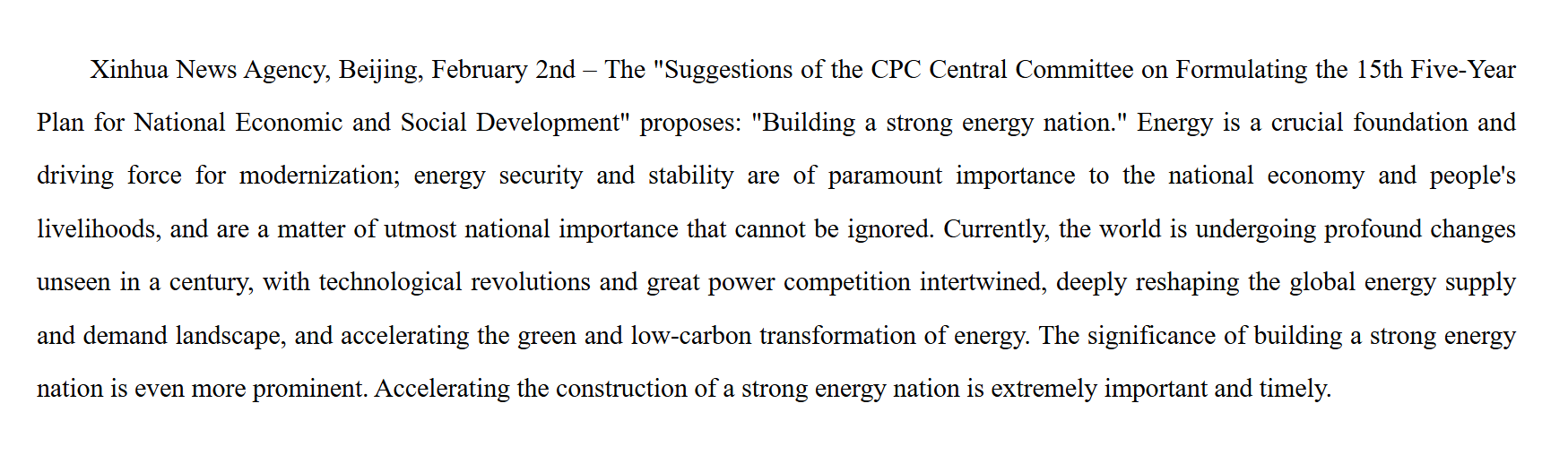
China imports more than 70% of the crude processed in its refineries and the government has identified this foreign dependence a critical issue for national security. The Communist Party’s Central Committee recently issued a call for “Building a Strong Energy Nation” as part of its formal input into drafting the Fifteenth Five-Year Plan covering the years from 2026 to 2030:
“[E]nergy security and stability are of paramount importance to the national economy and people’s livelihoods, and are a matter of utmost national importance that cannot be ignored.”
“Currently, the world is undergoing profound changes unseen in a century, with technological revolutions and great power competition intertwined, deeply reshaping the global energy supply and demand landscape.”
There is “an urgent requirement for enhancing energy security and gaining the initiative in great power competition. Currently, frequent regional conflicts exacerbate geopolitical risks, and the United States continues to contain and suppress China, making the politicization and weaponization of energy issues more prominent.”
“To prevent shocks in the energy sector and effectively guarantee domestic development, my country's energy system must improve its own development level and security capabilities.”
“Building a strong energy nation … is the only way for my country to achieve fundamental energy security,” the
X (formerly Twitter)
John Kemp (@JKempEnergy) on X
[MUST READ] "Building a strong energy nation" - formal input from the Central Committee of the Communist Party of China into the Fifteenth Five Yea...
.
OIL IN WARTIME
Throughout history, governments have accumulated stocks of critical materials as well as armaments in preparation for conflicts. Strategic

. From antiquity to the medieval period, walled cities and fortresses stockpiled water, food and fuel to help withstand a prolonged siege; defensive walls without stocks of critical supplies were an invitation to famine.
Since the First World War, which saw the first widespread use of oil for battleships and other transport, the preoccupation with stockpiling has applied to oil as well.
Modern governments have accumulated strategic reserves as well as encouraging domestic oil production and incentivising alternative fuels as to protect their economies and warfighting ability in the event of conflict.
“Petroleum will continue to be the most essential fuel of industry in both peace and war,” the U.S. Senate’s Special Committee Investigating Petroleum Resources concluded in 1947. “No nation which lacks a sure supply of liquid fuel can hope to maintain a position of leadership among the peoples of the world.”
“In time of peace a nation, to maintain a first-class rating in the trade and commerce of the modern world, must have access to an abundant supply of oil because mechanized industry and transportation depend upon it. Oil is also of basic importance for purposes other than the provision of energy. Petroleum lubricates the fleets, airplanes, and machines of the world. It is a raw material in the whole field of chemicals. It is used in the manufacture of pharmaceutical products, paints, solvents, plastics, and synthetic rubber.”
“In time of war, as twice demonstrated on a large scale in the present century, a nation, to remain a first-class Power, must have petroleum resources immediately and continuously available in virtually unlimited volume. Oil is the sine qua non of military victory.
For countries with limited production on their own territory, relying on imports, ensuring uninterrupted supplies has usually meant accumulating strategic stocks to be drawn down in the event imports are disrupted.
PRE-WAR PLANNING
Since 1928, French law has required the permanent availability of three months of oil stocks with the aim of being “energy independent in case of crisis”.
In Britain, the Royal Commission on Fuel and Engines stressed the importance of holding large stocks in reserve as early as 1913 as the Royal Navy shifted its fuel from domestically produced coal to imported petroleum.
In 1934, the Oil Board, a subcommittee of the Committee of Imperial Defence, Britain’s top military planning body, was instructed to prepare plans for a war against a European enemy with a target date of 1 January 1940.
The Oil Board recommended the Royal Navy, the Army and the Royal Air Force should each lay in stocks equivalent to six months of wartime consumption (later raised to as much as one year in the case of the Air Force).
The

Internet Archive
Oil. A Study of War-time Policy and Administration (History of the Second World War United Kingdom Civil Series) : D J Payton-Smith (Derek Joseph) : Free Download, Borrow, and Streaming : Internet Archive
Digitised by Google Books from the collection at Stanford University https://books.google.com/books?id=1yS1AAAAIAAJA volume in the series History o...
Britain’s oil companies should raise their own stocks to the equivalent of three months of peacetime consumption, a recommendation subsequently accepted by the industry.
In 1938, Britain’s Parliament approved the Essential Commodities Reserves Act, which gave the government power to obtain information about commodities vital in the event of war and make provisions for reserves.
In agreement with the Treasury, the

Essential Commodities Reserves Act 1938 - Wikipedia
or loans to traders to encourage them to hold increased stocks of essential commodities, or acquire and own them its own right.
IEA EMERGENCY STOCKS
The idea of holding oil reserves equivalent to three months of consumption or net imports has remained a benchmark incorporated into subsequent iterations of strategic reserves. In 1974, following the Arab oil embargo the previous year, the governments of the United States, Japan and Western Europe concluded an Agreement on an International Energy Program.
Each participating country committed to maintain “emergency reserves sufficient to sustain consumption for at least 60 days with no net oil imports” (later raised to 90 days or three months).
The emergency reserve requirement could be satisfied by oil stocks, fuel switching capacity, or stand-by oil production.
The agreement also created a

Cambridge Core
Agreement on an International Energy Program (IEP) - Compendium of Sustainable Energy Laws
Compendium of Sustainable Energy Laws - April 2005
and an International Energy Agency (IEA) to oversee and implement the programme.
In the United States, the agreement was given effect by the 1975 Energy Policy and Conservation Act, which established the government-owned and run Strategic Petroleum Reserve.
In the United Kingdom, it was given effect by the 1976 Energy Act, which gave the government powers to order oil suppliers or users to maintain stocks at a minimum specified level.
Similar legislation was enacted in the other participating countries – in most cases requiring oil producers, importers, distributors or users to maintain stocks at minimum levels, either themselves or by agreement with third parties.
CHINA’S ESTIMATED STOCKS
Between 2023 and 2025, China imported between 4.1 billion and 4.2 billion barrels of crude each year, according to data from the General Administration of Customs. China’s supplies are extremely vulnerable given it relies on imports mostly along sea lanes in the Middle East, Indian Ocean and South China Sea patrolled by the U.S. Navy and allies.
Policymakers have followed their western counterparts in trying to lessen the risks by building commercial and strategic reserves at tank farms near ports and refineries as well as below ground to protect them from air attack. By mid-2024, China’s total crude storage capacity at tank farms was estimated at more than 1.8 billion barrels by consultants Kayrros and shared in prepared testimony to the U.S.-China Economic and Security Review Commission.
Between 2016 and 2024, China’s observed stocks above ground had ranged between 850 million and a little over 1 billion barrels, according to Kayrros, using geospatial analysis on the roofs of floating roofs at tank farms. Above ground inventories included approximately 200 million barrels of strategic reserves at various sites. There was also below ground storage in at least four locations with the capacity to store another 100 million barrels.
China’s observed and estimated oil inventories are a combination of commercial stocks (held for operational and speculative purposes) and strategic stocks (held in readiness for any future disruption of imports). More recently, in March 2025, the country’s commercial stocks were estimated at around 670 million barrels, with a further 400 million held as strategic reserves, according to Kayrros.
The country also had underground facilities capable of holding a further 130 million barrels with an unknown fill rate.
Total inventories were estimated at between 1.1 billion and 1.2 billion barrels – equivalent to around 100 days or just over three months of imports. But the country’s above ground storage facilities were less than 60% full at the time, implying there was scope to increase stocks further.
China continued to import crude in excess of its refinery requirements throughout the rest of 2025 implying inventories had been raised even higher by the end of the year.
LACK OF TRANSPARENCY
Stockpiling can contribute to strategic stability or instability depending on point of view: it may make governments feel more secure and less prone to strike first, or embolden them to engage in more aggressive and risky behavior.
China’s policymakers have always considered the exact amount of oil held in commercial and strategic storage to be a matter of national security and a state secret. Secrecy is understandable given the country’s extreme vulnerability to any interruption of imports; there is no benefit sharing inventory levels with potential adversaries.
But the lack of transparency has fueled suspicions about the country’s intentions and whether stockpiling is defensive in nature or indicates a more aggressive preparation for war.
“China’s outsized oil storage expansion … has profound strategic implications,” one analyst
https://www.bakerinstitute.org/sites/default/files/2024-06/Tes-Collins-Energy-Stockpiling-062024_0.pdf
, because it can “dramatically enhance China’s ability to weather an oil blockade.”
There is also ambiguity about the distribution and management of commercial compared with strategic stocks. China’s oil inventories are much less transparent than those of the United States and other IEA members, but the stockholding arrangements themselves are not that unusual.
“Nine clearly demarcated SPR bases exist, but often sit adjacent to far larger commercial tank capacity. The stocks share
https://www.bakerinstitute.org/sites/default/files/2024-06/Tes-Collins-Energy-Stockpiling-062024_0.pdf
.”
The somewhat ambiguous relationship between commercial and strategic inventories is not that unusual. Nor is co-location and sharing pipelines and refineries. Crude oil is not useful without access to refineries and pipelines for long-distance transmission and distribution so sharing infrastructure makes sense.
IEA members themselves employ a variety of models for maintaining strategic reserves - owned and run by the government itself, by industry, or by specialised stockholding agencies and third parties. The purpose of strategic stocks has always been somewhat ambiguous and has become more so over time as policymakers have sought to use them more actively.
Most IEA members hold stocks to deal with military and economic emergencies - outright supply interruptions as well as sudden spikes in prices. It is not always easy to distinguish between them.
GLOBAL MARKET IMPACT
China is the world’s second-largest oil consumer (after the United States) and by far the world’s largest crude importer, so the country’s consumption and inventories have a significant impact on global balances. Lack of transparency about the size of inventories, their purpose, and future trends has become a major source of uncertainty for the oil industry.
There is some evidence purchases by China’s refiners and possibly its stockpile managers have been sensitive to prices – with imports accelerating when prices have been relatively low. But this has been based on empirical observations of the rate of imports rather than a firm understanding of inventory management policies.
China’s rapid imports in 2025 absorbed some of the surplus oil production as Saudi Arabia and its OPEC⁺ partners boosted output rapidly in the face of tepid global consumption.
China’s inventory building has been described as “a secondary source of oil demand” by the U.S.

EIA forecasts lower oil prices in 2026 and 2027 due to persistent stock builds - U.S. Energy Information Administration (EIA)
Energy Information Administration - EIA - Official Energy Statistics from the U.S. Government
(EIA). By absorbing some excess production and removing it from the open market, at least for now, stockpiling probably prevented a much faster and deeper decline in prices, especially in the spot market.
China’s inventory accumulation may have helped stabilize prices, informally and unintentionally making the country a market adjuster or buffer stock manager. But the scale and timing of future changes in both commercial and strategic inventories remain unknown and difficult to forecast.
If purchases for inventory are sensitive to prices, China might accelerate them if prices decline further (subject to logistics constraints) or taper them if prices rise. Price-sensitive purchasing policies would help dampen volatility again.
The
Short-Term Energy Outlook - U.S. Energy Information Administration (EIA)
Energy Information Administration - EIA - Official Energy Statistics from the U.S. Government
: “We assume that China will continue building strategic stockpiles at nearly the same rate of about 1.0 million b/d in 2026, before reducing strategic builds in 2027.”
But given the lack of transparency around the stockpiles, it is impossible to forecast purchasing behaviour with a high degree of confidence.
Other than in time of war, the conditions under which China might release oil from commercial and especially strategic stocks are also obscure.
China has a long tradition of actively employing state-owned reserves of food to manage prices and dampen fluctuations as well as relieving outright shortages. More recently, strategic reserve managers have purchased materials including aluminium and copper to support domestic producers and prices in periods of excess supply, before releasing them later when prices have risen.
But the conditions (if any) under which China would release oil from strategic stocks in response to high prices and shortages other than in a conflict remain unknown.
CONCLUDING OBSERVATIONS
China’s reliance on imported crude most of it arriving along sea lanes patrolled by the U.S. Navy and its allies has been identified by the government as one of the top threats to national security. China’s economy and its warfighting ability would both be vulnerable to sanctions or an embargo in the event of a future conflict with the United States over Taiwan.
Like other import-dependent countries, China’s government has responded by accumulating strategic inventories, as well as encouraging greater fuel efficiency, oil substitutes and more domestic production.
China’s inventories are still rising, but are currently equivalent to slightly more than three months of net imports, which is comparable to stocks planned by other import-dependent countries over the last century.
China treats inventory levels as a national security matter and a state secret, which is understandable given the country’s extreme vulnerability. But the lack of transparency encourages suspicion and speculation about the country’s military planning for future conflicts.
Lack of transparency has also become the single most important source of uncertainty in forecasting future production, consumption, inventory and price balances in the global oil market.
Tyler Durden | Zero Hedge
Zero Hedge
Tue, 02/17/2026 - 17:25
China's Unprecedented Oil Stockpiling Sparks Questions If Beijing Is Preparing For War | ZeroHedge
ZeroHedge - On a long enough timeline, the survival rate for everyone drops to zero

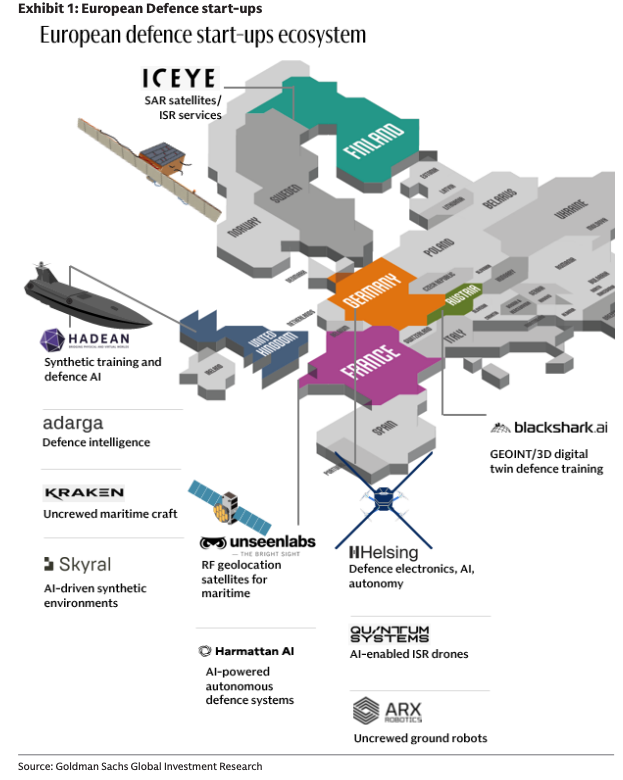
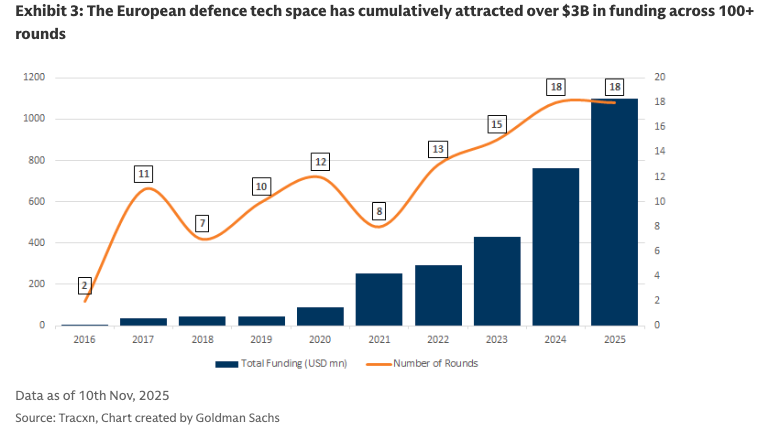 He said these startups are clustered around major innovation hubs in London, Munich, Stockholm, Paris, and Helsinki, backed by early-stage investors and public programs, including the NATO Innovation Fund and the EIF Defense Equity Facility.
Here's a visual breakdown of the EU defense startups ecosystem:
He said these startups are clustered around major innovation hubs in London, Munich, Stockholm, Paris, and Helsinki, backed by early-stage investors and public programs, including the NATO Innovation Fund and the EIF Defense Equity Facility.
Here's a visual breakdown of the EU defense startups ecosystem:
 "Recent conflicts, particularly the war in Ukraine, have underscored the need for rapid technological iteration, multi-domain integration, and a digitally enabled battlefield," Burgess said.
Burgess' note is exactly on point and follows our view of the rise of war unicorn startups as big defense primes face an "adapt or die" moment, as the war in Ukraine and a surge in dual-use technologies (drones, ground bots, and AI kill chains) have pushed Secretary of War Pete Hegseth to recently announce a move to accelerate the fielding of this new technology.
Translation: The DoW under Hegseth and the rest of the procurement process are moving away from bloated legacy defense primes toward defense tech startups, creating a boom as we've characterized by the rise of war unicorns like Palmer Luckey's Anduril Industries.
The shift away from big defense primes in the DoW's procurement process comes as the war in Ukraine has given military planners and strategists an uncomfortable preview of what conflict in the 2030s could look like. It's not just about expensive stealth jets, bombers, and big, fancy missiles and cannons. It's about ground robots, drones, and consumer-grade products that can easily be weaponized.
portal.
Wed, 02/18/2026 - 05:45
"Recent conflicts, particularly the war in Ukraine, have underscored the need for rapid technological iteration, multi-domain integration, and a digitally enabled battlefield," Burgess said.
Burgess' note is exactly on point and follows our view of the rise of war unicorn startups as big defense primes face an "adapt or die" moment, as the war in Ukraine and a surge in dual-use technologies (drones, ground bots, and AI kill chains) have pushed Secretary of War Pete Hegseth to recently announce a move to accelerate the fielding of this new technology.
Translation: The DoW under Hegseth and the rest of the procurement process are moving away from bloated legacy defense primes toward defense tech startups, creating a boom as we've characterized by the rise of war unicorns like Palmer Luckey's Anduril Industries.
The shift away from big defense primes in the DoW's procurement process comes as the war in Ukraine has given military planners and strategists an uncomfortable preview of what conflict in the 2030s could look like. It's not just about expensive stealth jets, bombers, and big, fancy missiles and cannons. It's about ground robots, drones, and consumer-grade products that can easily be weaponized.
portal.
Wed, 02/18/2026 - 05:45
 The diplomat's words were captured in an interview with Russian newspaper Izvestia on Tuesday. Kelin
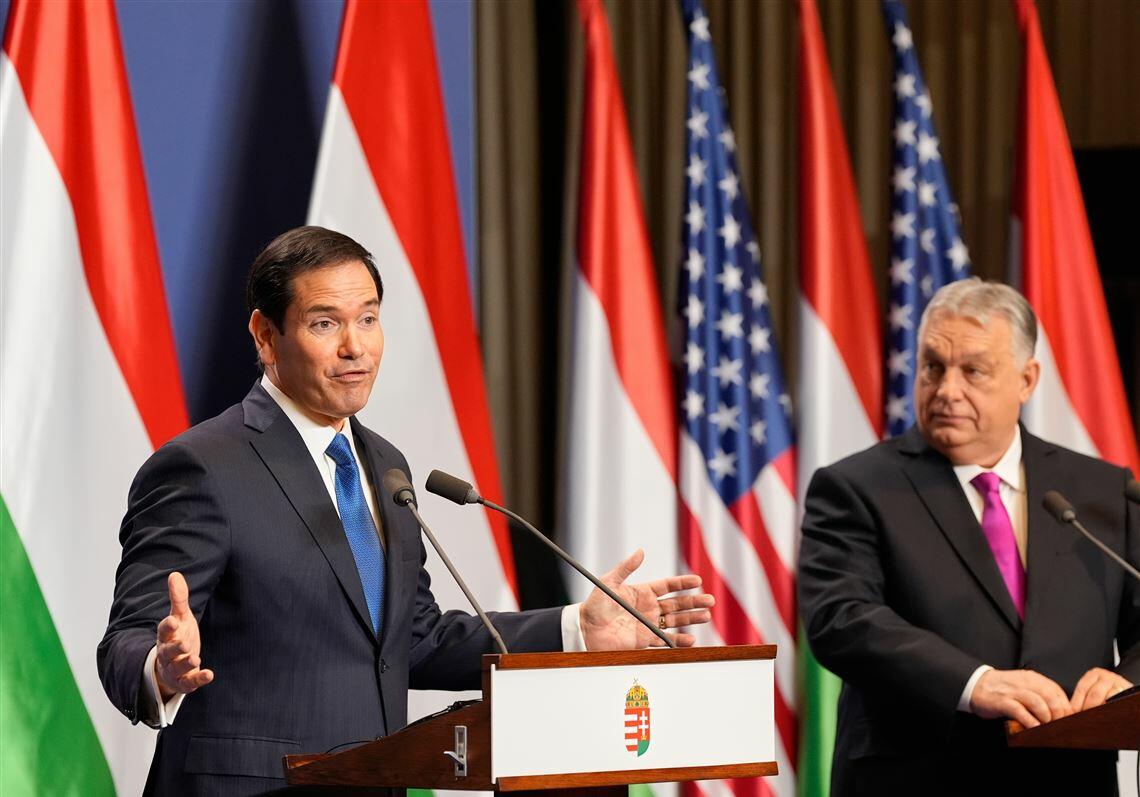 "I think it has been incredibly beneficial to the relationship between our two countries, and it’s important to understand how important the relations between leaders are to the relations between countries." He continued, "President Trump is deeply committed to your success."
While Orbán has a strong relationship with President Donald Trump, he has been a roadblock to European leaders' efforts to increase Western support for Ukraine. Hungary has used its position in NATO and the EU to slow or limit aid to Ukraine and the economic war against Russia.
Some EU members were attempting to use frozen Russian assets as collateral for a massive loan to Ukraine. Orbán was key to preventing the EU from moving forward with the loan.
Budapest has repeatedly expressed displeasure with Kiev over Ukraine's disabling of the Russian pipeline that carries oil to Hungary. Hungary is now requesting that Croatia allow Russian oil transit to bypass Ukraine.
President Donald Trump has been willing to use his leverage to influence elections around the globe. In Argentina, he conditions a $20 billion assistance package on President Javier Milei’s party winning elections. The President has also voiced strong support or opposition to candidates in Honduras and Iraq.
Rubio told Orbán that Hungary could receive similar support as Argentina.
2019: Senator Rubio and others expressed concerns about Hungary's "democratic erosion" and urged the Trump administration to address issues like the rule of law, media freedom, and corruption during meeting with Orbán.
2026: Secretary Rubio endorsed Orbán.
"I think it has been incredibly beneficial to the relationship between our two countries, and it’s important to understand how important the relations between leaders are to the relations between countries." He continued, "President Trump is deeply committed to your success."
While Orbán has a strong relationship with President Donald Trump, he has been a roadblock to European leaders' efforts to increase Western support for Ukraine. Hungary has used its position in NATO and the EU to slow or limit aid to Ukraine and the economic war against Russia.
Some EU members were attempting to use frozen Russian assets as collateral for a massive loan to Ukraine. Orbán was key to preventing the EU from moving forward with the loan.
Budapest has repeatedly expressed displeasure with Kiev over Ukraine's disabling of the Russian pipeline that carries oil to Hungary. Hungary is now requesting that Croatia allow Russian oil transit to bypass Ukraine.
President Donald Trump has been willing to use his leverage to influence elections around the globe. In Argentina, he conditions a $20 billion assistance package on President Javier Milei’s party winning elections. The President has also voiced strong support or opposition to candidates in Honduras and Iraq.
Rubio told Orbán that Hungary could receive similar support as Argentina.
2019: Senator Rubio and others expressed concerns about Hungary's "democratic erosion" and urged the Trump administration to address issues like the rule of law, media freedom, and corruption during meeting with Orbán.
2026: Secretary Rubio endorsed Orbán. 
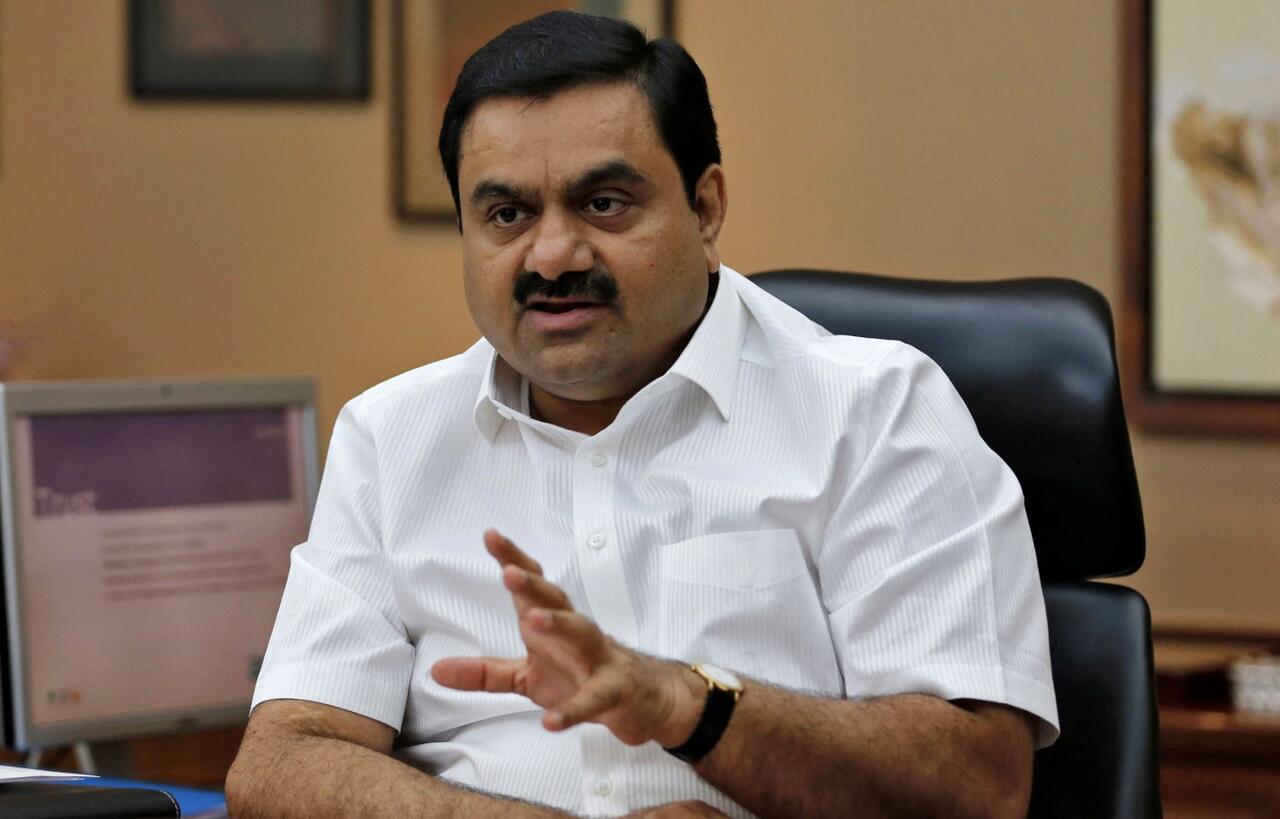 Both men have surfaced in past Indian investigations into alleged Adani misconduct — cases that were ultimately dropped. A 2007 diamond-trading probe and a 2014 over-invoicing inquiry connected them to companies tied to Vinod Adani, the chairman’s brother. Vinod was at the heart of many Hindenburg allegations, with the firm questioning his management of overseas shell companies and alleging financial improprieties relating to potential manipulation of Adani shares.
Hindenburg also identified Chang as linked to a disclosed “related party.” Earlier reporting cited evidence that their trades were coordinated with Adani-linked entities.
OCCRP
Both men have surfaced in past Indian investigations into alleged Adani misconduct — cases that were ultimately dropped. A 2007 diamond-trading probe and a 2014 over-invoicing inquiry connected them to companies tied to Vinod Adani, the chairman’s brother. Vinod was at the heart of many Hindenburg allegations, with the firm questioning his management of overseas shell companies and alleging financial improprieties relating to potential manipulation of Adani shares.
Hindenburg also identified Chang as linked to a disclosed “related party.” Earlier reporting cited evidence that their trades were coordinated with Adani-linked entities.
OCCRP 



 The probe, announced on Feb. 16 by the European Commission, marks the bloc’s first formal proceeding against the company under the Digital Services Act (DSA), a set of sweeping online regulations that governs nearly all corners of the digital ecosystem, from e-commerce platforms to social media networks.
Brussels
The probe, announced on Feb. 16 by the European Commission, marks the bloc’s first formal proceeding against the company under the Digital Services Act (DSA), a set of sweeping online regulations that governs nearly all corners of the digital ecosystem, from e-commerce platforms to social media networks.
Brussels 

 Another focus of the inquiry will be the alleged “lack of transparency” around the algorithms Shein uses to recommend content and products to users. Under the DSA, “very large platforms,” defined as those with over 45 million users in the EU, must disclose the main parameters of their recommender systems and offer at least one easily accessible option that is not based on profiling.
A spokesperson for Shein said the company takes its “obligations under the DSA seriously” and will cooperate with investigators.
“Over the last few months, we have continued to invest significantly in measures to strengthen our compliance with the DSA. These include comprehensive systemic-risk assessments and mitigation frameworks, enhanced protections for younger users, and ongoing work to design our services in ways that promote a safe and trusted user experience,” the spokesperson said in a statement to The Epoch Times.
The investigation is the latest in a series of actions the EU has taken that affect Chinese-owned tech and e-commerce firms.
From July 1, 2026, Brussels will begin collecting a flat 3-euro (about $3.55) charge on each low-value item in small parcels worth under 150 euros (about $178) sent directly from non-EU countries to consumers in the bloc, a measure widely seen as aimed at platforms such as Shein, Temu, and AliExpress. According to
Another focus of the inquiry will be the alleged “lack of transparency” around the algorithms Shein uses to recommend content and products to users. Under the DSA, “very large platforms,” defined as those with over 45 million users in the EU, must disclose the main parameters of their recommender systems and offer at least one easily accessible option that is not based on profiling.
A spokesperson for Shein said the company takes its “obligations under the DSA seriously” and will cooperate with investigators.
“Over the last few months, we have continued to invest significantly in measures to strengthen our compliance with the DSA. These include comprehensive systemic-risk assessments and mitigation frameworks, enhanced protections for younger users, and ongoing work to design our services in ways that promote a safe and trusted user experience,” the spokesperson said in a statement to The Epoch Times.
The investigation is the latest in a series of actions the EU has taken that affect Chinese-owned tech and e-commerce firms.
From July 1, 2026, Brussels will begin collecting a flat 3-euro (about $3.55) charge on each low-value item in small parcels worth under 150 euros (about $178) sent directly from non-EU countries to consumers in the bloc, a measure widely seen as aimed at platforms such as Shein, Temu, and AliExpress. According to 

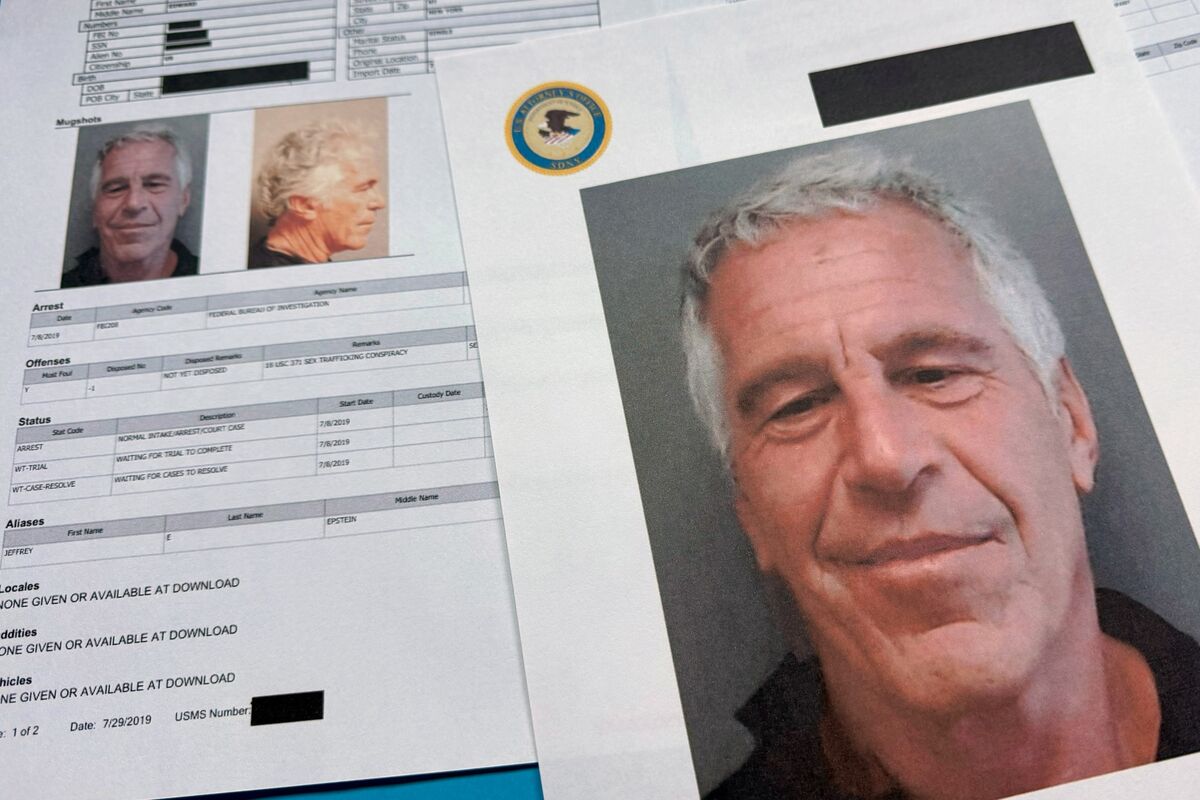
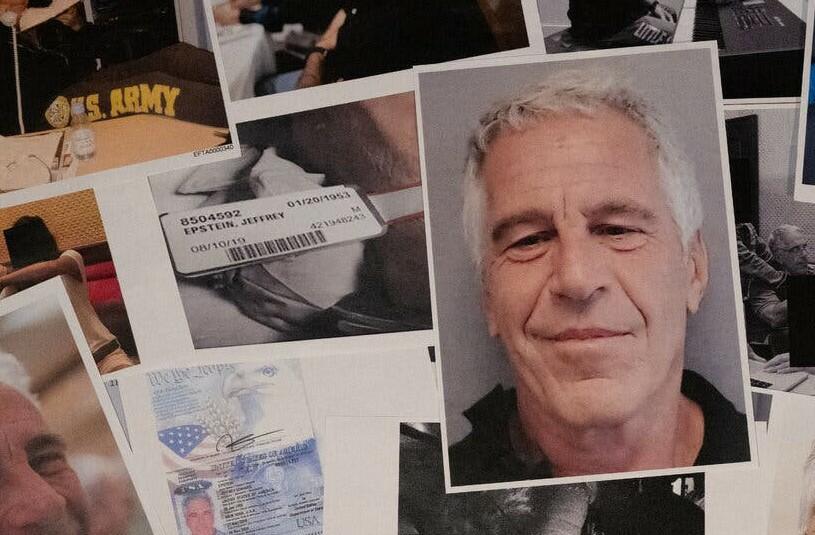 Files released by the Department of Justice show Epstein and Brende had three dinners in 2018 and 2019, and exchanged various text messages. One dinner occurred in September 2018, more than a decade after Epstein's 2008 conviction and guilty plea in Florida for procuring a child for prostitution, and another on June 13, 2019, shortly before Epstein's final arrest on federal sex-trafficking charges.
Like many powerful figures, Brende has claimed that he was unaware of Epstein's criminal history at the time of their meetings, and is said to have ordered the probe into his communications with Epstein.
"I was completely unaware of Epstein’s past and criminal activities," Brende said in a statement to Bloomberg. "Had I known about his background, I would have declined the initial invitation and any subsequent dinner invitations or other communications.”
"I recognize that I could have conducted a more thorough investigation into Epstein’s history, and I regret not doing so,” he added.
Klaus Schwab, who founded the WEF in 1971, has maintained that he is “certain” that he never met with Epstein, a press representative told
Files released by the Department of Justice show Epstein and Brende had three dinners in 2018 and 2019, and exchanged various text messages. One dinner occurred in September 2018, more than a decade after Epstein's 2008 conviction and guilty plea in Florida for procuring a child for prostitution, and another on June 13, 2019, shortly before Epstein's final arrest on federal sex-trafficking charges.
Like many powerful figures, Brende has claimed that he was unaware of Epstein's criminal history at the time of their meetings, and is said to have ordered the probe into his communications with Epstein.
"I was completely unaware of Epstein’s past and criminal activities," Brende said in a statement to Bloomberg. "Had I known about his background, I would have declined the initial invitation and any subsequent dinner invitations or other communications.”
"I recognize that I could have conducted a more thorough investigation into Epstein’s history, and I regret not doing so,” he added.
Klaus Schwab, who founded the WEF in 1971, has maintained that he is “certain” that he never met with Epstein, a press representative told 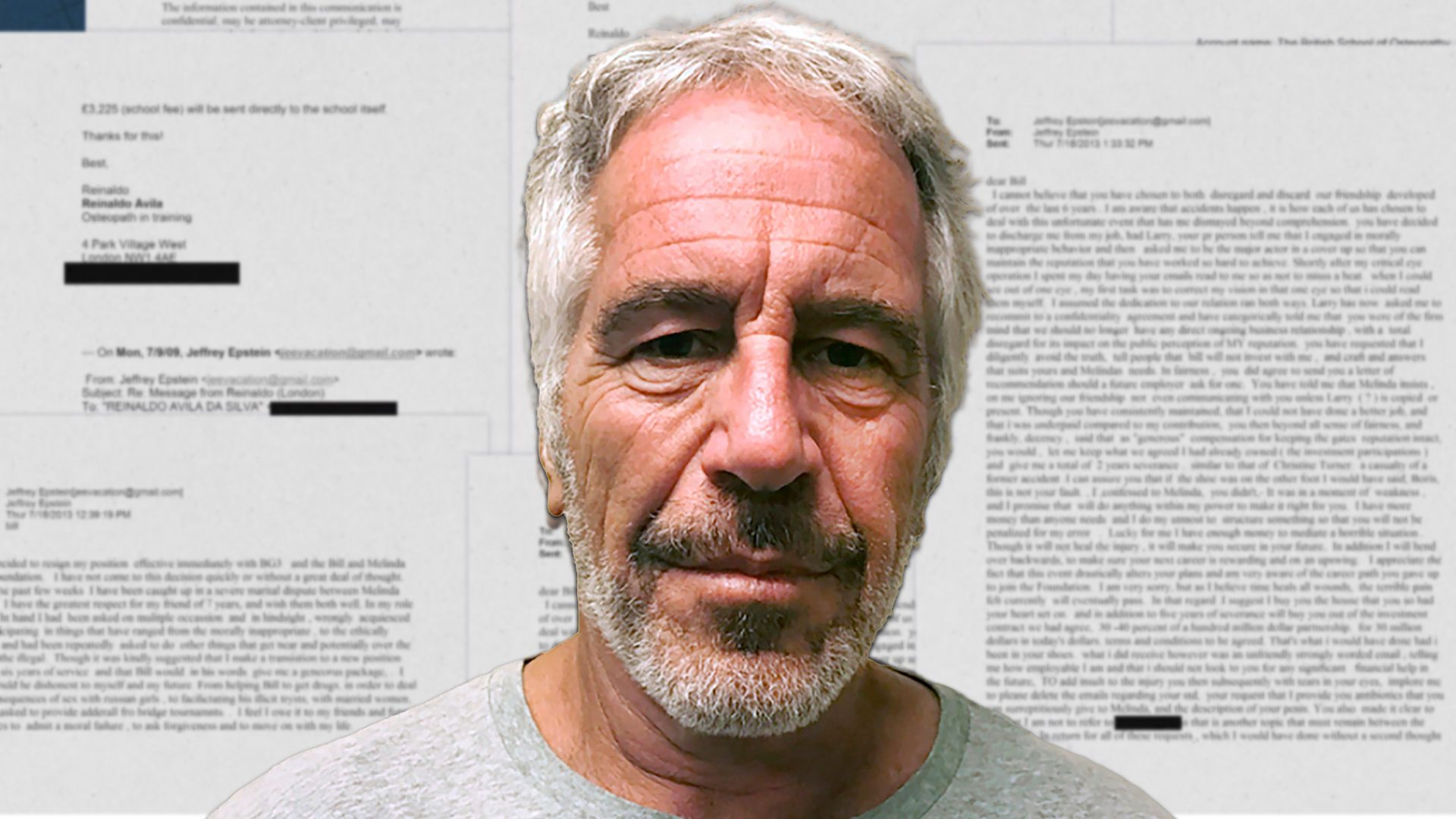

 Worden had alleged in July 2019 that her estranged spouse guessed her password and illegally viewed her account while stationed aboard the International Space Station. Court evidence later established the accusation was unfounded. Records showed Worden opened the account in April 2018 and that both women used it until January 2019, when she changed the login information. Investigators determined she had shared access to her banking details, including credentials, as early as 2015.
KBTX
Worden had alleged in July 2019 that her estranged spouse guessed her password and illegally viewed her account while stationed aboard the International Space Station. Court evidence later established the accusation was unfounded. Records showed Worden opened the account in April 2018 and that both women used it until January 2019, when she changed the login information. Investigators determined she had shared access to her banking details, including credentials, as early as 2015.
KBTX 
 Yet despite the severity and duration of the storm, the national electric grid largely held. Hospitals remained open. Emergency services stayed online. Most homes stayed warm. That outcome was not accidental. It was the result of dependable, dispatchable generation—chief among it, coal.
During the coldest days of the storm, coal-fired generation across the Lower 48 surged, rising from roughly 70 gigawatt-hours per day to approximately 130. That additional generation represented a massive increase in available power at precisely the moment when electric heating demand spiked and system margins tightened. In practical terms, coal generation helped keep power flowing to tens of millions of households nationwide, sustaining heat and essential services during the most extreme conditions of Winter Storm Fern.
Coal plants responded exactly as they are designed to do: steadily, predictably, and at scale. In the Midcontinent Independent System Operator (MISO) region, coal supplied as much as 40% of electricity during peak hours. In PJM, coal accounted for roughly one-quarter of total generation. These were not marginal contributions—they were foundational to grid stability.
The contrast with weather-dependent resources was unmistakable. Wind generation declined as turbines iced over or were curtailed for safety. Solar output fell sharply as panels were covered by snow and daylight hours shortened. Hydropower faced limitations from frozen waterways and constrained inflows. Each of these resources plays a role in the broader energy mix, but Winter Storm Fern underscored their limitations during prolonged, widespread cold.
Coal’s advantage in these moments is straightforward: on-site fuel. Stockpiled coal insulated power plants from supply chain disruptions at precisely the moment when other fuels faced constraints. This is not a theoretical benefit. It is a practical one that has been demonstrated repeatedly during extreme weather events.
That lesson should sound familiar. After Winter Storm Uri in 2021, coal was often blamed for grid failures. Subsequent analyses showed the most significant disruptions stemmed from widespread natural gas system freeze-offs—not coal plant performance. In the years since, coal facilities invested in winterization, fuel access, and operational readiness. During Winter Storm Fern, those preparations paid off.
Federal policymakers recognized this reality in real time. The U.S. Department of Energy issued emergency orders under Section 202(c) of the Federal Power Act, temporarily allowing certain coal units to operate at higher output to maintain grid stability. Similar actions in 2025 prevented the premature retirement of coal plants in Colorado, Indiana, Washington, and Michigan—preserving more than 17 gigawatts of firm coal capacity that otherwise faced near-term shutdown.
These decisions were not ideological. They were driven by reliability.
Warnings from grid authorities reinforce the point. The Department of Energy and the North American Electric Reliability Corporation have both cautioned that continued coal retirements—without equivalent replacement by firm, dispatchable resources—increase the risk of outages, particularly during extreme winter conditions. At the same time, electricity demand is rising rapidly due to data centers, electrification, and industrial growth. The margin for error is shrinking.
Coal is not static. Modern coal plants operate with advanced emissions controls, improved efficiency, and increasingly sophisticated monitoring. Mining practices have evolved, and research into carbon management and advanced coal technologies continues. Coal also remains essential for steelmaking and other industrial uses, making domestic production a matter of economic and strategic importance.
Affordability matters as much as reliability. Regions that retired coal prematurely have often experienced higher electricity prices and greater exposure to fuel volatility. Coal’s stable fuel costs and on-site inventory provide a measure of price certainty that consumers increasingly lack—especially during weather emergencies, when energy costs hit household budgets the hardest.
Winter Storm Fern delivered a clear message. When the grid was under maximum stress, coal did not merely contribute—it carried a substantial share of the load. A resilient energy strategy does not eliminate reliable resources before dependable replacements are ready. It builds a diversified generation portfolio that includes coal, natural gas, nuclear, and emerging technologies, each performing the role it does best.
America’s energy future depends on reliability first. During one of the harshest winter tests in recent years, coal proved once again that it remains an essential part of keeping the lights on—and the heat running.
Emily Arthun is current CEO of the American Coal Council, she brings over twenty years of experience across the coal and hard-rock mining sectors Prior to her role at ACC, she worked with the Women’s Mining Coalition, supporting advocacy for domestic mining. Her industry experience includes Stillwater Mining Company and Cloud Peak Energy. She serves on the Washington Coal Club and Women’s Mining Coalition boards.
Yet despite the severity and duration of the storm, the national electric grid largely held. Hospitals remained open. Emergency services stayed online. Most homes stayed warm. That outcome was not accidental. It was the result of dependable, dispatchable generation—chief among it, coal.
During the coldest days of the storm, coal-fired generation across the Lower 48 surged, rising from roughly 70 gigawatt-hours per day to approximately 130. That additional generation represented a massive increase in available power at precisely the moment when electric heating demand spiked and system margins tightened. In practical terms, coal generation helped keep power flowing to tens of millions of households nationwide, sustaining heat and essential services during the most extreme conditions of Winter Storm Fern.
Coal plants responded exactly as they are designed to do: steadily, predictably, and at scale. In the Midcontinent Independent System Operator (MISO) region, coal supplied as much as 40% of electricity during peak hours. In PJM, coal accounted for roughly one-quarter of total generation. These were not marginal contributions—they were foundational to grid stability.
The contrast with weather-dependent resources was unmistakable. Wind generation declined as turbines iced over or were curtailed for safety. Solar output fell sharply as panels were covered by snow and daylight hours shortened. Hydropower faced limitations from frozen waterways and constrained inflows. Each of these resources plays a role in the broader energy mix, but Winter Storm Fern underscored their limitations during prolonged, widespread cold.
Coal’s advantage in these moments is straightforward: on-site fuel. Stockpiled coal insulated power plants from supply chain disruptions at precisely the moment when other fuels faced constraints. This is not a theoretical benefit. It is a practical one that has been demonstrated repeatedly during extreme weather events.
That lesson should sound familiar. After Winter Storm Uri in 2021, coal was often blamed for grid failures. Subsequent analyses showed the most significant disruptions stemmed from widespread natural gas system freeze-offs—not coal plant performance. In the years since, coal facilities invested in winterization, fuel access, and operational readiness. During Winter Storm Fern, those preparations paid off.
Federal policymakers recognized this reality in real time. The U.S. Department of Energy issued emergency orders under Section 202(c) of the Federal Power Act, temporarily allowing certain coal units to operate at higher output to maintain grid stability. Similar actions in 2025 prevented the premature retirement of coal plants in Colorado, Indiana, Washington, and Michigan—preserving more than 17 gigawatts of firm coal capacity that otherwise faced near-term shutdown.
These decisions were not ideological. They were driven by reliability.
Warnings from grid authorities reinforce the point. The Department of Energy and the North American Electric Reliability Corporation have both cautioned that continued coal retirements—without equivalent replacement by firm, dispatchable resources—increase the risk of outages, particularly during extreme winter conditions. At the same time, electricity demand is rising rapidly due to data centers, electrification, and industrial growth. The margin for error is shrinking.
Coal is not static. Modern coal plants operate with advanced emissions controls, improved efficiency, and increasingly sophisticated monitoring. Mining practices have evolved, and research into carbon management and advanced coal technologies continues. Coal also remains essential for steelmaking and other industrial uses, making domestic production a matter of economic and strategic importance.
Affordability matters as much as reliability. Regions that retired coal prematurely have often experienced higher electricity prices and greater exposure to fuel volatility. Coal’s stable fuel costs and on-site inventory provide a measure of price certainty that consumers increasingly lack—especially during weather emergencies, when energy costs hit household budgets the hardest.
Winter Storm Fern delivered a clear message. When the grid was under maximum stress, coal did not merely contribute—it carried a substantial share of the load. A resilient energy strategy does not eliminate reliable resources before dependable replacements are ready. It builds a diversified generation portfolio that includes coal, natural gas, nuclear, and emerging technologies, each performing the role it does best.
America’s energy future depends on reliability first. During one of the harshest winter tests in recent years, coal proved once again that it remains an essential part of keeping the lights on—and the heat running.
Emily Arthun is current CEO of the American Coal Council, she brings over twenty years of experience across the coal and hard-rock mining sectors Prior to her role at ACC, she worked with the Women’s Mining Coalition, supporting advocacy for domestic mining. Her industry experience includes Stillwater Mining Company and Cloud Peak Energy. She serves on the Washington Coal Club and Women’s Mining Coalition boards.
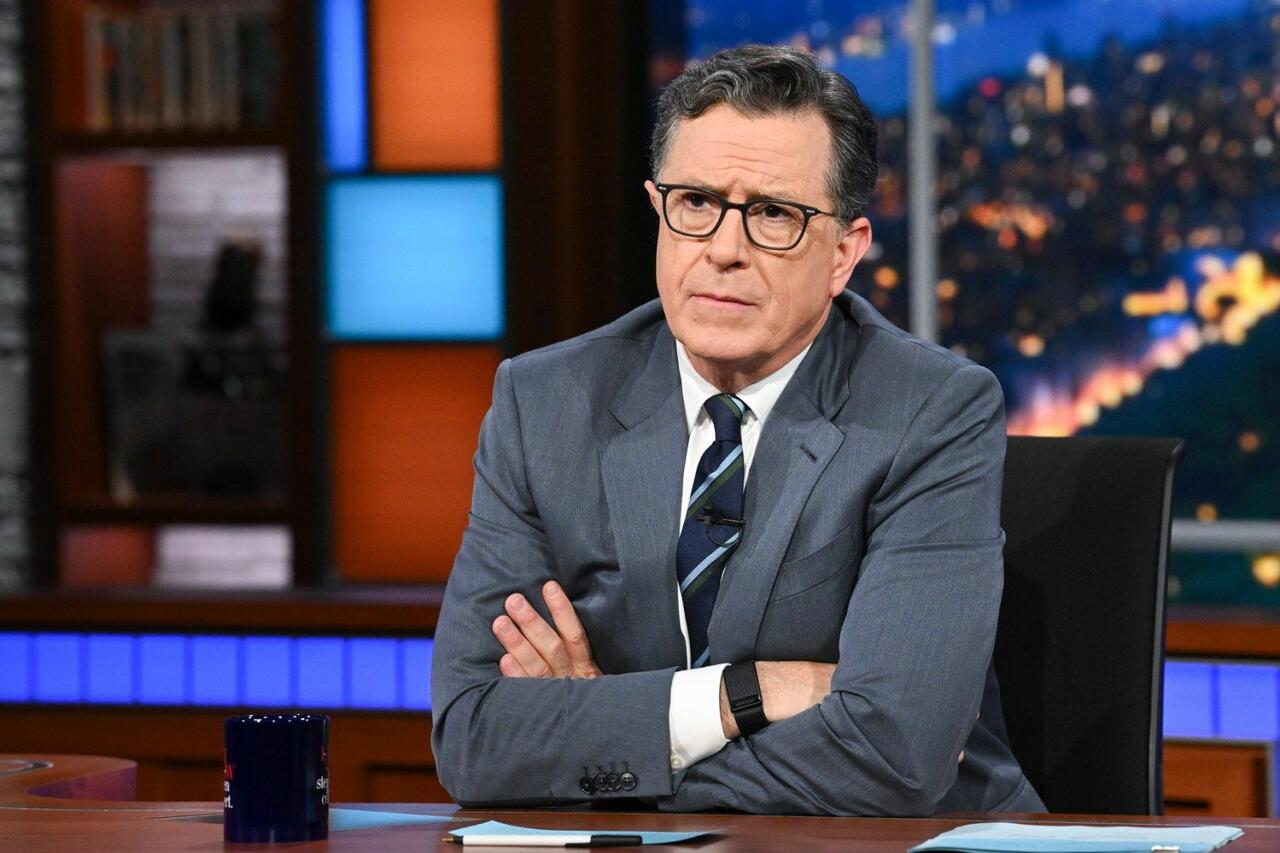 Colbert told his audience that Talarico was "supposed to be here,” but CBS lawyers informed the production team "in no uncertain terms…that we could not have him on the broadcast." The network also instructed Colbert not to mention the situation on air, an instruction he promptly ignored with theatrical defiance.
"Because my network clearly doesn't want us to talk about this, let's talk about this," Colbert announced before launching into his grievance session.
The FCC's equal time rule requires broadcast networks to provide equal airtime to opposing political candidates. According to the Philadelphia Enquirer, the FCC hasn’t applied the rule to late-night television
Colbert told his audience that Talarico was "supposed to be here,” but CBS lawyers informed the production team "in no uncertain terms…that we could not have him on the broadcast." The network also instructed Colbert not to mention the situation on air, an instruction he promptly ignored with theatrical defiance.
"Because my network clearly doesn't want us to talk about this, let's talk about this," Colbert announced before launching into his grievance session.
The FCC's equal time rule requires broadcast networks to provide equal airtime to opposing political candidates. According to the Philadelphia Enquirer, the FCC hasn’t applied the rule to late-night television 



 The Salvadoran national’s case attracted attention across the country, including widespread protests, after the federal government



 The first round of the Presidential 1776 Award takes place online the week of Feb. 22–28, according to the program website. In the second round, winners from each state advance to one of five regional semifinals in May. Round three, the national finals, are planned for late June in Washington, just ahead of America’s semi-quincentennial.
“What better way to get our students excited about learning more of our nation’s deep and rich history than a friendly competition meant to challenge high schoolers to show off their knowledge of our great nation’s founding ideals?” Education Secretary Linda McMahon said in a news release.
“As we prepare to celebrate America’s 250th birthday, this competition is an opportunity for young people to push themselves, learn our history, and take pride in the principles that unite us. Game on!”
The James Madison Memorial Fellowship Foundation will provide the scholarship money.
The foundation’s Executive Secretary and CEO Julie Adams said the aim of this program extends far beyond just recognizing and awarding three top students.
“The knowledge of American civics and history is vital to the survival of the Republic,” she said in a news release. “We agree with our namesake James Madison, who wrote in 1822, ‘Knowledge will forever govern ignorance.’”
Teacher-scholars from the foundation wrote “challenging but fair questions” for the young competitors, Adams said.
The upcoming qualifying round, the “Impossible Civics Test,” is an electronically proctored multiple-choice online exam. Students will have 90 minutes to answer up to 4,000 questions on U.S. history across three 30-minute sections of increasing difficulty.
Top-performing students from every state who advance to the second round will engage in a short-answer verbal competition held in five regional locations simultaneously across the country. The top four students from each region will advance to the finals.
The championship in the nation’s capital is a short-answer verbal competition. The finalists get one point for each correct answer. The three winners will receive scholarships totaling $250,000.
The program
The first round of the Presidential 1776 Award takes place online the week of Feb. 22–28, according to the program website. In the second round, winners from each state advance to one of five regional semifinals in May. Round three, the national finals, are planned for late June in Washington, just ahead of America’s semi-quincentennial.
“What better way to get our students excited about learning more of our nation’s deep and rich history than a friendly competition meant to challenge high schoolers to show off their knowledge of our great nation’s founding ideals?” Education Secretary Linda McMahon said in a news release.
“As we prepare to celebrate America’s 250th birthday, this competition is an opportunity for young people to push themselves, learn our history, and take pride in the principles that unite us. Game on!”
The James Madison Memorial Fellowship Foundation will provide the scholarship money.
The foundation’s Executive Secretary and CEO Julie Adams said the aim of this program extends far beyond just recognizing and awarding three top students.
“The knowledge of American civics and history is vital to the survival of the Republic,” she said in a news release. “We agree with our namesake James Madison, who wrote in 1822, ‘Knowledge will forever govern ignorance.’”
Teacher-scholars from the foundation wrote “challenging but fair questions” for the young competitors, Adams said.
The upcoming qualifying round, the “Impossible Civics Test,” is an electronically proctored multiple-choice online exam. Students will have 90 minutes to answer up to 4,000 questions on U.S. history across three 30-minute sections of increasing difficulty.
Top-performing students from every state who advance to the second round will engage in a short-answer verbal competition held in five regional locations simultaneously across the country. The top four students from each region will advance to the finals.
The championship in the nation’s capital is a short-answer verbal competition. The finalists get one point for each correct answer. The three winners will receive scholarships totaling $250,000.
The program 

 The military statements said the three boats were allegedly "operated by Designated Terrorist Organizations." The post further referred to those killed as "male narco-terrorists," detailing that eight were killed on two boats in the eastern Pacific - or the Western side of Latin America - and three were killed on a boat in the Caribbean.
No American forces were harmed, the post said, in the assault conducted at the direction of Marine Corps Gen. Francis Donovan, who serves as the commander of Southern Command.
War (Defense) Secretary Pete Hegseth celebrated the fresh strikes in a post
The military statements said the three boats were allegedly "operated by Designated Terrorist Organizations." The post further referred to those killed as "male narco-terrorists," detailing that eight were killed on two boats in the eastern Pacific - or the Western side of Latin America - and three were killed on a boat in the Caribbean.
No American forces were harmed, the post said, in the assault conducted at the direction of Marine Corps Gen. Francis Donovan, who serves as the commander of Southern Command.
War (Defense) Secretary Pete Hegseth celebrated the fresh strikes in a post 
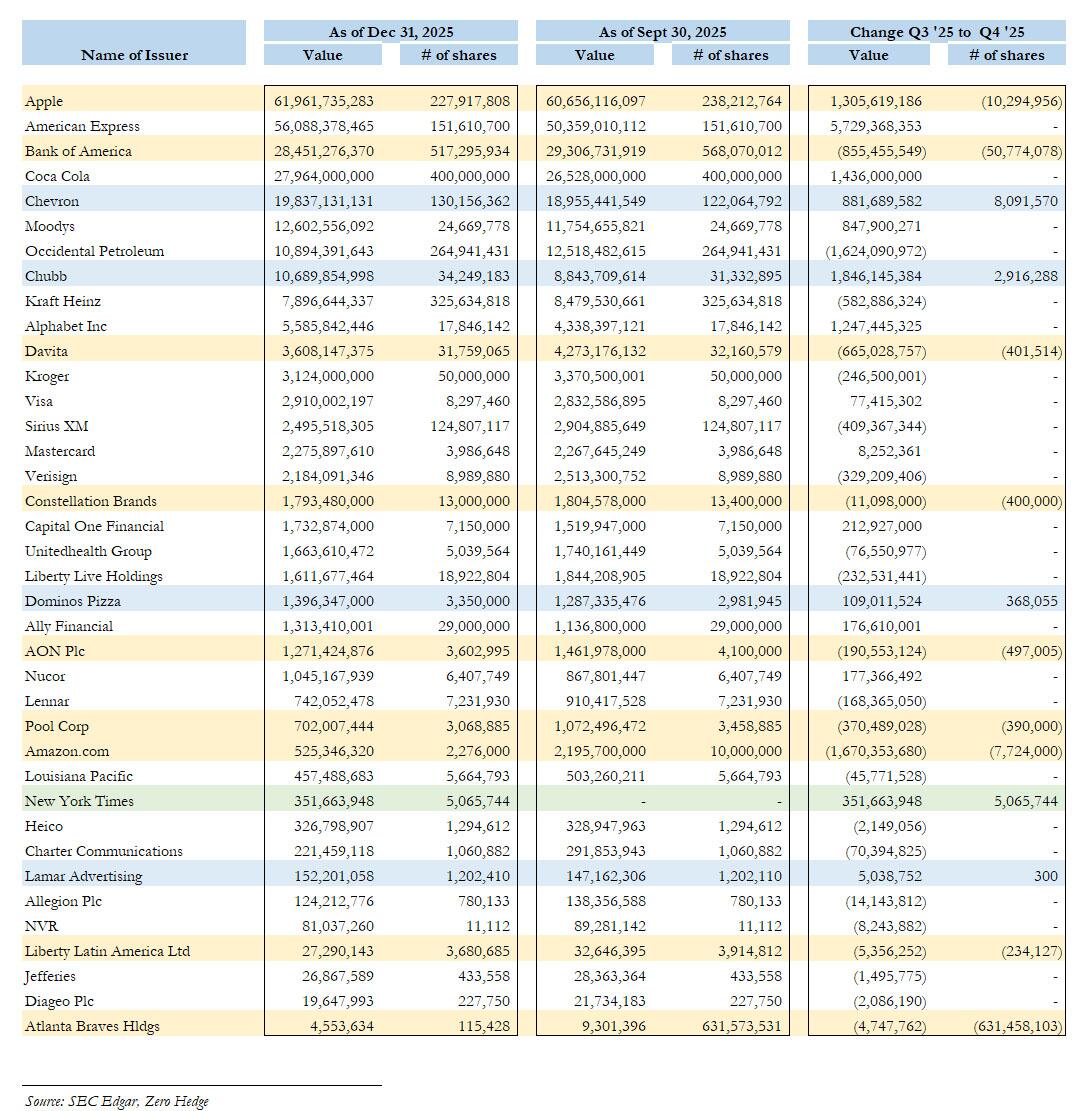
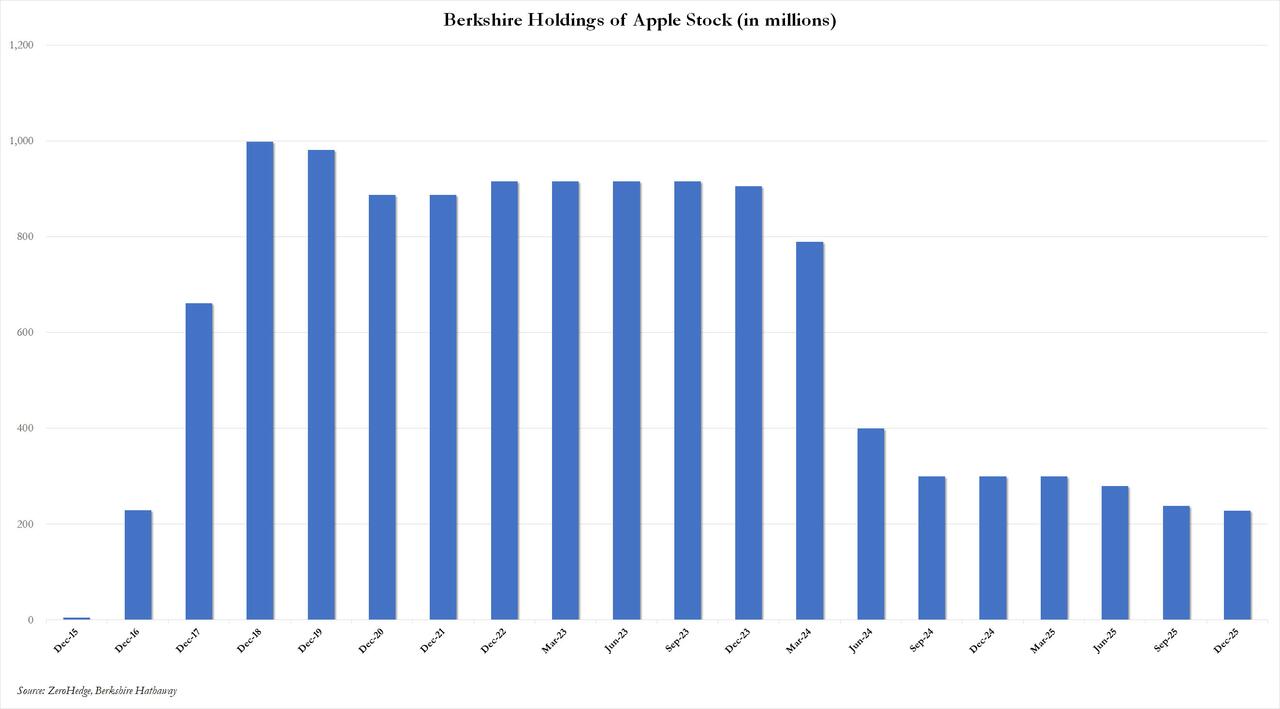 Other holdings that were trimmed included Davita, Constellation Brands, AON, Pool and Liberty Latin.
It wasn't all sales: in Q4, Berkshire increased its stakes in oil producer Chevron and insurance firm Chubb during the period, to 6.5% and 8.7%, respectively. The conglomerate unveiled its initial investment in Chubb in May 2024, after secretly building it the previous year. Chubb’s shares rose roughly 11% over the fourth quarter after a trade publication reported that the firm made an informal approach to buy American International Group. Berkshire also added modestly to its Dominos Pizza stake.
Berkshire also launched a small new position in New York Times, adding 5.1 million shares valued at $352 million at the end of Q4, making it Berkshire's 29th largest holding out of 38.
Buffett, who stepped down as CEO at the end of 2025, appeared to be back on the hunt for purchases in recent quarters, reaching a deal to buy Occidental Petroleum's petrochemical business for $9.7 billion and building a $5.6 billion stake in Alphabet. Both positions were unchanged in Q4.
The full breakdown of Berkshire's Q4 13F is below.
Other holdings that were trimmed included Davita, Constellation Brands, AON, Pool and Liberty Latin.
It wasn't all sales: in Q4, Berkshire increased its stakes in oil producer Chevron and insurance firm Chubb during the period, to 6.5% and 8.7%, respectively. The conglomerate unveiled its initial investment in Chubb in May 2024, after secretly building it the previous year. Chubb’s shares rose roughly 11% over the fourth quarter after a trade publication reported that the firm made an informal approach to buy American International Group. Berkshire also added modestly to its Dominos Pizza stake.
Berkshire also launched a small new position in New York Times, adding 5.1 million shares valued at $352 million at the end of Q4, making it Berkshire's 29th largest holding out of 38.
Buffett, who stepped down as CEO at the end of 2025, appeared to be back on the hunt for purchases in recent quarters, reaching a deal to buy Occidental Petroleum's petrochemical business for $9.7 billion and building a $5.6 billion stake in Alphabet. Both positions were unchanged in Q4.
The full breakdown of Berkshire's Q4 13F is below.
 Source:
  This unexpected statement of Trump's was serious enough for Zelensky to issue a response later the same day. The Ukrainian leader said in a just published interview with Axios that the Ukrainian public itself won't let him cede territory.
It seems this is his way of evading the mounting criticism and pressure from Trump - basically by passing it off as unpopular domestically. According to
This unexpected statement of Trump's was serious enough for Zelensky to issue a response later the same day. The Ukrainian leader said in a just published interview with Axios that the Ukrainian public itself won't let him cede territory.
It seems this is his way of evading the mounting criticism and pressure from Trump - basically by passing it off as unpopular domestically. According to 

 Chloe Cole, who drew national attention after speaking out against subjecting children to gender-reassignment procedures such as hormones and surgeries, has an April 5, 2027, trial date, according to Mark Trammell, CEO of the Center for American Liberty, which represents several detransitioners.
Cole and others, known as detransitioners, stopped or reversed a medical gender transition that they started earlier.
She
Chloe Cole, who drew national attention after speaking out against subjecting children to gender-reassignment procedures such as hormones and surgeries, has an April 5, 2027, trial date, according to Mark Trammell, CEO of the Center for American Liberty, which represents several detransitioners.
Cole and others, known as detransitioners, stopped or reversed a medical gender transition that they started earlier.
She 
 The New York jury awarded Varian $2 million—$1.6 million for pain and suffering, and $400,000 for future medical expenses.
The Fox verdict sent shockwaves through the gender medicine industry, while offering hope for other detransitioners.
Trammell said that while medical negligence lawsuits aren’t new, those involving transgender medicine are.
“How do you put a price tag on a young woman having her breasts amputated and potentially never being able to have a child?” he asked.
The hope is that detransitioners will now see that they can win a legal victory.
“I look at that as a tremendous, tremendous victory, not just for Fox Varian, but for other detransitioners who are maybe thinking about filing lawsuits,” he said.
The New York jury awarded Varian $2 million—$1.6 million for pain and suffering, and $400,000 for future medical expenses.
The Fox verdict sent shockwaves through the gender medicine industry, while offering hope for other detransitioners.
Trammell said that while medical negligence lawsuits aren’t new, those involving transgender medicine are.
“How do you put a price tag on a young woman having her breasts amputated and potentially never being able to have a child?” he asked.
The hope is that detransitioners will now see that they can win a legal victory.
“I look at that as a tremendous, tremendous victory, not just for Fox Varian, but for other detransitioners who are maybe thinking about filing lawsuits,” he said.
 Trammell said that the success of medical negligence cases depends on establishing that doctors and hospitals failed to meet the standard of care. That’s why
 Trammell said states have already helped protect vulnerable children by passing laws banning transgender-related hormone treatments and surgery for minors.
However, state lawmakers could have a bigger impact by creating a carve-out on the statute of limitations for medical malpractice.
In many states, lawsuits must be filed within two years of the alleged malpractice, but it can take children much longer to realize the harm they suffered.
In Texas, 60 lawmakers signed a letter supporting a detransitioner’s case, heard on Feb. 11 by the Texas Supreme Court, that was originally dismissed based on the expiration of the statute of limitations. The state lawmakers vowed to support legislation next year to extend the statute of limitations for detransitioners.
Soren Aldaco filed a
Trammell said states have already helped protect vulnerable children by passing laws banning transgender-related hormone treatments and surgery for minors.
However, state lawmakers could have a bigger impact by creating a carve-out on the statute of limitations for medical malpractice.
In many states, lawsuits must be filed within two years of the alleged malpractice, but it can take children much longer to realize the harm they suffered.
In Texas, 60 lawmakers signed a letter supporting a detransitioner’s case, heard on Feb. 11 by the Texas Supreme Court, that was originally dismissed based on the expiration of the statute of limitations. The state lawmakers vowed to support legislation next year to extend the statute of limitations for detransitioners.
Soren Aldaco filed a 

 The advisor said the US threatened measures against the State Oil Marketing Organization (SOMO), the Central Bank of Iraq, as well as security and diplomatic sectors, and unnamed political figures.
Economic steps could include restricting Iraqi oil sales, limiting Baghdad’s access to US dollars, and targeting banks, which the advisor warned could trigger "an almost complete halt in foreign trade" and create serious obstacles to paying public-sector salaries.
A member of the CF confirmed the authenticity of the message, saying it reached the alliance through a senior figure who met US chargé d’affaires Joshua Harris.
The US embassy in Iraq later disclosed that Harris had met Abdul Hussein al-Moussawi, head of the National Approach Alliance, and reiterated Washington’s readiness to "use the full range of tools to counter Iran’s destabilizing activities in Iraq."
Trump said on Friday, "We are monitoring the situation regarding the prime minister. We will see what happens. We have some thoughts about it, but in the end, everyone needs America."
Earlier, Maliki said stepping aside would endanger Iraq's sovereignty and that he would withdraw only if the CF formally requested it, condemning what he described as "blatant American interference in Iraq’s internal affairs."
Internal resistance within the alliance has reportedly grown, with one member stating: "No one wants … to risk the collapse of the political system if Washington carries out its threats."
Earlier this month, Washington
The advisor said the US threatened measures against the State Oil Marketing Organization (SOMO), the Central Bank of Iraq, as well as security and diplomatic sectors, and unnamed political figures.
Economic steps could include restricting Iraqi oil sales, limiting Baghdad’s access to US dollars, and targeting banks, which the advisor warned could trigger "an almost complete halt in foreign trade" and create serious obstacles to paying public-sector salaries.
A member of the CF confirmed the authenticity of the message, saying it reached the alliance through a senior figure who met US chargé d’affaires Joshua Harris.
The US embassy in Iraq later disclosed that Harris had met Abdul Hussein al-Moussawi, head of the National Approach Alliance, and reiterated Washington’s readiness to "use the full range of tools to counter Iran’s destabilizing activities in Iraq."
Trump said on Friday, "We are monitoring the situation regarding the prime minister. We will see what happens. We have some thoughts about it, but in the end, everyone needs America."
Earlier, Maliki said stepping aside would endanger Iraq's sovereignty and that he would withdraw only if the CF formally requested it, condemning what he described as "blatant American interference in Iraq’s internal affairs."
Internal resistance within the alliance has reportedly grown, with one member stating: "No one wants … to risk the collapse of the political system if Washington carries out its threats."
Earlier this month, Washington 


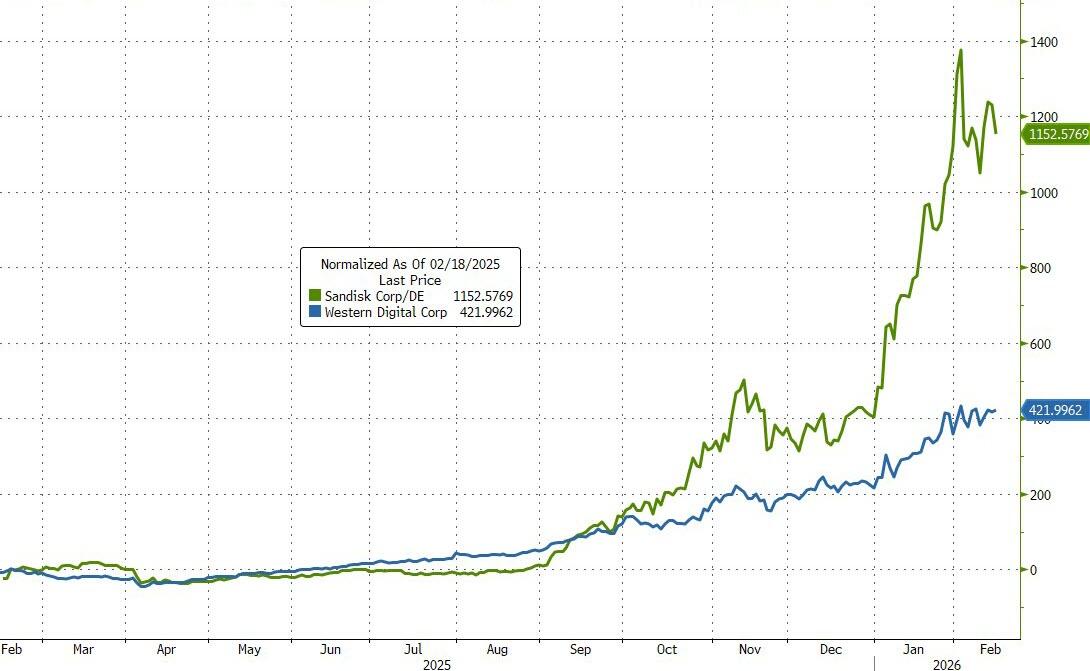 Chief Financial Officer Kris Sennesael said on Western Digital’s quarterly earnings call Jan. 29. that the company planned to sell its remaining 7.5 million Sandisk shares before the one-year anniversary of the separation.
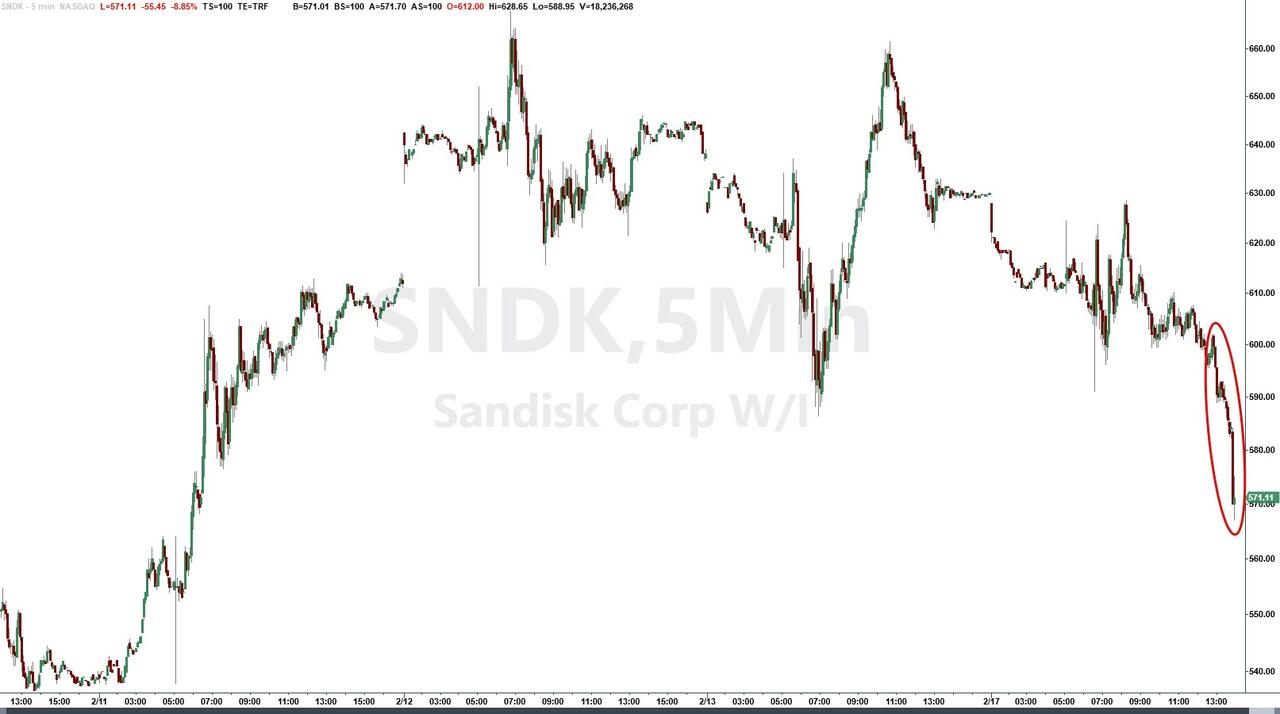
And so, according to a statement Sandisk launched the sale on behalf of its former parent in a statement Tuesday that didn’t disclose how many shares it would sell.
According to the statement, Western Digital is expected to exchange the SanDisk shares for debt held by affiliates of JPMorgan and Bank of America.
For now, WDC is flat in the after-hours trade but SNDK is down around 8%, extending the losses during the day...
Chief Financial Officer Kris Sennesael said on Western Digital’s quarterly earnings call Jan. 29. that the company planned to sell its remaining 7.5 million Sandisk shares before the one-year anniversary of the separation.
And so, according to a statement Sandisk launched the sale on behalf of its former parent in a statement Tuesday that didn’t disclose how many shares it would sell.
According to the statement, Western Digital is expected to exchange the SanDisk shares for debt held by affiliates of JPMorgan and Bank of America.
For now, WDC is flat in the after-hours trade but SNDK is down around 8%, extending the losses during the day...
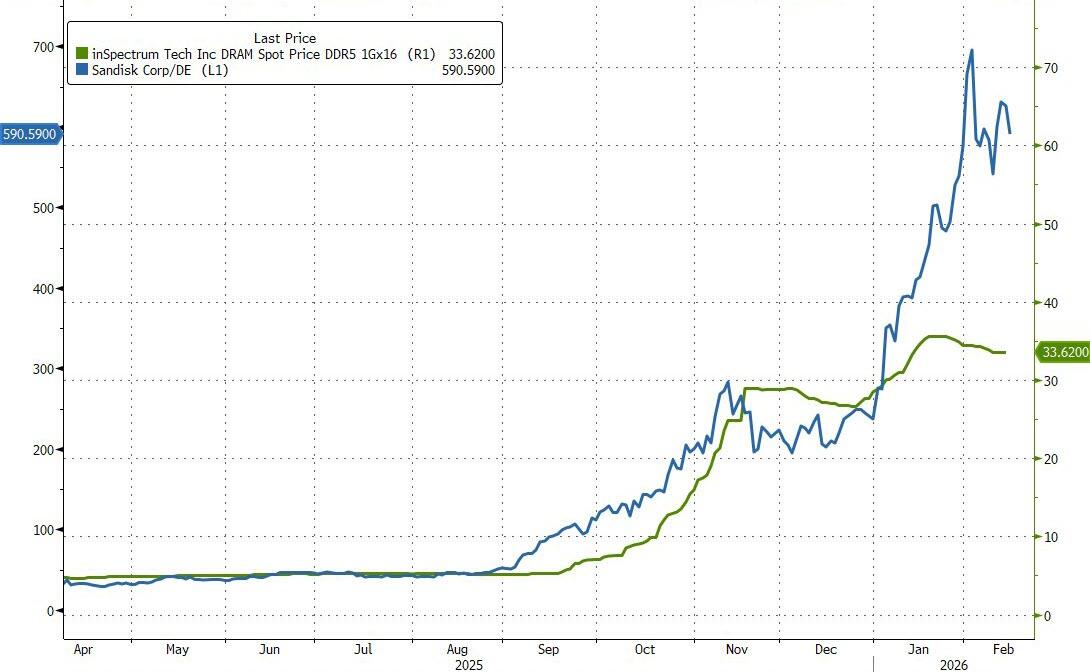
 Amid a global shortage of flash memory, that has sent DRAM prices soaring since September, demand for Sandisk’s products, which are used in computers and mobile phones, has, as Bloomberg reports, been linked to the tech industry’s characteristic boom and bust cycles, keeping valuations in check.
 The banks will sell the stock to the underwriters of the offering, whom they represent.
Did WDC's decision just mark the top in the memory melt-up?
The banks will sell the stock to the underwriters of the offering, whom they represent.
Did WDC's decision just mark the top in the memory melt-up?

 In a fresh interview with Turkish media, Patrushev said Moscow is advancing a "multipolar world order on the oceans" to counter what he blasted as Western hegemony.
"We will tap into the potential of BRICS, which should now be given a full-fledged strategic maritime dimension," he said. These fresh mid-February drills are being called Maritime Security Belt 2026.
It turns out Russian and Chinese warships have already been in the region as part of prior Iran-hosted drills, and without doubt they've lingered to keep a very close eye on developments after President Trump started threatening Tehran over its nuclear as well as ballistic missiles programs.
Also coming off last month's BRICS naval drills in South Africa which were dubbed "Will for Peace 2026" - Chinese, Russian, and Iranian ships have in recent years showed deepened coordination and cooperation, in an increased number of joint drills.
"The Maritime Security Belt 2026 exercises in the Strait of Hormuz, where Russia, China, and Iran sent their ships, proved to be relevant," he added.
If the US were to launch a 'surprise' attack on Iran, it remains unlikely that either Russia or China would come to Tehran's direct aid and engage militarily with Washington.
However, it's possible more Chinese and Russian ships would be sent to patrol flashpoint waters, making things more delicate and difficult in terms of US Navy maneuvering and firing.
In a fresh interview with Turkish media, Patrushev said Moscow is advancing a "multipolar world order on the oceans" to counter what he blasted as Western hegemony.
"We will tap into the potential of BRICS, which should now be given a full-fledged strategic maritime dimension," he said. These fresh mid-February drills are being called Maritime Security Belt 2026.
It turns out Russian and Chinese warships have already been in the region as part of prior Iran-hosted drills, and without doubt they've lingered to keep a very close eye on developments after President Trump started threatening Tehran over its nuclear as well as ballistic missiles programs.
Also coming off last month's BRICS naval drills in South Africa which were dubbed "Will for Peace 2026" - Chinese, Russian, and Iranian ships have in recent years showed deepened coordination and cooperation, in an increased number of joint drills.
"The Maritime Security Belt 2026 exercises in the Strait of Hormuz, where Russia, China, and Iran sent their ships, proved to be relevant," he added.
If the US were to launch a 'surprise' attack on Iran, it remains unlikely that either Russia or China would come to Tehran's direct aid and engage militarily with Washington.
However, it's possible more Chinese and Russian ships would be sent to patrol flashpoint waters, making things more delicate and difficult in terms of US Navy maneuvering and firing.
 Likely Moscow and Beijing would team up to issue a UN Security Council condemnation, and would seek to rally the globe against another Iraq-style war in the Middle East, with likely disastrous consequences for the whole region.
The second round of Iran-US talks wrapped up Tuesday in Geneva with mixed results. The Iranians have said the sides could be headed toward a new deal, and yet diplomats have admitted it was a heavy, and not very positive or amicable atmosphere. So things remain ultra-tense and charged, to say the least.
Likely Moscow and Beijing would team up to issue a UN Security Council condemnation, and would seek to rally the globe against another Iraq-style war in the Middle East, with likely disastrous consequences for the whole region.
The second round of Iran-US talks wrapped up Tuesday in Geneva with mixed results. The Iranians have said the sides could be headed toward a new deal, and yet diplomats have admitted it was a heavy, and not very positive or amicable atmosphere. So things remain ultra-tense and charged, to say the least.