Justin Nakamoto-San ☑️'s avatar
Justin Nakamoto-San ☑️
Justin@primal.net
npub1alcg...l2uf
Hipster, Iconoclast, ฿atman. "People are strange: they are constantly angered by trivial things, but on a major matter like totally wasting their lives [by not buying bitcoin], they hardly seem to notice." - Charles Bukowski
It's astounding that there is no exchange that supports multisig but I guess it prevents a different threat (for btc not the other coins). At least libsecp256k1 now has musig2 support
I think US politicians should meet with their counterparts in other countries to convince them to start buying Bitcoin. Because that will speed things up here
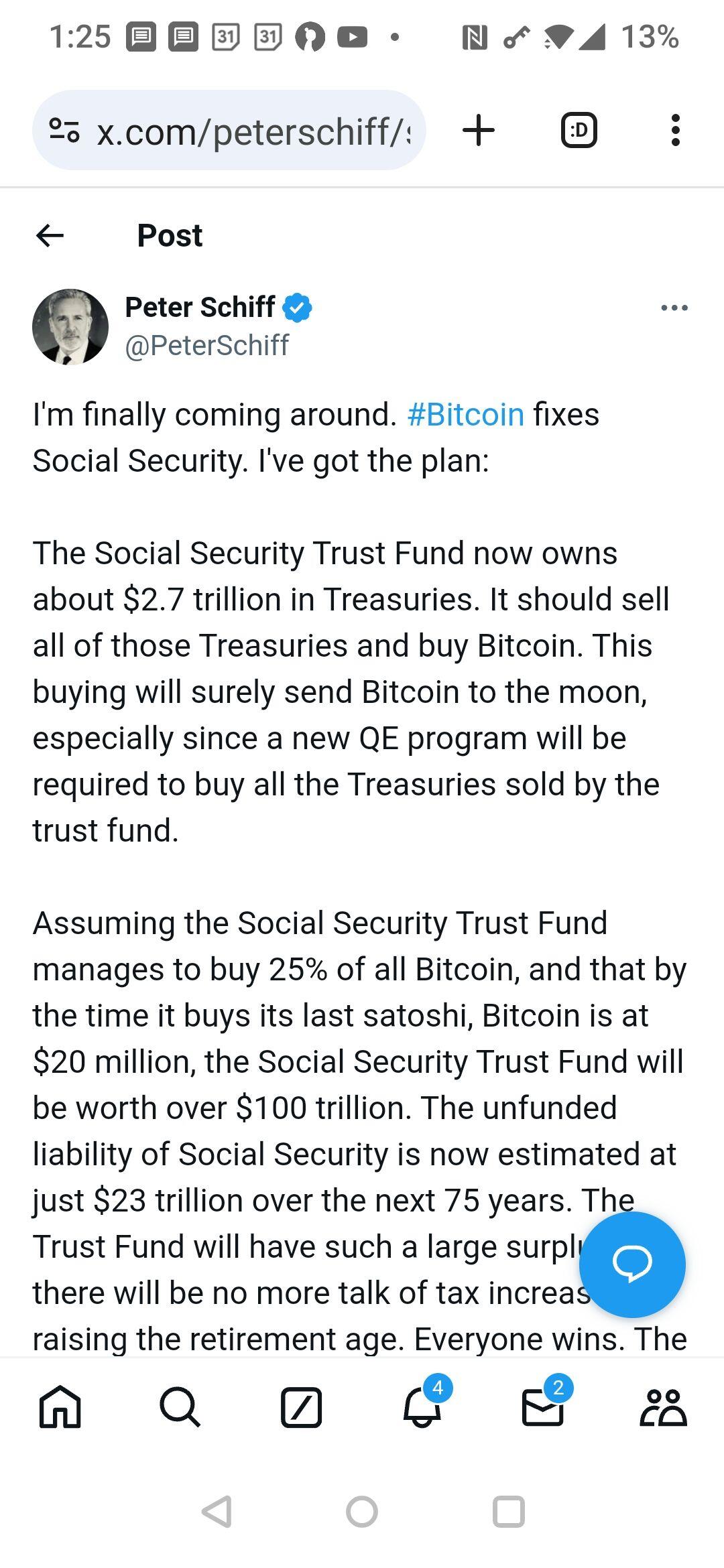
Wow, Schiff gives up! I'm finally coming around. #Bitcoin fixes Social Security. I've got the plan: The Social Security Trust Fund now owns about $2.7 trillion in Treasuries. It should sell all of those Treasuries and buy Bitcoin. This buying will surely send Bitcoin to the moon, especially since a new QE program will be required to buy all the Treasuries sold by the trust fund. Assuming the Social Security Trust Fund manages to buy 25% of all Bitcoin, and that by the time it buys its last satoshi, Bitcoin is at $20 million, the Social Security Trust Fund will be worth over $100 trillion. The unfunded liability of Social Security is now estimated at just $23 trillion over the next 75 years. The Trust Fund will have such a large surplus that there will be no more talk of tax increases or raising the retirement age. Everyone wins. The Trust Fund could then use all the Social Security payroll taxes it collects to buy more Bitcoin, supporting the price of Bitcoin and maintaining the value of its only asset. There’s just one small wrinkle. With all Social Security tax revenue being used to buy Bitcoin, how will the government pay its benefits? It's not like the Trust Fund could sell Bitcoin to cover those payments, as it would crash the market. So, like all true Bitcoiners, it must HODL. Fortunately, there is a workable solution. The government declares Bitcoin a reserve asset, then deposits its Bitcoin as collateral at the Federal Reserve, which provides the cash needed to pay Social Security benefits. This arrangement is better for the government than the Fed holding Treasuries, as it doesn’t have to pay interest on Bitcoin, nor is there principal to repay. The Fed can simply HODL Bitcoin on its balance sheet indefinitely—the ultimate diamond hands. After Bitcoin fixes Social Security, the government can move on to fixing everything else with Bitcoin. It's too bad it took Satoshi so long to come up with this cure-all image
Here's a list of some well-known privacy-focused cryptocurrencies. These cryptocurrencies use different methods to prioritize user privacy and anonymity in transactions. 1. Monero (XMR) Privacy Feature: Ring signatures, stealth addresses, and RingCT (Ring Confidential Transactions). Strengths: Monero is highly regarded for its strong privacy and untraceability features. It obfuscates both the sender and receiver's addresses and transaction amounts. 2. Zcash (ZEC) Privacy Feature: zk-SNARKs (Zero-Knowledge Succinct Non-Interactive Arguments of Knowledge). Strengths: Zcash allows users to choose between transparent and shielded transactions. Shielded transactions hide the sender, receiver, and transaction amount. 3. Dash (DASH) Privacy Feature: PrivateSend (based on CoinJoin). Strengths: Dash allows optional privacy features that anonymize funds by mixing transactions with others, but it's not as fully private as Monero or Zcash. 4. Verge (XVG) Privacy Feature: TOR and I2P network integrations for anonymity. Strengths: Verge obfuscates IP addresses to protect user identities, but transactions are still visible on the public ledger. 5. Beam (BEAM) Privacy Feature: Mimblewimble protocol. Strengths: Beam is built on the Mimblewimble protocol, which provides privacy and scalability by obfuscating transaction data without the need for additional layers. 6. Grin (GRIN) Privacy Feature: Mimblewimble protocol. Strengths: Similar to Beam, Grin uses Mimblewimble to provide private and scalable transactions with minimal on-chain data. 7. Firo (FIRO) Privacy Feature: Lelantus protocol, zk-SNARKs. Strengths: Firo uses Lelantus for anonymous transfers, which hides both transaction sender and recipient. It was formerly known as Zcoin. 8. Pirate Chain (ARRR) Privacy Feature: zk-SNARKs with mandatory shielded transactions. Strengths: Pirate Chain enforces privacy by making all transactions private by default, using the strongest form of zk-SNARKs available. 9. Haven Protocol (XHV) Privacy Feature: Based on Monero, uses RingCT. Strengths: Built on Monero’s codebase, Haven offers private transactions with the added ability to create synthetic assets that track other assets' values. 10. Navcoin (NAV) Privacy Feature: Dual-transaction system with NAVTech (private payment system). Strengths: Navcoin offers private transactions through a dual-transaction layer that obfuscates sender and receiver addresses. 11. PIVX (PIVX) Privacy Feature: zk-SNARKs-based anonymity protocol. Strengths: PIVX allows optional privacy through a Zerocoin protocol implementation, but it’s currently focusing on enhancing its staking mechanism. 12. Secret Network (SCRT) Privacy Feature: Secret contracts and encrypted data. Strengths: Secret Network allows for privacy-preserving smart contracts, protecting transaction data, unlike most blockchains. 13. Aeon (AEON) Privacy Feature: Similar to Monero but optimized for mobile and light usage. Strengths: Aeon aims for mobile-friendly privacy with less resource-intensive requirements than Monero. 14. Bytecoin (BCN) Privacy Feature: Cryptonote technology. Strengths: Bytecoin is one of the first privacy coins and is based on the Cryptonote protocol, which inspired Monero. 15. MobileCoin (MOB) Privacy Feature: Ring signatures, SGX (Secure Enclave). Strengths: Focused on mobile privacy, MobileCoin uses a combination of hardware (SGX) and cryptographic techniques to secure transactions on mobile devices. These privacy coins employ a mix of cryptographic protocols, ranging from zk-SNARKs and Mimblewimble to CoinJoin, RingCT, and stealth addresses, to provide varying levels of privacy and anonymity. However, keep in mind that regulations may affect the availability of these coins in certain regions.
The year is 2034 and Saylor has a new narrative: "Bitcoin is a shining plumbus in cyberspace" #RickAndMorty
fun fact: the Ayatollah Khamenai, Iran's supreme leader, can be added to any Twitter group chat @khamenei_ir