Btrust Builders's avatar
Btrust Builders
builders@btrust.tech
npub1353s...gajp
Training the next generation of open-source Bitcoin and Lightning developers from Africa
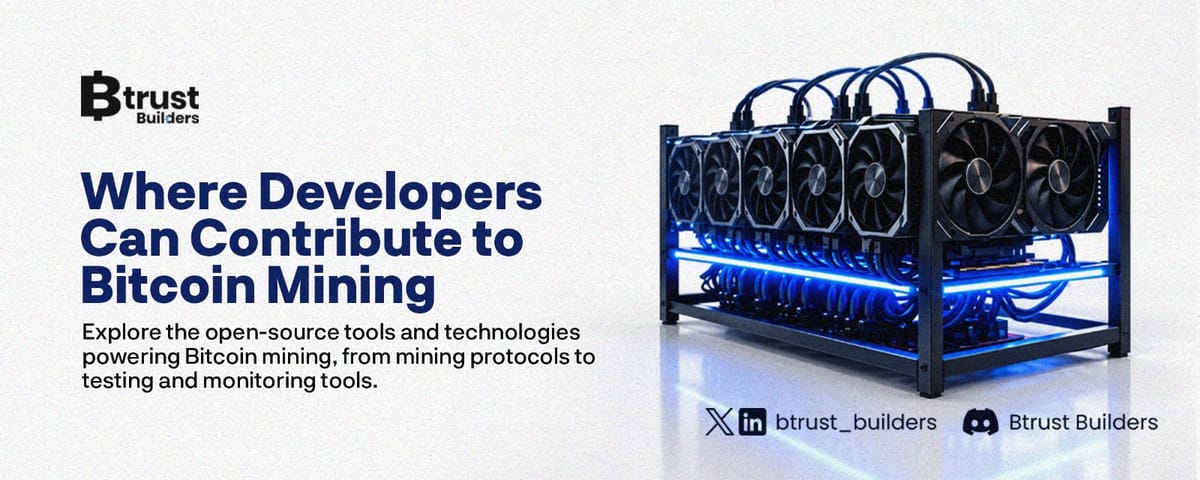
Bitcoin mining ⛏️ is often associated with specialized hardware, electricity consumption, and hashrate. Less visible is the software that keeps it running. Behind the machines are protocols connecting miners to pools, applications distributing work, and tools for testing and monitoring these systems. Our latest article explores where developers can contribute, from networking and backend applications to firmware and fleet management, with projects such as Stratum V2, Braidpool, Mujina, and Proto Fleet as starting points. Interested in building beyond the hardware? Discover the software behind mining and where to begin. Read the full article here: image
What does it mean to contribute to Bitcoin open-source projects in the age of Al? Al can help developers investigate bugs, explore solutions, and write code. Turning that work into a useful contribution still requires technical judgement, testing, and an understanding of the project's expectations. Our latest article looks at where Al can help, how projects approach its use, and the responsibilities that remain with contributors. Read the full article here:
Finding an open-source project to contribute to is easy, but choosing one where you can learn, contribute, and keep going takes a little more thought. Bitcoin’s open-source ecosystem spans protocol development, Lightning, wallets, mining, privacy, ecash, developer tools, infrastructure, testing, documentation, and more. With so many directions to explore, your first project can shape how you experience open-source development. In our latest article, we break down what to look for before you commit, how to assess your interests and skills, understand a project before touching the code, read its community, choose a contribution you can finish, and ask better questions when you get stuck. If you're figuring out where to make your first contribution, start here:
Btrust Builders's avatar
Btrust Builders 2 months ago
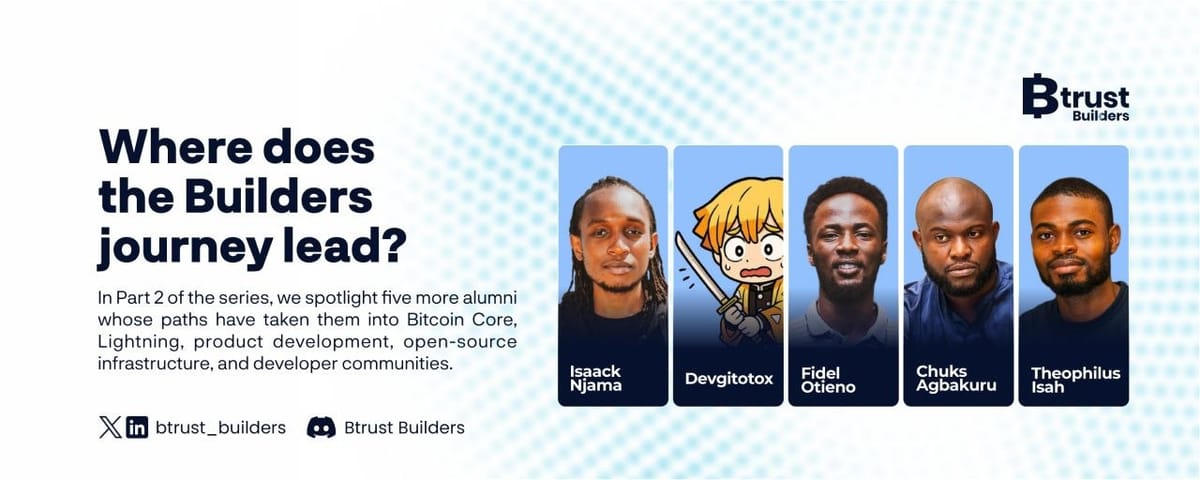
In part 2 of the series, we continue following the work of Btrust Builders alumni beyond the program. This time, we meet Isaack Njama, Theophilus Isah, Fidel Otieno, devgitotox, and @Chuks, five alumni whose work spans different corners of the Bitcoin ecosystem, from building products and open-source infrastructure to contributing to Bitcoin Core, Lightning, and supporting the developers coming behind them. Their journeys have taken different turns, but the work continues. Read the full story on our blog: image
Btrust Builders's avatar
Btrust Builders 3 months ago
Today, we wrapped up the week 5 study group session of the Bitcoin CLI live cohort. ⚡ This week, participants took a deeper dive into Bitcoin Script by exploring Pay-to-Script-Hash (P2SH) transactions and script-based timelocks. The cohort learned how P2SH makes it possible to embed more complex spending conditions into Bitcoin transactions, including multisignature and SegWit scripts. They also explored how timelock opcodes like CheckLockTimeVerify (CLTV) and CheckSequenceVerify (CSV) can be used to control when bitcoin can be spent, enabling more advanced and flexible transaction workflows. Through hands-on technical exercises, partner discussions, and collaborative learning, participants gained practical experience writing and working with these more advanced Bitcoin scripting features.
Btrust Builders's avatar
Btrust Builders 3 months ago
Today, we wrapped up the week 6 study group session of the Mastering Bitcoin live cohort. ⚡ This week, participants explored the blockchain and mining & consensus. The cohort examined how blocks are linked together to form Bitcoin's immutable ledger, how miners validate transactions and secure the network through proof of work, and how consensus allows thousands of independent nodes to agree on a single version of the blockchain without relying on a central authority. As always, participants met with their study partners ahead of the session to discuss the readings before coming together to share insights, ask questions, and unpack these concepts during the group study.
Btrust Builders's avatar
Btrust Builders 3 months ago
We've just wrapped up the week 4 study group session of the Bitcoin CLI live cohort. ⚡ This week, participants explored more advanced ways of building Bitcoin transactions by working with timelocks and OP_RETURN, learning how transactions can be scheduled for future execution or used to store small amounts of data on the blockchain. The cohort also took its first deep dive into Bitcoin Script, the scripting language that powers Bitcoin's spending conditions. Participants learned how scripts are used to authorize transactions, explored common script types like P2PKH and P2WPKH, and began writing and testing their own scripts to better understand how Bitcoin transactions are validated. As always, the week combined hands-on technical exercises, partner discussions, and collaborative learning, giving participants the opportunity to apply what they learned and deepen their understanding together.
Btrust Builders's avatar
Btrust Builders 3 months ago
We've just wrapped up the week 5 study group session of the Mastering Bitcoin live cohort. ⚡ This week, participants explored transaction fees and the Bitcoin network, gaining a deeper understanding of how transactions are prioritized for inclusion in blocks and the factors that influence confirmation times. They also examined how bitcoin nodes communicate, validate, and relay transactions across the network, and the different ways users interact with Bitcoin through full nodes and lightweight clients. As always, participants met with their study partners ahead of the session to discuss the readings before coming together to share insights, ask questions, and learn from one another during the group study.
Btrust Builders's avatar
Btrust Builders 6 months ago
We just concluded week 6 of the Mastering Bitcoin live cohort. 📚 This week focused on understanding how the Bitcoin blockchain works and how new blocks are created through mining and consensus. Participants explored the structure of the blockchain, including how blocks store transaction data, how blocks are linked together using cryptographic hashes, and how the block header contains the key information used to secure and validate each block. The cohort also examined merkle trees and how they efficiently organize transactions inside a block, allowing nodes to verify transactions without needing to download the entire blockchain. In addition, we studied the mining⛏️ process and Bitcoin’s proof‑of‑work consensus mechanism, learning how miners compete to solve cryptographic puzzles, how difficulty adjustments keep block production consistent, and how block rewards and transaction fees incentivize miners to secure the network. We also discussed how consensus emerges across the distributed network, ensuring that all nodes agree on the valid chain while maintaining Bitcoin’s decentralized and trustless design. Throughout the week, participants reviewed the assigned materials, collaborated with their partners, and worked through discussion questions to deepen their understanding. During the live session, participants shared insights with the group and the faculty led the discussion on key ideas from the readings.
Btrust Builders's avatar
Btrust Builders 7 months ago
This week we wrapped up week 3 of the live cohort of the Mastering Bitcoin pathway, continuing our deep dive into how Bitcoin works under the hood. Over the past week, participants studied chapters 5 and 6 of Mastering Bitcoin and met with their learning partners to talk through the material before joining the group session with faculty. The week began with a closer look at bitcoin wallets and recovery. Bitcoin wallets don’t actually store bitcoins. Instead, they store the keys that give someone control over the bitcoins recorded on the blockchain. The group discussed how early wallets generated keys independently, which meant users had to back up their wallets frequently to avoid losing access to funds. From there, the conversation moved to how modern wallets solve this problem using deterministic key generation. Participants learned how a single random seed can be used to generate many keys and addresses, making it possible to recover an entire wallet from one backup. The group also explored hierarchical deterministic (HD) wallets, which organize keys in a tree structure and allow wallets to create new addresses while keeping private keys secure. The discussions also touched on recovery phrases, often called seed phrases, and why backing them up safely is essential. Participants reflected on how these recovery systems help users protect their funds while still making wallets practical to use. After exploring wallets and recovery, the cohort moved into bitcoin transactions and how value actually moves across the network. Instead of coins being physically transferred, Bitcoin works by updating a shared record that shows which keys control which bitcoins. Participants unpacked how transactions are structured, looking at the roles of inputs and outputs. Inputs reference previously received funds, while outputs define where the bitcoin will go next and the conditions required to spend it. The group also explored several deeper parts of the transaction structure, including scripts, witness data, and Segregated Witness (SegWit). These components help verify that transactions are authorized and make the system more efficient and secure. By the end of the session, participants had a clearer picture of how wallets manage keys and how transactions move value through the network. The discussions helped connect the ideas from earlier chapters about keys and cryptography with the practical mechanics of sending and receiving bitcoin.
Btrust Builders's avatar
Btrust Builders 9 months ago
In 2025, we took a major step forward in strengthening Africa’s Bitcoin developer pipeline through the Btrust Builders program. 🚀 Over the course of the year, 493 developers across Africa and beyond were supported through Builders pathways, selected from 1,800+ applications, a 180% increase from the previous year. Developers joined from 15+ countries, spanning West, East, Central, and Southern Africa, with additional participation from South America, Europe, and South Asia. We evolved from a single‑cohort program into a continuous, modular learning pipeline, supporting developers at different stages; from first exposure to Bitcoin, through hands-on technical learning, and into real open‑source contributions. In 2025, we delivered: • Foundational learning through Mastering Bitcoin • Hands‑on technical practice via Bitcoin from the Command Line • Protocol‑level development in Rust for Bitcoiners • Programming fundamentals through Language Clubs (Python & C++) • Advanced open‑source onboarding through Start Your Career in BOSS To bridge learning and contribution, we also launched our first Open Source Bootcamp. Over four weeks, 38 developers from 7 countries submitted 103 code contributions, opened 50+ pull requests, and saw 12 PRs merged, including 3 to Bitcoin Core. The impact went well beyond training. Several Builders alumni transitioned into fully funded open‑source work, supported by @Btrust and @HRF, contributing to projects like Bitcoin Core, LDK Node, BlueWallet, Bitcoin Dev Kit, and Rust‑Payjoin. Others went on to start their own Bitcoin projects, applying what they learned to build new tools and infrastructure in the ecosystem. We also launched the Builders Resource Hub, which has since been widely shared across the Bitcoin developer ecosystem as a go‑to learning library for open‑source contribution, tooling, and deep technical study. Check it out here: In recognition of this work, the @African Bitcoiners team named Btrust Builders the 2025 African Bitcoin Project of the Year at the 2025 @Africa Bitcoin Conference. All this was made possible by the dedication of faculty and chaperones, many of whom are alumni themselves; mentors who gave their time, experience, and patience; and the core Builders team, including Stephanie Titcombe, the program lead, and Kelvin Isievwore, the engineering lead, who carried the vision from design through delivery. Just as importantly, the wider Builders community, learners, alumni, contributors, and supporters, shaped the culture that made collaboration, accountability, and growth possible.🧡 We’ve shared what worked, what we learned, and how Builders has grown into a long‑term contributor pipeline helping decentralize Bitcoin development. ➡️ Read the full blog for more: image
Btrust Builders's avatar
Btrust Builders 10 months ago
A week after the @Africa Bitcoin Conference, we’re still feeling the excitement. 🙌🎉 This year was especially meaningful as we were recognized as the African Bitcoin Project of the Year, a huge honor we're grateful to the @African Bitcoiners team for. Some of our community members also hosted workshops, we connected with builders from across the world, and the sessions throughout the conference were incredibly insightful. The conversations opened up fresh perspectives and sparked exciting ideas. We’re grateful to @Btrust for the chance to be part of it, and we’re already looking forward to the next one. Till then, we keep building 🚀 #ABC25 #ABC2025
We're super excited to announce the graduates of our first-ever Rust for Bitcoiners and Language Clubs cohorts. 🥳🎉 These talented developers from over 15 countries dedicated themselves to acquiring the core skills needed for open-source Bitcoin projects. We've captured all the highlights, insights from the cohorts, and what's next in our full recap, which you can read here: If you're interested in joining upcoming cohorts, keep an eye out on our Discord and application page for details: image
Do you get frustrated with how today’s digital payments seem to demand a tradeoff; forcing you to give up your privacy, pay high fees, or worry about data breaches every time you accept a transaction? Many merchants and shoppers feel boxed in by systems that leave a trail of personal information behind with every tap or scan, making privacy feel like a thing of the past. But what if you didn’t have to choose between fast, modern payments and the anonymity of cash? In our latest blog, Tobechi, a @Btrust grantee, introduces Cashu, a digital cash protocol that lets merchants enjoy the best of both worlds. With Cashu, you can accept Bitcoin-backed payments instantly and privately, without exposing customer data or risking chargebacks. The blog breaks down exactly how Cashu works, explaining the roles of tokens, wallets, and mints in this ecosystem. He explores ways businesses can benefit from Cashu. You’ll also find a simple guide on how to start accepting Cashu payments using BTCPay Server so you can quickly bring digital cash into your store. Curious how Cashu can transform your business and give your customers true payment privacy? Check out the full blog post here: image
We did it! Our very first Open-Source Bootcamp brought together 38 developers from Africa and Brazil, equipping them to make contributions to Bitcoin open-source projects like Bitcoin Core and BTCPay Server.🚀 Over 4 weeks, this diverse group submitted 103 pieces of code, learned from experienced maintainers, and gained the skills and confidence to shape the future of open source. 👏 Kudos to everyone who joined, and an extra congratulations to those who made it to the end. 🔗 Check out our blog to see their journey, impact, and see what’s coming up:
Unlock the future of Bitcoin node performance with our newest blog, Schnorr and Steady Wins the Race: The Case for Batch Validation. Oghenovo dives deep into how BIP340 Schnorr signatures and batch verification are transforming the efficiency of Bitcoin Core, explaining the math behind it, the use of multi-scalar multiplication, and the real benchmark data that demonstrates faster block verification times. As Taproot continues to gain traction and new technologies like Silent Payments, MuSig2, and FROST drive even greater Schnorr adoption, these optimisation techniques become essential to keep Bitcoin scalable, private, and secure. If you want to understand the mechanics of batch validation or see the real-world impact on block validation speed, this article covers that and sets the stage for the next era of Bitcoin scalability. Read the full article here:
Last week, BitDevs Gitega 🇧🇮 hosted its very first meetup! The community came together to explore Bitcoin and open-source development, with the team introducing BitDevs and breaking down the basics of Bitcoin and Lightning⚡. If you're in Gitega, come learn, build, and connect with fellow enthusiasts. For more info, visit: bitdevsgtga.org Here’s to the first of many! 🚀
Last Saturday, BitDevs Lagos 🇳🇬 hosted another meetup, bringing the community together for a hands-on and insightful session. Peter introduced the Bitcoin Development Kit (BDK) and the BDK CLI tool, showing how these can be used to build Bitcoin applications, manage wallets, sync data, and handle transactions with ease. Chigala then dove into Bitcoin scripting. He explained what OP_Codes are, how Bitcoin scripts operate using a stack-based model, and demonstrated how to construct scripts using different OP_Codes. With Bitscript (https://www.bitscript.app/), attendees had an interactive playground to experiment and test scripts themselves, making complex ideas more accessible. The meetup also marked Bitcoin Pizza Day, with plenty of pizza, great company, and vibrant conversations all around. 🍕 BitDevs Lagos remains one of the most active and longest-running BitDevs communities in Africa, thanks to the dedication of the organizers and the energy of everyone who attends. A huge thank you to Peter, Enyeazu, Tobechi and everyone who joined. See you at the next one!
BitDevs Uyo 🇳🇬 recently held its inaugural meetup, marking the latest BitDevs location to be supported by Btrust. 🚀 Participants explored the why behind Bitcoin, dove into hands-on wallet setups, shared sats with each other, and learned how wallets, transactions, and nodes work under the hood. The meetup also introduced everyone to the wider Builders community and shared opportunities to get involved in open source development. A huge thank you to the BitDevs Uyo organizers for a great start, and kudos to all the speakers who made the day so insightful. Check them out and follow them on X through their website: https://bitdevsuyo.org/
After a long pause, BitDevs Kampala 🇺🇬 made a comeback last Friday. The meetup brought together over 40 developers, students, and Bitcoin enthusiasts for an evening of learning and connection. The session, hosted by Jemimah Nagasha and MC’d by Wafoyo Angella, featured speakers Angella Mulikatete and Brindon Mwiine. Topics ranged from Bitcoin 101 and common misconceptions to getting started in Bitcoin open-source. A highlight of the evening came from Builders pathways alumni who shared their learning journeys. BitDevs Kampala is back, and there's more to come. You can follow them on X, join their community, and stay updated here:
↑