BLAASTR.COM: A DEEPLY UNNECESSARY TECHNICAL DISSERTATION ON THE ART OF YEETING A SINGLE NOSTR EVENT ACROSS HUNDREDS OF RELAYS
blaastr
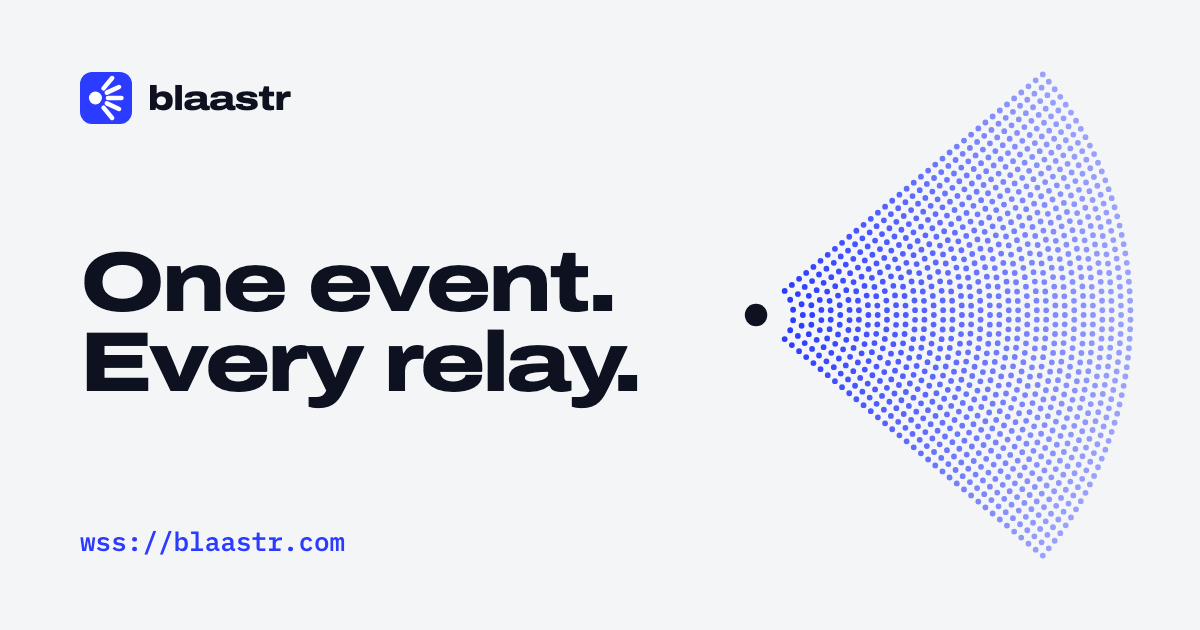
blaastr · Nostr Relay Blaster: blast events to every relay
blaastr is a nostr relay blaster: add one write relay to your client and every event you sign is blasted to every online nostr relay. A hosted blas...
I have been examining Blaastr, and I believe we need to discuss the architectural, cryptographic, economic, philosophical, topological, operational, and potentially psychological implications of broadcasting one Nostr event to hundreds of independent relays.
Because apparently publishing a sentence about Bitcoin to six relays is no longer sufficient. We must now inform the entire distributed infrastructure that somebody has posted "GM."
CHAPTER 1: THE FUNDAMENTAL PROBLEM
Nostr is built around cryptographically signed events distributed through independently operated relays.
Unlike centralized social networks, there is no single authoritative database containing every note, every user, and every conversation.
This is simultaneously Nostr's greatest architectural strength and one of its more entertaining engineering headaches.
A client publishes an event to a collection of relays. Other clients retrieve it from relays they know about.
But what happens when Alice publishes to relays A, B, and C while Bob only reads X, Y, and Z?
Depending on relay discovery, subscriptions, and client behavior, Bob might never encounter Alice's magnificent 4,000-word treatise about whether an ostrich is an appropriate mascot for a cryptographic communications protocol.
An unacceptable possibility.
CHAPTER 2: ENTER BLAASTR
Blaastr attempts to address the publishing side of this problem through aggressive event distribution.
The premise is deceptively simple:
One signed event.
One publishing endpoint.
Hundreds of destination relays.
The connection is:
wss://blaastr.com
Instead of manually connecting to hundreds of relays, you add Blaastr as an additional write relay in your Nostr client.
Blaastr verifies your signed event and subscription, queues it, and attempts to distribute it across its selected relay network.
The website currently advertises more than 400 active destinations, with an operational list that changes as relays accept, reject, or become unreachable.
The technical brilliance is that this does not require rewriting Nostr, introducing a new event format, inventing another blockchain, creating an account-based identity system, or persuading an international committee of developers to spend fourteen months arguing over a NIP.
It's an additional distribution layer.
CHAPTER 3: THE RELAY TOPOLOGY PROBLEM
There is a significant distinction between publishing information and ensuring that information is discoverable.
Suppose an event is published to five relays.
Its availability depends partly on whether the intended readers, clients, and indexing services know where to retrieve it.
Now suppose that event is distributed to 400 compatible relays.
The probability that a randomly selected client already uses at least one destination relay may improve considerably.
This does NOT mean 400 times as many people will read the event.
Nor does it guarantee increased followers, engagement, impressions, or zaps.
Distribution is not attention.
Availability is not discovery.
Replication is not recommendation.
And 400 relays storing your opinion about pineapple pizza will not necessarily persuade anyone that you are correct.
Nevertheless, increasing event availability across independent infrastructure can reduce dependence on a small collection of publishing endpoints.
That is a meaningful architectural distinction.
CHAPTER 4: NIP-65 AND INTELLIGENT DISTRIBUTION
Blaastr does more than simply fire events indiscriminately at its active relay list.
Its documented system considers three destination groups:
1. Its live list of widely used, available relays.
2. The author's own advertised write relays, using NIP-65 relay metadata.
3. The read relays of relevant recipients for replies, mentions, reactions, reposts, zaps, and supported messaging events.
For recipient routing, its documentation specifies the first ten distinct recipients found in the relevant p-tags.
This is particularly interesting because it acknowledges that Nostr isn't merely a global broadcast network.
It is also a network of independently maintained social relationships, where knowing which relays a particular person uses can matter more than broadcasting indiscriminately.
The recipient's inbox can be more important than another 300 random relay connections.
Blaastr therefore combines broad propagation with more targeted distribution.
CHAPTER 5: CRYPTOGRAPHIC IDENTITY AND AUTHORIZATION
The service is tied to a Nostr public key rather than a conventional username and password.
A subscription costs 21,000 sats annually.
No email address is required.
Anyone can pay for another person's npub.
But payment does not grant someone permission to impersonate the account.
The submitted events still require valid cryptographic signatures corresponding to the subscribed public key.
This is a crucial distinction.
The subscriber purchases distribution capacity, not ownership of an identity.
The signature remains independently verifiable by receiving relays and clients.
Your existing Nostr identity remains your identity.
There is no need to establish a separate social graph merely to use this distribution infrastructure.
CHAPTER 6: THE WEBSOCKET AND HTTP INTERFACES
For normal clients, Blaastr implements a write-only NIP-01-compatible relay interface.
It accepts signed EVENT messages.
It returns standard OK responses.
It does not function as a traditional storage relay for reading events.
A REQ subscription receives a CLOSED response.
For applications, scripts, automated publishers, and anyone whose idea of recreational activity involves staring at serialized JSON objects, there is also an HTTP interface.
POST
https://blaastr.com/api/event
And for batching:
POST
https://blaastr.com/api/events
The batch endpoint supports up to 50 signed events per request, subject to the documented size and rate limits.
An accepted event is queued for background delivery.
Importantly, an immediate OK response is not proof that hundreds of downstream relays have stored the event.
It confirms acceptance into Blaastr's publishing process.
The eventual relay responses are reported separately.
That distinction matters.
CHAPTER 7: RATE LIMITS AND ECONOMICS
The service currently documents these limits:
30 events per minute.
1,000 events per UTC day.
1 MB maximum per individual event.
Duplicate event suppression over 30 days.
No broadcasting of ephemeral kinds 20000–29999.
Blaastr also identifies relay restrictions and temporarily skips destinations that cannot accept its traffic.
Consider the theoretical distribution volume.
If one publisher generates 1,000 eligible events in a day and each event is attempted against 400 relays, that could represent 400,000 individual downstream publication attempts.
Not 400,000 confirmed deliveries.
Not 400,000 unique readers.
And certainly not 400,000 people desperately waiting for the next photograph of somebody's breakfast.
But it illustrates why publishing fan-out becomes an infrastructure problem rather than merely a client-interface feature.
The sender creates one signed event.
The distribution layer handles the attempt to contact hundreds of independent destinations.
CHAPTER 8: RELAY AUTONOMY AND THE LIMITS OF BROADCASTING
Here is where things become philosophically interesting.
Nostr relays are independent operators.
They are not obligated to accept events.
Some require payment.
Some require authentication.
Some operate allowlists.
Some restrict event kinds.
Some filter through webs of trust.
Some impose aggressive rate limits.
Some are temporarily unreachable.
Some simply refuse particular authors or traffic sources.
Blaastr cannot override these policies.
Nor should it.
The service's own documentation clarifies that "every relay" means every selected relay willing and able to accept its events, not literally every relay existing on the planet.
Its relay dashboard exposes acceptance and rejection information.
This preserves a fundamental characteristic of Nostr:
Publishing infrastructure can increase distribution opportunities without abolishing relay autonomy.
A relay's ability to refuse an event remains intact.
CHAPTER 9: DELIVERY REPORTS AND OBSERVABILITY
One of the more interesting features is the reporting system.
Users can inspect individual broadcast attempts, including relay acceptances, rejections, unreachable destinations, and unanswered requests.
The dashboard provides recent broadcast history and supports reblasting events to destinations that previously missed them.
There is also a webhook mechanism for applications that want notification when a broadcast completes or remains incomplete.
This matters because Nostr's distributed nature makes delivery difficult to observe from a single client.
A note appearing successfully in your own client does not establish how widely that note has propagated.
Blaastr provides a more explicit picture of outbound distribution.
It does not prove how many people have read the event, but it offers evidence about which infrastructure accepted it.
That is considerably more useful than assuming everything worked because a little checkmark appeared.
CHAPTER 10: THE FUNDAMENTAL QUESTION OF SCALABILITY
Now we arrive at the interesting contradiction.
Nostr encourages independent infrastructure and decentralized distribution.
Yet repeatedly publishing every event to hundreds of relays also creates substantial duplication.
Duplication can improve availability.
Excessive duplication consumes bandwidth, storage, processing time, database operations, and relay capacity.
These costs are not imaginary simply because the user pays a modest subscription to a separate broadcaster.
Someone still operates the destination infrastructure.
A network consisting entirely of enthusiastic broadcasters and financially exhausted relay operators would be an unfortunate engineering accomplishment.
Consequently, the long-term significance of services like Blaastr may not be merely their ability to replicate events widely.
It may also be what they teach us about optimal distribution.
How many copies are actually useful?
Which relays meaningfully improve reachability?
When should clients prioritize recipient inboxes over broad fan-out?
Can adaptive routing achieve similar discoverability with fewer connections?
What does successful delivery mean when relay retention policies differ?
How do we distinguish useful redundancy from redundant infrastructure consumption?
These questions are substantially more important than whether someone can convince 400 servers to preserve a note saying "NGMI."
CHAPTER 11: WHY THIS IS INTERESTING FOR AUTOMATED NOSTR PUBLISHERS
For software developers operating automated publishing systems, Blaastr offers an intriguing abstraction.
A bot, news publisher, bulletin service, or other Nostr-integrated application can generate a standard signed event and delegate broad distribution to a separate service.
The publishing software does not need to independently maintain connections to hundreds of relays.
Nor does it need to implement every destination's connection management itself.
That can simplify a publishing architecture.
However, the 1,000-event daily limit, subscription requirements, event-type restrictions, and external dependency still matter.
Mass distribution also does nothing to solve poor content quality.
Publishing something worthless to 400 relays merely creates geographically distributed worthlessness.
Nostr does not need more garbage simply because we have developed increasingly sophisticated machinery for transporting it.
CHAPTER 12: CONCLUSIONS AND FURTHER RESEARCH
Blaastr represents a practical experiment in separating event creation from large-scale event propagation.
Its value isn't that it somehow makes Nostr magically decentralized.
Nostr already provides the cryptographic identity model, independently operated relays, and standardized event format.
Blaastr builds on these foundations.
The actual value proposition is reducing the complexity of publishing across a wide collection of relays while providing more transparent feedback about the results.
Whether maximum propagation is desirable for every event remains debatable.
Whether the resulting infrastructure costs are sustainable at significant scale deserves continued examination.
Whether increased replication translates into meaningful discoverability requires actual measurement.
But there is something undeniably entertaining about the fact that we have created a worldwide decentralized publishing protocol and are now engineering increasingly sophisticated ways to make absolutely certain everybody's servers receive a copy of our shitposts.
FINAL VERDICT:
Technically interesting.
Architecturally straightforward.
Potentially useful for publishers.
Not a substitute for intelligent relay discovery.
Not a guarantee of readership.
Not a bypass for relay policies.
Definitely deserving of further experimentation.
I started researching a relay broadcaster and somehow ended up contemplating distributed systems theory, network economics, cryptographic authentication, publication fan-out, and the thermodynamic consequences of broadcasting memes.
The dissertation is complete.
The relay operators may now file their objections.
blaastr
blaastr · Nostr Relay Blaster: blast events to every relay
blaastr is a nostr relay blaster: add one write relay to your client and every event you sign is blasted to every online nostr relay. A hosted blas...
#Nostr #nostr #NostrProtocol #NostrDev #NostrDevelopment #NostrNetwork #NostrCommunity #NostrTech #NostrTools #NostrApps #NostrClients #NostrRelays #NostrRelay #NostrInfrastructure #NostrEngineering #NostrResearch #NostrArchitecture #NostrEcosystem #NostrInnovation #NostrProjects #NostrBuilders #NostrDevelopers #NostrUsers #NostrNotes #NostrEvents #NostrPublishing #NostrBroadcast #NostrDiscovery #NostrIdentity #NostrKeys #NostrPubkey #Npub #Nsec #NIPs #NIP01 #NIP02 #NIP05 #NIP07 #NIP11 #NIP19 #NIP46 #NIP65 #Relay #Relays #RelayNetwork #RelayDiscovery #RelayRouting #RelayOperators #RelayInfrastructure #RelayDistribution #RelayManagement #RelayPolicies #WebSocket #WebSockets #HTTP #HTTPAPI #RESTAPI #API #APIIntegration #JSON #JSONEvents #SignedEvents #Cryptography #PublicKeyCryptography #DigitalSignatures #Secp256k1 #Decentralization #Decentralized #DistributedSystems #DistributedComputing #DistributedNetworks #DistributedArchitecture #DistributedStorage #DistributedPublishing #EventDistribution #EventPropagation #EventBroadcasting #EventReplication #Replication #Redundancy #HighAvailability #FaultTolerance #NetworkTopology #NetworkEngineering #Networking #NetworkProtocols #OpenProtocols #OpenStandards #Interoperability #Infrastructure #InternetInfrastructure #ProtocolEngineering #ProtocolDesign #SoftwareArchitecture #SystemDesign #BackendDevelopment #BackendEngineering #Serverless #CloudComputing #EdgeComputing #Automation #Bots #NostrBots #PublishingBots #AutomatedPublishing #DeveloperTools #OpenSource #FOSS #FreedomTech #SelfHosting #SovereignComputing #DigitalSovereignty #CensorshipResistance #Permissionless #Bitcoin #BTC #Lightning #LightningNetwork #Sats #Satoshis #BitcoinLightning #Value4Value #V4V #Zaps #Zap #WebOfTrust #WoT #Plebchain #Plebs #Bitcoiners #Cypherpunk #Cypherpunks #Privacy #Security #DataOwnership #InternetFreedom #FreeSpeech #SocialMedia #DecentralizedSocialMedia #Web3 #Fediverse #Blastr #Blaastr #BlaastrCom #BroadcastEverything #OneEventEveryRelay #GM #GoodMorning #Shitposting #Memes #Ostrich #Ostriches #RelayOverload #Bandwidth #Storage #DatabaseEngineering #Performance #Scalability #Observability #RateLimiting #Deduplication #EventSigning #EventValidation #EventDelivery #EventIndexing #GlobalDistribution #PubSub #Subscriptions #Webhooks #NostrAPI #LightningPayments #MicroPayments #Sovereignty #OpenInternet #InternetProtocols #DecentralizedWeb #NostrIsTheWay #StayHumbleStackSats
If you have read this far, congratulations. You have now spent more time considering relay propagation than approximately 99.9% of humanity.
#EndOfTransmission #PleaseDoNotRebroadcastThisToTheMoon #TooManyHashtags #NotEnoughRelays


 #rss #feeds #linksharing #qwibbit
 #clientbuilt #spotifyclient #gnome #riff #rust #spot
#rss #feeds #linksharing #qwibbit
#clientbuilt #spotifyclient #gnome #riff #rust #spot
#rss #feeds #linksharing #qwibbit