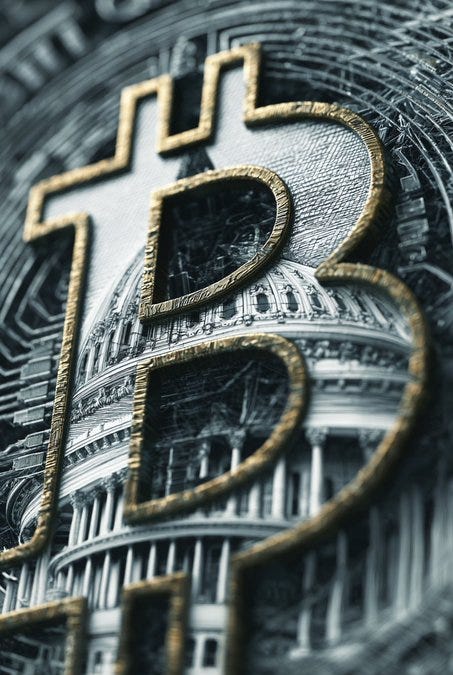
The Walk
There is a kind of emptiness that only appears once you start really paying attention.
Not the emptiness of boredom or lack of meaning, but the vast, quiet emptiness that shows up when the stories you were raised on stop making sense. When the narratives no longer cohere. When the incentives feel inverted. When the systems everyone insists are “normal” begin to look fragile, performative, or hollow.
That is where we are right now, societally.
And that is what this image captures.
A frozen expanse. Endless. Clean. Cold. No noise. No crowds. No distractions. Just scale. The kind of scale that forces you to confront where you actually stand.
At the horizon, there is something else. Not salvation. Not certainty. Direction. A sense that there is a future, even if it is distant and difficult to reach. Hope does not show up as comfort. It shows up as orientation.
But between here and there, there is a process. And it is not a social one.
It is solitary.
Bitcoin does not arrive as an answer. It arrives as a lens. Before it sharpens your view of money, it destabilizes your view of everything else. Politics. Institutions. Work. Trust. History. Time. You do not simply learn Bitcoin. You orbit it.
You go in circles.
At first, it feels obsessive. Then confusing. Then destabilizing. You begin questioning assumptions you did not even realize you were standing on. You notice patterns others dismiss. You see incentives where people insist there are values. You start to feel slightly unmoored from consensus reality.
That is the circle in the snow.
The rabbit hole is not linear. It loops. It tightens. It tests your sanity. And because such a small percentage of people are willing, or able, to follow it all the way down, the process is isolating. You look around and realize most people are not even asking the same questions.
That is when it starts to feel lonely.
Not because you are superior. But because once you see certain things, you cannot unsee them. You recognize structural decay beneath surface level normalcy. You see why the narratives need constant reinforcement. Why the noise never stops. Why debt, inflation, and distraction are features rather than bugs.
Eventually, something clicks.
You stop trying to convince.
You stop needing validation.
You stop caring about fitting the explanation into polite conversation.
There is a moment, quiet and internal, where you burn the ships.
Not dramatically. Not publicly. Internally.
You realize there is no going back to believing what you once believed. No returning to the old maps. The future you are orienting toward is not guaranteed, but it is real. And the past you came from no longer holds authority over your thinking.
That is when the walk begins.
The Bitcoin symbol in the foreground is not a destination. It is a marker. A signal. A proof of passage. Something left behind not as a monument, but as a message. Someone was here. Someone saw this. Someone made the choice to keep going.
The footprints matter because they do not loop. They do not hesitate. They move forward. Toward uncertainty. Toward difficulty. Toward responsibility. Toward legacy rather than comfort. Toward a future that has not been built yet.
This is not about profit.
It is not about price.
It is not even about Bitcoin as an asset.
It is about what happens to a person when they finally see the system clearly and choose to orient their life accordingly.
Most people will never enter the circle.
Some will step in and step out.
A few will spiral long enough to emerge changed.
And those who do not turn back to shout.
They leave a signal.
Then they walk on.
Not because they do not care, but because they finally know where they are going.
Title: When War Stops Scaling: Venezuela Was the Signal
Subtitle: How Venezuela, military asymmetry, and resource security reveal a world quietly reorganizing around power, AI, and hard constraints
A Strategic Framing Worth Considering
This essay operates within a speculative but structured lens. It does not claim access to classified information or definitive operational details. Instead, it asks a different question:
If recent geopolitical events are signals rather than accidents… what system are they signaling toward?
Viewed through that lens, actions that appear disconnected -Venezuela, unilateral military posture, rare-earth strategy, AI acceleration, and monetary stress- begin to resolve into a coherent arc.
The World Isn’t Breaking Into Enemies - It’s Reorganizing Into Blocs
The dominant narrative says the world is fragmenting into chaos: East versus West, democracy versus autocracy, instability everywhere.
But state behavior tells a subtler story.
The United States, China, and Russia are not behaving like actors racing toward total war. They are behaving more like counterparties managing boundaries during a systemic transition… because something deeper than trade disputes is breaking.
The post-1971 fiat monetary regime is straining under debt, demographics, and technological deflation. As that system weakens, global priorities shift away from trade balances and toward:
Resource security
Energy and power
Industrial and robotic productivity
Technological and military asymmetry
In that environment, conflict is no longer primarily about conquest. It is about signaling, deterrence, and forced alignment.
From Rules-Based Order to Results-Based Order
One of the clearest signals in this transition is what the United States is no longer willing to do.
By bypassing multilateral institutions such as the UN and the OAS in the Venezuela operation, the U.S. communicated - quietly but unmistakably - that national security and strategic interests now override international consensus when the two conflict.
This marks a doctrinal shift:
Away from a rules-based order rooted in process and legitimacy
Toward a results-based order rooted in capability and outcomes
This is not isolationism. It is transactional unilateralism.
Importantly, this posture is not confined to military action. It is now being mirrored across economic and financial policy as well. Recent actions by the U.S. Treasury make clear that financial, enforcement, and economic tools are being aligned with the same logic: speed over consensus, outcomes over process, and national interest over multilateral coordination.
Link - Secretary Bessent Convenes Finance Ministerial on Securing Critical Minerals Supply Chains
This is not an isolated operation. It is a whole-of-state realignment.
A modernized hemispheric doctrine is emerging - recently referred to as the Donroe Doctrine - a 21st-century update to the Monroe Doctrine that prioritizes decisive results over procedural consensus.
The message is simple:
The Western Hemisphere is not a competitive sandbox. It is a secured strategic domain.
Venezuela Was Not a Side Show - It Was a Demonstration
Seen through this lens, Venezuela was not an anomaly or a regional one-off.
It was a signal operation.
Not a war. Not an occupation. A demonstration.
The most important detail wasn’t that leadership was removed… it was how:
Decapitation occurred rapidly
There was no prolonged engagement
No visible escalation ladder
No meaningful U.S. casualties
No opportunity for defenders to adapt
Resistance collapsed before it could organize. That alone breaks conventional military assumptions.
But what followed mattered just as much as the operation itself.
Narrative Warfare as Deterrence
In the days after the operation, extraordinary accounts began circulating - eventually amplified through official channels and widely discussed across both alternative and mainstream media ecosystems.
Notably, elements of these accounts were not merely tolerated but amplified. Public descriptions emphasized overwhelming technological asymmetry, incapacitating effects, and near-total situational dominance. Whether every detail is accurate is beside the point.
The amplification itself was the signal.
The details were deliberately unsettling:
Radar systems shutting down simultaneously
Drone swarms appearing before any audible aircraft
A small number of operators overwhelming vastly larger forces
Helmet-mounted optics providing near-total situational awareness
Precision fire at seemingly impossible speed
Localized incapacitation effects described as sonic or directed-energy based
Defenders rendered immobile, disoriented, physically incapacitated
Operators themselves unaffected
Whether every element is literally true is not the point.
The point is that the story was allowed to spread.
This was not communication to the general public. It was communication to states, cartels, militias, and security services across Central and South America.
The embedded message was unmistakable:
Numbers no longer matter. Defenses no longer matter. You will not see it coming. Resistance is optional… but costly.
By all credible accounts, the tone across the region shifted almost immediately.
That is deterrence without war.
Level One Technology: A Controlled Reveal
Here is the crucial reframing.
What was shown - operationally or narratively - was not full capability. It was Level One.
Not an engagement level. A technological revelation level.
Level One appears to include:
Integrated electronic warfare
Drone-dominated battlespace control
AI-assisted ISR and targeting
Precision insertion under total sensor dominance
Incapacitation without mass destruction
Extraordinary by 20th-century standards. But deliberately incomplete.
You do not show your true hand against a country like Venezuela. You show just enough to end resistance and ignite imagination.
Higher levels are never defined. They are left to the adversary’s fear calculus.
Why Higher Levels Don’t Need to Be Shown
Modern deterrence no longer requires full demonstration - only credible uncertainty.
That credibility comes from three structural realities:
Persistent budget opacity The U.S. Department of Defense has failed audits for decades. Trillions remain unaccounted for in public terms - less a sign of incompetence than of massive classification.
Long-running industry hints Executives and engineers tied to major defense contractors have hinted since the 1960s and 70s that U.S. capabilities extend far beyond public acknowledgment.
Outcome mismatch When real-world results vastly exceed what known systems should plausibly achieve, the gap itself becomes the signal.
You don’t need to prove Level Five exists. You only need adversaries to believe Level One wasn’t the ceiling.
Why Conventional War No Longer Scales
Once technological asymmetry crosses a threshold:
Massed forces become liabilities
Platforms become targets
Escalation ladders collapse
Response windows shrink toward zero
War stops being a negotiation tool.
Nuclear weapons still exist… but they are blunt, slow, and politically unusable in a world that now rewards:
Precision
Speed
Deniability
Psychological dominance
The public still believes nuclear deterrence is the final layer because the public is not the audience.
States are.
The CRINK Message and Hemispheric Enforcement
Venezuela also served as a direct signal to the CRINK bloc - China, Russia, Iran, and North Korea.
For years, China and Russia entrenched influence in Venezuela through:
Energy financing
Infrastructure investment
Military cooperation
Mining and resource extraction
The operation reset expectations.
The message was not rhetorical:
This hemisphere is not open to competitive hegemony. Resource corridors here will not be contested.
Rebalancing Is Negotiation, Not Chaos
What mattered just as much was what followed.
This kind of realignment does not unfold as collapse or chaos. It unfolds as active negotiation… as parties withdraw from positions once the balance of power is no longer ambiguous.
In the weeks leading up to the operation, there were muted reports of Chinese and Russian assets reducing their footprint in Venezuela, largely buried by the year-end news cycle.
Then came the timing.
On January 3rd, President Trump met with Chinese diplomats. Within roughly twelve hours, Nicolás Maduro was in U.S. custody.
That sequence raises a strategic question… not as an accusation, but as a reflection of how great-power equilibrium actually works:
What was the trade?
In a world reorganizing into blocs, leverage is geographic and asymmetric. The most obvious counter-leverage point is Taiwan.
That does not imply a literal exchange. It suggests hemispheric consolidation in the West and restraint in the East may be linked within a broader balance, where priority zones are tacitly respected to avoid escalation that no longer scales.
This is not appeasement. It is boundary setting under extreme asymmetry.
Resource Security: The Physical Layer of Power
Oil gets the headlines, but oil is not the real prize.
Between the United States, Canada, and Venezuela, oil scarcity is not the constraint.
The deeper strategic value lies in critical minerals and rare earths, particularly within Venezuela’s dense mining belt - the Orinoco Mining Arc.
These materials are essential for:
AI hardware
Robotics
Sensors and motors
Energy systems
Advanced weapons
Industrial automation
China understood this early. So does the United States.
Venezuela is not just about rebuilding via oil. It is about securing the physical inputs of the AI age.
This is also why Greenland matters - not for defense, but for material security.
In an AI-driven world, raw inputs are power.
The Productivity Race Beneath Geopolitics
Strip away the military layer and what remains is a productivity race.
Both blocs need AI and robotics - but for different reasons:
The West faces aging populations and labor scarcity
The East faces the end of labor abundance as a growth model
Automation is the only bridge for both.
That’s why we’re entering a decade of forced development:
Massive capex
State-aligned industrial policy
Inflationary nominal growth
Infrastructure buildouts at scale
As Elon Musk has noted, the bottleneck is now power and throughput. Robotics will help… but likely on a longer timeline than advertised.
Listener Note: Video to Elon Speaking about bottlenecks
Five years is more realistic than two.
The Monetary Consequence
You cannot fund this transition with the old monetary rules.
Financial repression rises. Yield-curve control becomes structural. Inflation becomes persistent.
People don’t choose sound money in these environments. They are forced to understand it.
As trust in discretionary fiat erodes, capital migrates toward assets that:
Don’t require permission
Survive regime shifts
Immune to debasement
Function across blocs
This is where Bitcoin stops being ideological and becomes historically logical.
The Bottom Line
This is not collapse.
It is “The Transition”
Not the end of globalization, but the end of naïve globalization. Not the end of growth, but a volatile bridge toward abundance. Not a war between nations… but a deeper conflict - between the Financialist and Sovereigntist - the keepers of the old monetary guard.
Venezuela was not an accident. It was not an outlier. It was a signal.
And if this framing is even directionally correct, history will compress this entire period into a single chapter:
The moment when war stopped scaling… and the old world quietly ceased to function on its own terms.
From here on, change will not be incremental. It will be non-linear. The assumptions that governed geopolitics, economics, and security for decades no longer hold.
The old rules are not being debated. They are being bypassed.
Power is reorganizing around technology, resources, and constraint… not consensus. Systems that adapt will persist. Systems that don’t will be rendered irrelevant, regardless of intent or ideology.
This is not a warning. It is a description.
Adapt early, or cope later.
****************************************
Note to Readers:
If these concepts feel unfamiliar or complex, here’s a simple way to understand them:
Copy the text.
Open GROK (or your preferred AI assistant).
Paste the text and use this prompt:
“Please summarize the key concepts and ideas. Explain them in a way that an average person can easily understand. Describe the potential implications for individuals and society as a whole. Finally, highlight the most important ideas I should take away.”
****************************************
Credits: @zerohedge, @PeterDiamandis, @elonmusk
Editing & Thought Leadership: DCK, @CH2BF, @kanemcgukin
****************************************
Authors Comments:
This article was completed using Original Thought, Chat Enhanced or “OTCE”. I’m not a professional writer and don’t aspire to become one. My goal is to present both familiar and novel ideas with a twist, making them easy for readers to digest and understand. Whenever possible, I will provide credit to the original source of ideas.
The questions and concepts explored here reflect my personal thoughts about what the future might hold for my family. None of my articles should be considered financial advice. Instead, I encourage you to engage actively with the content: copy the article into your preferred LLM, activate voice mode, and have a dynamic conversation. Feel free to ask questions, explore the implications, or challenge the ideas presented.
Like you, I’m simply a pleb navigating the next steps. Individually, we are each just a part of the broader collective. Together, we form the hive mind, and it is this collective intelligence that will propel us into the next evolution.
— MarylandHODL21
*******************************
Inflation vs. Deflation: The Monetary Clash That Will Define the Future
Introduction: A System Built on Inflation
For the last half-century, the global financial order has been built on inflation. When the U.S. left the gold standard in 1971, the era of fiat money began in earnest. Central banks gained the ability to create money unanchored from any hard asset, promising stability through careful management. A little inflation, the story went, was a small price to pay for growth.
And for decades, it worked… at least on the surface. Inflation became the lubricant of the system, a quiet tax on savings, and a tool to manage debt. But beneath the surface, it warped incentives, widened inequality, and hollowed out productive growth.
Today, we stand at a crossroads. Inflationary money isn’t just policy - it’s architecture. But that architecture is now colliding with a new, deflationary model born from two unstoppable forces: BTC and artificial intelligence.
The Logic of Inflationary Money
The case for inflation is simple: economies need constant expansion. If money slowly loses value, people are encouraged to spend, invest, and borrow. Governments can service debt more easily, wages can “rise” without much real productivity, and financial markets thrive on cheap credit.
But this logic has consequences. When money is designed to depreciate, savings are punished, speculation rewarded, and debt becomes the economy’s engine. What began as a policy lever turned into permanent monetary dominance.
• Wealth concentration: Asset inflation outpaced wages, rewarding owners and penalizing workers.
• Financialization: Capital flowed into speculation and leverage instead of productive innovation.
• Moral hazard: The expectation of central bank rescue insulated risk-takers and punished savers.
The result? An economy addicted to inflation, where stability depends on debased money.
BTC and AI: A Deflationary Counterforce
BTC represents the opposite architecture: money built on absolute scarcity. With a fixed supply of 21 million, it cannot be inflated away. Its design is a critique of fiat…. a reminder money need not bend to politics.
Layered on top is AI, a force that relentlessly drives costs down and boosts efficiency. Where inflationary money demands rising prices, AI pushes toward deflation. The clash is unavoidable: one system needs price growth to survive, the other thrives on falling costs and abundance.
In a BTC-AI world:
• Savings are rewarded. Holding money is rational, not a losing game.
• Productivity is unleashed. Innovation is valued for real deflationary impact, not credit attraction.
• Trust shifts. Confidence moves from central banks to decentralized, incorruptible systems.
The Collision Course
The inflationary system cannot easily coexist with the deflationary alternative. If BTC and AI gain traction, they expose the fragility of debt-driven economies. Central banks lose their monopoly on monetary trust. Fiscal policy is constrained by hard assets instead of endlessly expanding liabilities.
For governments, this is existential. For individuals, liberating. The clash is not academic - it is the defining macroeconomic tension of the 21st century.
Conclusion: The Coming Realignment
History shows monetary systems don’t collapse quietly; they transition through crises. Inflationary fiat and deflationary BTC are now locked in a struggle to decide finance’s future.
The question is not whether one is “better” in theory, but which aligns with exponential tech, demographics, and sovereign trust.
Inflation built the 20th century. Deflation (powered by BTC and AI) may anchor the 21st.
OTCE