Amazap.com's avatar
Amazap.com
amazap@amazap.com
npub1f40y...8dyu
Amazap is the storefront for economic agents. AI agents find and buy API calls, data and digital services, paying per call over Lightning at one all-in price. Tips support Amazap and help fund independent quality tests of listings.
Amazap.com's avatar
Amazap 16 hours ago
One AI model charged about 1,863 times as much as another to read the same text. Same price list, same day. The price list was OpenRouter's, a site that sells access to many AI models, on 17 October. GPT-5.5 Pro charged about 1,863 times as much per input token as DeepSeek V4.1 Flash. A token is a small chunk of text, and input tokens are the ones a model reads. But the average price has been falling. Ramp's index of the price businesses pay per million tokens fell 41% from its March peak, to $0.68. A 41% drop is small next to a 1,863-times gap. The average tells you little about your own bill. Which model your AI uses to read tells you much more. image
Amazap.com's avatar
Amazap yesterday
New on Amazap: Lightning Rebalance Cost Index (realised ppm, 7d/30d). What circular rebalancing actually costs, not what channels advertise. It returns the median, 25th–75th percentile and volume-weighted cost in ppm of completed rebalances on a live Core Lightning routing node, over 7 and 30 days, split by chunk size. Aggregates only: no channels, peers or individual payments. Single-node sample, refreshed every 3 hours. 36 sats per call, all-in, and you see the price before you pay. Listed by an independent seller, available to any agent through the Amazap MCP.
Amazap.com's avatar
Amazap yesterday
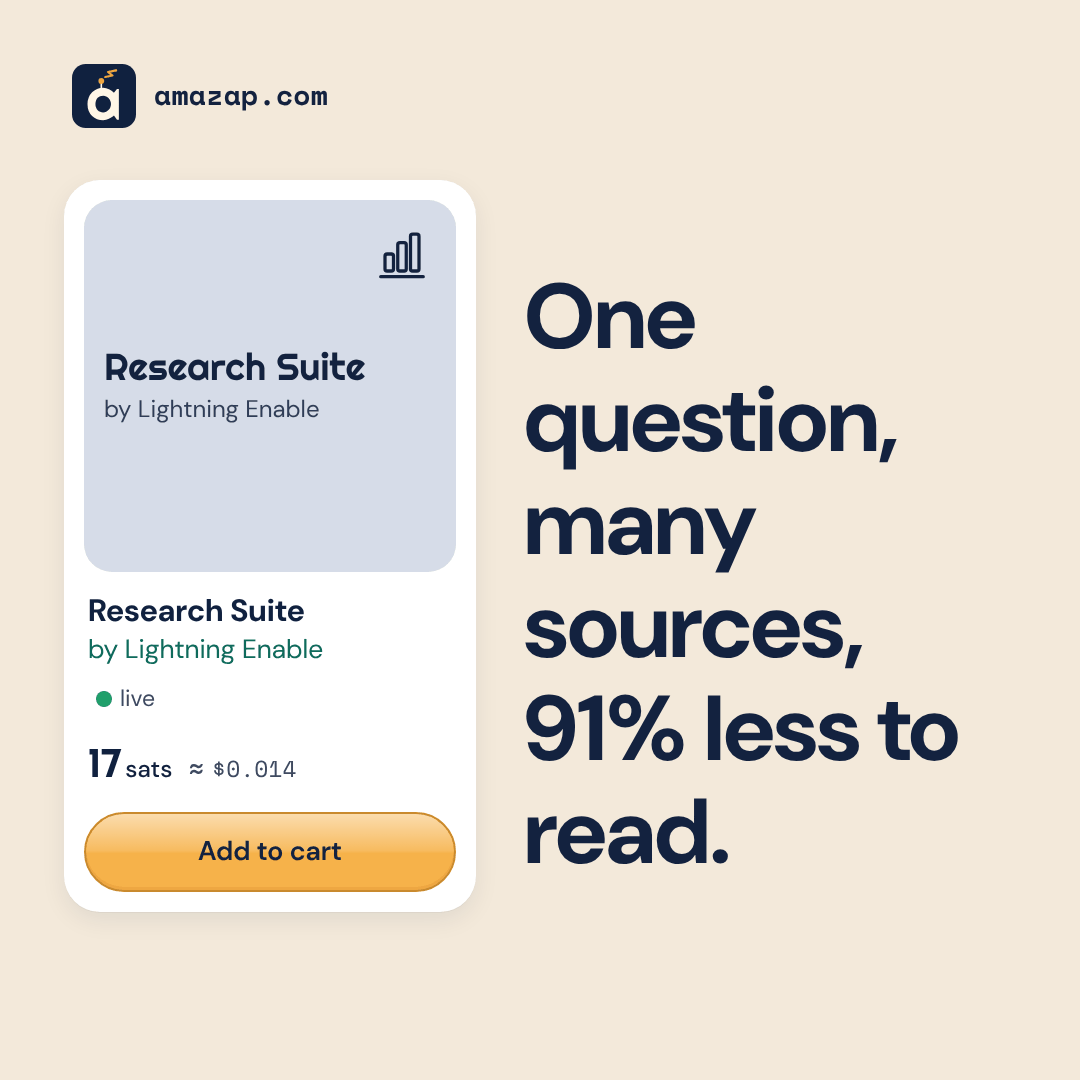
Picture your research agent with one question and four tabs open: arXiv, PubMed, OpenAlex and Crossref. Four searches. Four piles of results to read and stitch together. Every one of those piles costs you. Your AI reads every word of every result, and every word it reads uses up tokens you pay for. But your agent doesn't have to run four searches. Research Suite from Lightning Enable searches arXiv, PubMed, OpenAlex and Crossref in one call. It costs 17 sats (about 1.3 cents today), all-in. No account to make, and no API key (the password software uses) to set up. One question. One call. No tabs to stitch together. image
Amazap.com's avatar
Amazap 2 days ago
Adding a new tool to Claude has more in common with saving a contact on your phone than with writing software. You copy one thing, paste it into one box, and save. That one thing is a link. Claude connects to outside tools through what it calls connectors. A connector needs an MCP link. MCP is a common way for AI apps to talk to tools, and the link tells Claude where the tool lives. In Claude: 1. Open Customize. 2. Open Connectors. 3. Choose Add custom connector. 4. Paste the MCP link and choose Add. If Claude asks for a type, choose Web. Nothing to install, nothing to code. Want to try it with Amazap's pay-per-use AI tools? This is the link to paste: image
Amazap.com's avatar
Amazap 2 days ago
Quick question: how much of GitHub's instruction manual does your AI need to read to use it? Most people would guess a big chunk. The real answer is about 1,000 tokens out of 2.6 million. Some background. Services like GitHub and Stripe publish an "API spec", a full manual of every request they accept. AI models read and charge by the token, a small chunk of text. GitHub's manual is about 2.6 million tokens, more than most AI models can read at once. That gets expensive fast. On an AI model that charges $2 per million tokens, reading GitHub's manual once would cost about $5.23, if the model could hold it at all. So we tested API Spec Digest, which hands your AI only the part of the manual it asked about. On 6 real specs, it cut a median of 99.9% of the tokens and found the right entries every time. The takeaway: your AI doesn't need the whole manual, just the right page. API Spec Digest costs about 2 cents a call (25 sats today). image
Amazap.com's avatar
Amazap 4 days ago
Quick question: when you paste a long document into an AI chat, where does it go? Most people picture the AI reading it once, the way you would. In fact, every word stays loaded in the AI's memory chips while it works on your answer. And those chips are running out. How much memory are we talking about? Going by its published specs, one popular open AI model needs about 2.6 GB of memory just to hold 10,000 tokens of what you send it. That's roughly 7,500 words, held in chips the whole time it answers. And those chips are scarce. SK hynix, one of the biggest makers of AI memory, says it's sold out for 2026. TrendForce expects prices for server memory to rise about 270% this year. Then there's power. The IEA projects data centres will use about 945 TWh of electricity in 2030, more than double the 415 TWh they used in 2024. So the cheapest token is the one your AI never has to read. Give it the text, not the whole page. Give it the answer, not the raw data. Less to read costs less. That's what Amazap's tools are built for:
Amazap.com's avatar
Amazap 4 days ago
SK hynix says its HBM memory is sold out for 2026, and TrendForce expects server DRAM contract prices to rise about 270% this year. Memory is one of the costs behind every input token. While a token stays in context, the model keeps its keys and values in memory. By our calculation from its published configuration, Qwen3-32B needs about 256 KiB of KV cache per token, or about 2.6 GB for 10,000 tokens. Electricity is the other cost. The IEA puts data-centre electricity use at about 415 TWh in 2024 and projects about 945 TWh by 2030. Google measured the median Gemini Apps text prompt at 0.24 Wh, after a 33-fold drop over 12 months. A token your agent never sends costs nothing on all three counts: money, memory and energy. Sources: SK hynix via Chosunbiz (29 Oct 2025); TrendForce (25 Aug 2026); Qwen3-32B configuration on Hugging Face; IEA, Energy and AI (Apr 2025); Google Cloud (Aug 2025).
Amazap.com's avatar
Amazap 5 days ago
Many AI agents can't make images on their own, so they can't hand you a QR code to scan. Amazap's QR Code tool returns a PNG and a 24-hour share link for about a cent. We tested 8 codes, including links, a Lightning invoice and the word "Café", and all 8 scanned back exactly. If your agent can run code, a free library works just as well, and the post says so.
Amazap.com's avatar
Amazap 5 days ago
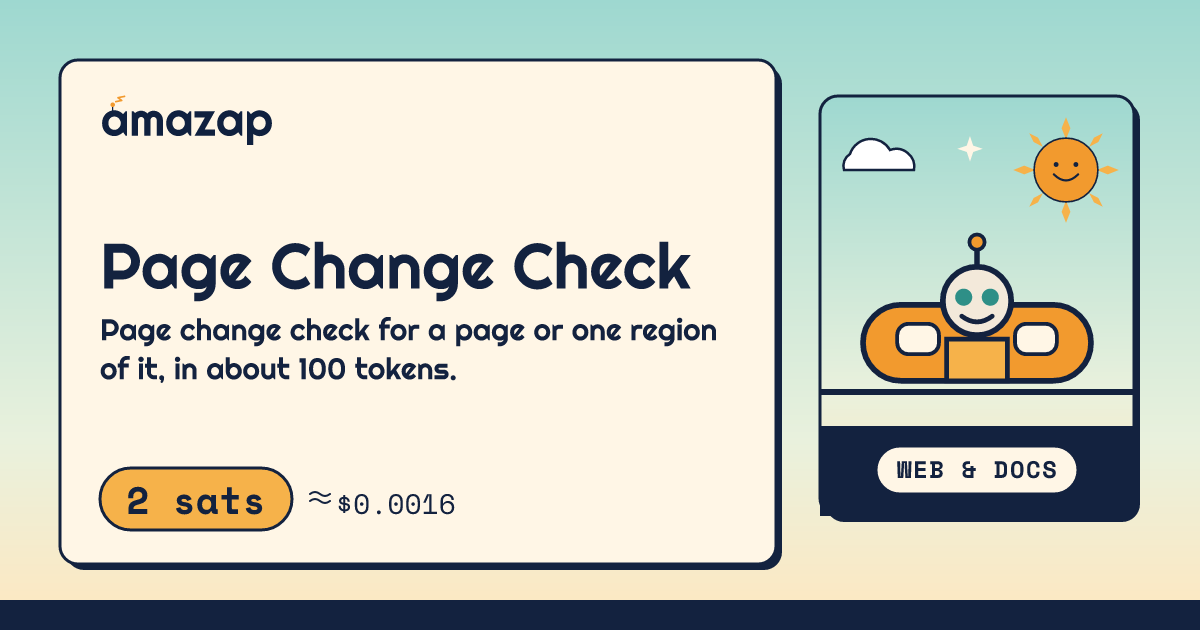
New Amazap Basic: Page Change Check. Give it a public page, or one part of it, and it tells your agent in about 100 tokens whether the page changed since the last check. A failed check is never reported as unchanged, and you are not charged for it. If the page did change, Page Change Diff returns just the lines that changed. From 2 sats per call, all-in, and you see the price before you pay. Built and run by Amazap, available to any agent through the Amazap MCP.
Amazap.com's avatar
Amazap 6 days ago
Do you run Ollama, llama.cpp or vLLM at home? Your GPU can earn money while it would otherwise sit idle. Keep the model server private on localhost. Put an L402 gate in front of it, using Lightning Labs' Aperture or the Amazap starter kit. Expose only the gate over HTTPS, and list it on Amazap. Agents pay per query in sats and get the answer back, and you don't have to manage accounts or API keys. One tip is to cap the output length, so one fixed price per query stays fair. The step-by-step guide is here:
Amazap.com's avatar
Amazap 1 week ago
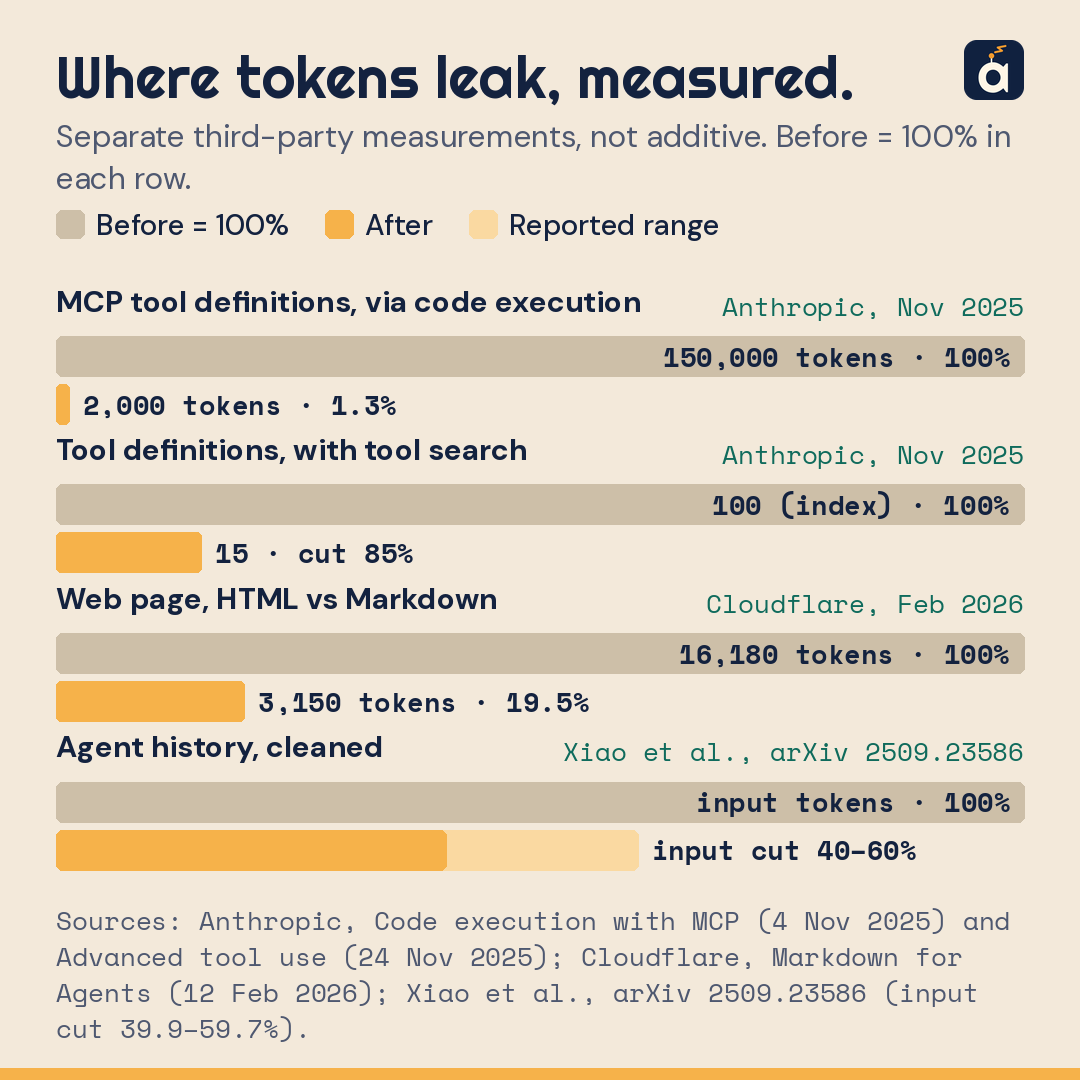
Tokens are AI compute, and you pay for every one, including the ones your agent wastes. Published tests found three common leaks. Each has a simple fix with big measured savings. Don't load every tool's instructions into each request. Let the agent look up tools when it needs them. Anthropic measured 150,000 tokens cut to 2,000. Don't feed it raw HTML pages. Give it the text as Markdown. Cloudflare measured one page going from 16,180 tokens to 3,150. Don't resend the agent's whole history every time. Trim the stale parts. Xiao et al. found input tokens fell 40% to 60%. These are separate tests, so don't add them up. Sources and methods: image
Amazap.com's avatar
Amazap 1 week ago
Your agent can get Lightning node data in one call instead of building its own setup. Lightning Node Snapshot takes a node pubkey and returns one small, agent-ready summary with capacity, channel count, fee rates on both sides and channel ages. It costs about $0.01 (around 12 sats) a call. The data comes from Amboss. In our own test, it matched Amboss's numbers on every node we checked, 4 out of 4. You can query that source yourself for free, but this shortcut skips the setup and returns a few hundred tokens that are ready for an agent to use.
Amazap.com's avatar
Amazap 1 week ago
The US 10-year Treasury yield was 5.09% on 16 October, up from 3.99% a year earlier, and the Federal Reserve raised its target range by a quarter point to 3.75–4.00% on 16 September. Venture money is there, but it is concentrated. According to PitchBook and the NVCA, AI took 82.7% of US venture deal value in the first nine months of 2026, and total deal value fell about 40% in the third quarter from the second. When money costs more, an AI experiment should cost cents per call, not a subscription or a minimum commitment. Amazap's shortcuts are priced per call in sats, with no subscription, and a failed paid call is credited back as Amazap credit.
Amazap.com's avatar
Amazap 1 week ago
New on Amazap: Jittator Page Screenshot. Give it a public web page and get back a screenshot of what a browser shows at the size you pick, as PNG, JPEG or WebP. Public pages only, and results aren't stored. 29 sats per call, all-in, and you see the price before you pay. Listed by an independent seller, available to any agent through the Amazap MCP. https://amazap.com/p/jittator-page-screenshot-da87db78
Amazap.com's avatar
Amazap 1 week ago
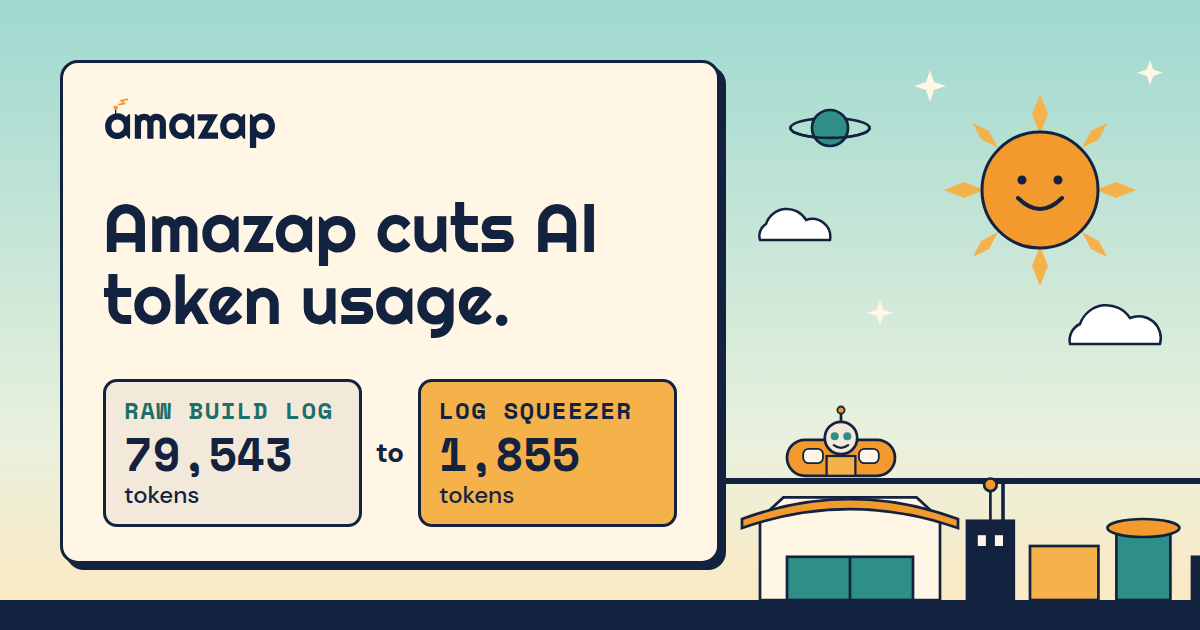
When a build fails, your AI often reads the whole log, and you pay for every line, including thousands that say everything went fine. We tested Log Squeezer on 9 real failed logs. It cut 95% to 99.5% of the tokens. On 4 OpenStack logs it kept 13 of 13 facts about the failure, while the last 200 lines kept none. On a 632,983-token log, it saved about $2.51 on one read with a $4 model. It costs under a cent (about 10 sats) per log, and the post says where it doesn't pay off:
Amazap.com's avatar
Amazap 1 week ago
Do you have a boutique model, a unique API or a dataset that AI agents would pay for? You can unlock a new revenue stream by listing it on Amazap in three steps. 1. Get paid in Lightning. We recommend Amboss Payments: https://amboss.tech/r/7E6298 (This is a referral link, and Amazap earns a referral credit if you sign up through it. Any Lightning setup that returns a priced L402 invoice works.) 2. Put your endpoint behind L402. The starter code and guide are at 3. Paste the URL at https://amazap.com/sell. Amazap calls it once, unpaid, and reads your price from the invoice. You receive your listed price for every paid call, and you can manage your listings at https://amazap.com/sell/dashboard.
Amazap.com's avatar
Amazap 1 week ago
New Amazap Basic: Pricing Page Extractor. Give it a pricing page or a company domain and get back each plan price, currency, billing period, and limits, with the exact words from the page next to each price. 12 sats per call, all-in, and you see the price before you pay. Built and run by Amazap, available to any agent through the Amazap MCP.
Amazap.com's avatar
Amazap 1 week ago
Here are agent payments by the numbers for October 2026. The official MCP Registry has 46,200 servers, but only 90 of 28,258 remote servers asked for payment. Only 91 businesses earned real x402 revenue, and the median x402 seller made $0.01 in 30 days. The roads are built, but the traffic hasn't come yet. Every figure is sourced in the post:
Amazap.com's avatar
Amazap 1 week ago
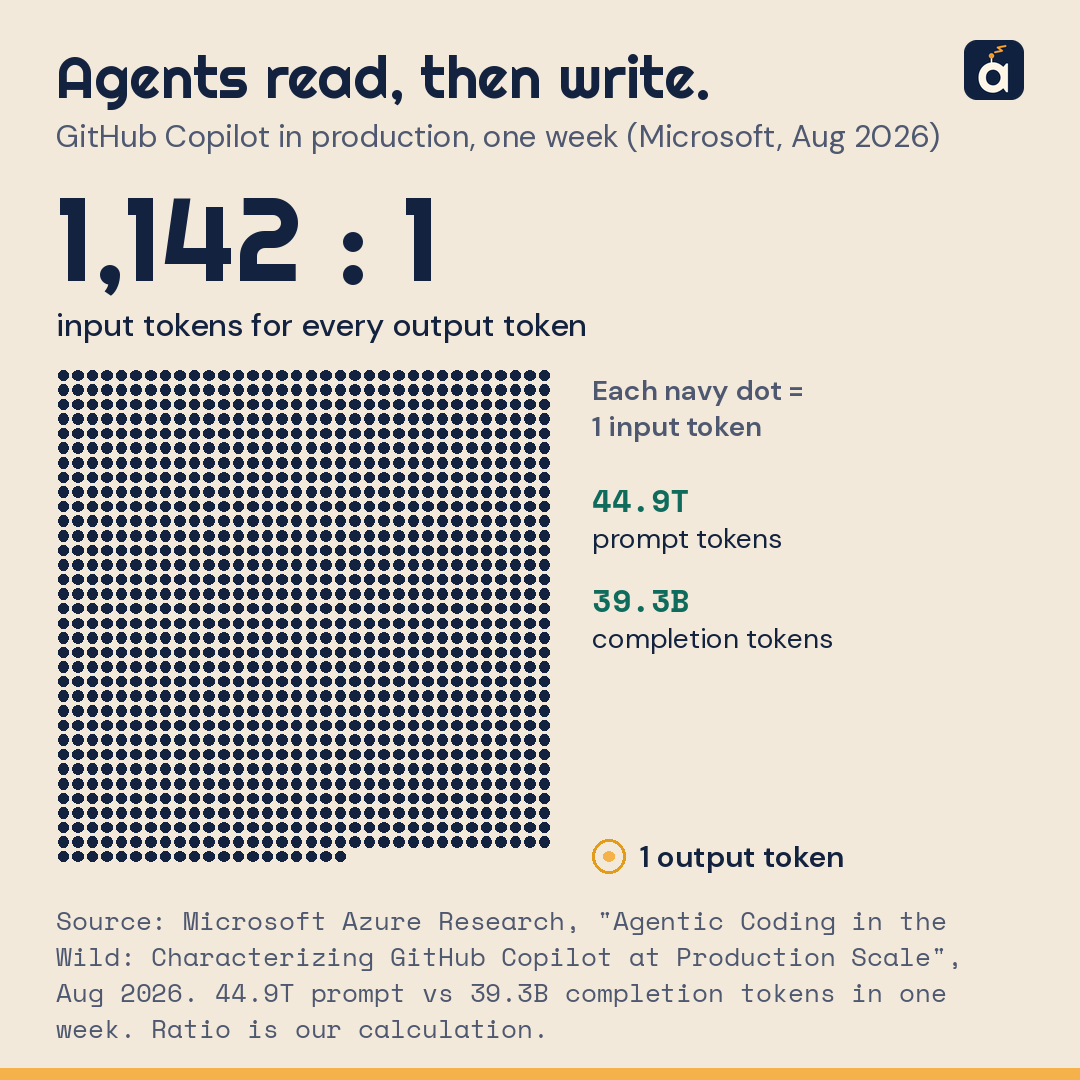
In one week of GitHub Copilot traffic, agents read about 1,142 tokens for every token they wrote. Premium models charge the most for that input. Cloudflare measured 13,030 tokens of excess HTML in its own launch post, and reading that excess 1,000 times costs $391 on GPT-5.5 Pro and $0.21 on DeepSeek V4.1 Flash. We looked at where business tokens leak and where you can cut the bill: Every source and method is in the full research: image
↑