Flextiger's avatar
Flextiger
flextiger@getalby.com
npub1gu5m...vf6c
Flextiger's avatar
Flextiger 1 year ago
image While US M2 has been rising since May 2024.
Flextiger's avatar
Flextiger 1 year ago
image September's bursting increase in global liquidity (M2) is the largest since November 2023. Remember last year’s Halloween Rally and Christmas Rally in the U.S. stock market? It may come earlier in 2024.

Flextiger's avatar
Flextiger 1 year ago
image The most likely price range for $BA by the end of 2024 is between $120 and $125. Very high probability (over 97%) will be above $125 by both November and December 2024. Today's (7/19/2024) price is $179.
Flextiger's avatar
Flextiger 1 year ago
$CRWD showed dump signal on July 10, 2024. Nine days before today's low level engineering error that crashed it. Oh, BTW, $VIX predicted two days ago that something big was upcoming. Charts do not lie!
Flextiger's avatar
Flextiger 1 year ago
VIX history shows we're in a low volatility period, but not at extreme lows yet. At 12.51, we're above the 9.5-10.6 range seen before past market shocks. Complacency? Maybe. But history suggests there's still room for volatility to drop before the next big spike. #MarketVolatility image
Flextiger's avatar
Flextiger 1 year ago
$BTC price Short-Term (1-2 Weeks): Bitcoin is likely to test support at $60,000. If this level holds, consolidation may occur. If it breaks, further declines are expected. Medium-Term (3-8 Weeks): Continued bearish momentum suggests potential further downside. A bullish reversal requires breaking above $70,000 with significant volume. Both the daily and weekly charts indicate bearish momentum, with the next critical support level at $60,000. Breaking above $70,000 is essential for a bullish trend reversal. A silver lining is last weekly $BTCimage price touched the 21 MA for the first time since the halving. The new week opens below the 21 MA. If this continues for a few weeks, repeating what happened after the 2016 halving, a solid springboard can form. (The white dot is the 21 MA.) image
Flextiger's avatar
Flextiger 1 year ago
The timing of the Federal Reserve's decision to lower interest rates depends on several economic factors and indicators. Based on the insights from the provided documents and current economic conditions, here are some considerations and a likely timeline for rate cuts: Economic Indicators to Monitor Inflation Trends: If inflation continues to moderate and move towards the Fed's target of 2%, this would provide room for the Fed to consider lowering rates. Employment Data: A rising unemployment rate and weakening job market could prompt the Fed to cut rates to stimulate economic activity. The current unemployment rate is relatively low but has shown signs of increase​​. Economic Growth: Slowing GDP growth, particularly if it falls below expectations, might lead the Fed to lower rates to support economic activity. Recent GDP reports have been below consensus expectations​​. Global Economic Conditions: External economic pressures, such as slower global growth or geopolitical uncertainties, could also influence the Fed's decisions. Predicted Timeline for Rate Cuts Late 2024: There is a possibility that the Fed may start cutting rates later in 2024. This is aligned with the expectation that inflationary pressures will ease, and economic growth might slow further, necessitating monetary easing​​​​. Early 2025: If the economic data remains mixed but does not show severe recessionary trends, the Fed might delay rate cuts until early 2025. This would allow more time to assess the impact of current monetary policies and adjust accordingly​​. Factors Influencing the Timing Fed’s Dual Mandate: The Fed aims to balance its dual mandate of stable prices and maximum employment. Significant deviations in either could prompt rate cuts. Market Expectations: Financial markets often price in expected Fed actions. If market conditions tighten significantly, the Fed might act sooner to prevent economic disruptions. Fiscal Policy Interactions: The interaction between fiscal and monetary policies, such as large fiscal deficits, can also influence the Fed’s timing. Loose fiscal policy can mitigate the need for immediate rate cuts but might necessitate them later to manage debt servicing costs and economic stability​​.
Flextiger's avatar
Flextiger 1 year ago
🚨 Breaking: Iran launches and concludes a slow drone attack on April 13, 2024, strategically timed between the close of Western markets and before Israeli stocks open on Sunday. A calculated move in a high-stakes global chess game. 🌍 #Geopolitics #MarketImpact
Flextiger's avatar
Flextiger 1 year ago
image Tools upgraded for BTC peaking strategy in the coming quarters. It's clock work. Easy money made during the low interest rate era, when wealth was given to real estate investors who knew how to accumulate properties with the easy money. BTC is easy money unless you refuse it!
Flextiger's avatar
Flextiger 1 year ago
image What stage is each market right now? Stock- Complacency (before the crash) or Disbelief (early recovery)? Crypto- Hope (Early adopters) or Optimism (Early majority)?
Flextiger's avatar
Flextiger 1 year ago
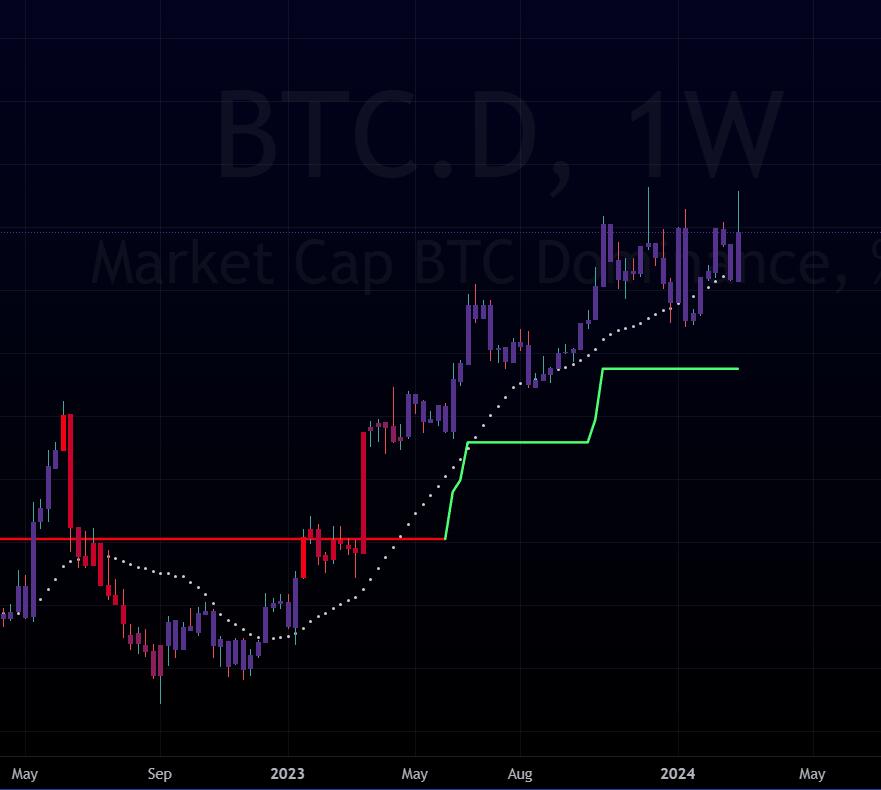
image BTC.D - Weekly $BTC Dominance chart looks beautiful - Steady Up!
Flextiger's avatar
Flextiger 1 year ago
How to Overcome the Inflation-Debt Paradox with AI Prosperity Leveraging the super-enhanced productivity to reshape our economy into one where growth, low-to-no inflation, and debt reduction go hand in hand. Imagine a new world where the same $100 bill can buy you significantly more goods and services than it does today, thanks to the deflationary impact of hyper-productivity. In this world, the Federal Reserve can lower interest rates without fear of stoking inflation, subsequently reversing the national debt and freeing up resources for growth and innovation. But Now, Face the Economic Labyrinth Before Us The current economic landscape is akin to navigating a impossible maze, where every turn presents the challenge of balancing inflation control with fostering economic growth, all while managing an ever-increasing national debt. The traditional tools wielded by the Federal Reserve, primarily the manipulation of the federal funds rate, have historically oscillated between stimulating growth and tempering inflation. However, this delicate equilibrium has been disrupted, evidenced by the unprecedented situation where the Fed was unable to transfer funds to the Treasury first time in history, and the national debt is projected to climb to a record 116% of GDP by the end of 2034, underscoring the urgency for innovative solutions to the burgeoning issue of national debt and its implications on fiscal policy. Spending on interest exceeded a number of other budget categories The Quest for a Sustainable Solution The critical challenge lies in recalibrating the federal funds rate to stimulate economic activity without igniting inflationary pressures. This task involves a nuanced understanding of the velocity and magnitude at which rate adjustments can be made to cool an overheating economy without stoking the fires of inflation. The theoretical underpinning for this approach finds roots in the Keynesian economic model, which advocates for active government intervention to manage economic cycles. The model suggests that carefully calibrated fiscal and monetary policies can stimulate demand and growth in times of economic downturn, while controlling inflation during periods of expansion. Strategizing Interest Rate Adjustments Aiming for an interest rate slightly above the long-term inflation goal of 2% emerges as a strategic solution. This approach aligns with the Fisher Equation, which delineates the relationship between nominal interest rates, real interest rates, and expected inflation. By setting rates that are modestly above the inflation target, the economy can achieve moderate growth and employment gains without precipitating inflationary pressure. Moreover, this strategy facilitates a more sustainable framework for managing national debt, alleviating the fiscal strain on the Treasury. Fisher Equation - Diagram The AI Catalyst: Transforming Economic Dynamics The advent of artificial intelligence (AI) and Artificial General Intelligence (AGI) introduces a paradigm shift. As Cathie Wood of Ark Invest suggests, these technologies are poised to serve as significant deflationary forces. The productivity boom fueled by AI—akin to the transformative impact of the Industrial Revolution—promises to elevate economic efficiency to unprecedented levels. This scenario is supported by Solow's productivity paradox, which observes that technological advancements initially may not reflect in productivity measurements until a significant integration period has passed. AI and AGI's full potential to revolutionize productivity and economic activity mirrors this concept, suggesting a future where the paradox is resolved, and productivity gains significantly outpace historical trends. Enhancing Purchasing Power Through AI In this new economic order, the concept of money itself undergoes a radical transformation. The deflationary impact of AI, coupled with its ability to exponentially increase productivity, could lead to a scenario where nominal inflation targets are maintained at 2%, yet the real inflation experiences a downward pressure, potentially reaching negative territories. This phenomenon is explained through the lens of the Quantity Theory of Money, which posits that the money supply's velocity and the volume of goods and services produced in an economy influence the price level. AI-driven productivity increases the volume of goods and services, thereby increasing the purchasing power of money. A New Economic Renaissance The emergence of an AI and AGI-driven economy not only promises to revolutionize our current financial systems but also fundamentally alters our understanding of money, interest, debt, and wealth. This shift introduces new economic theories and business practices, challenging and eventually replacing outdated models. The once-daunting challenge of national debt becomes a solvable problem, gradually clearing the path toward a future of financial stability and prosperity.
Flextiger's avatar
Flextiger 1 year ago
I anticipate the Federal Reserve's potential interest rate cuts in 2024, but I'm considering their broader economic implications quite different from our expectation. Traditionally, rate cuts stimulate growth by making borrowing cheaper. But I believe the increased liquidity from these rate cuts may be used more for managing government fiscal challenges, such as refilling the Treasury and paying off national debt, rather than stimulating the economy. This approach differs significantly from the economic expansion during the Reagan era, which suggests a more complex and perhaps less optimistic outcome for the stock market in the coming years.