Paulo Sacramento's avatar
Paulo Sacramento
psacramento@primal.net
npub1uesc...7chm
Creative thinker with bias for action.
Paulo Sacramento's avatar
psacramento 7 months ago
How many challenges in your life would already be solved if you had adopted the mindset: forget your feelings, follow the plan? How much further would you be in the areas that truly matter to you? Of course, this mindset has a price: it can turn you into someone emotionally detached, blind to your own feelings and those of others, creating an entirely new set of problems in different parts of your life.
Paulo Sacramento's avatar
psacramento 7 months ago
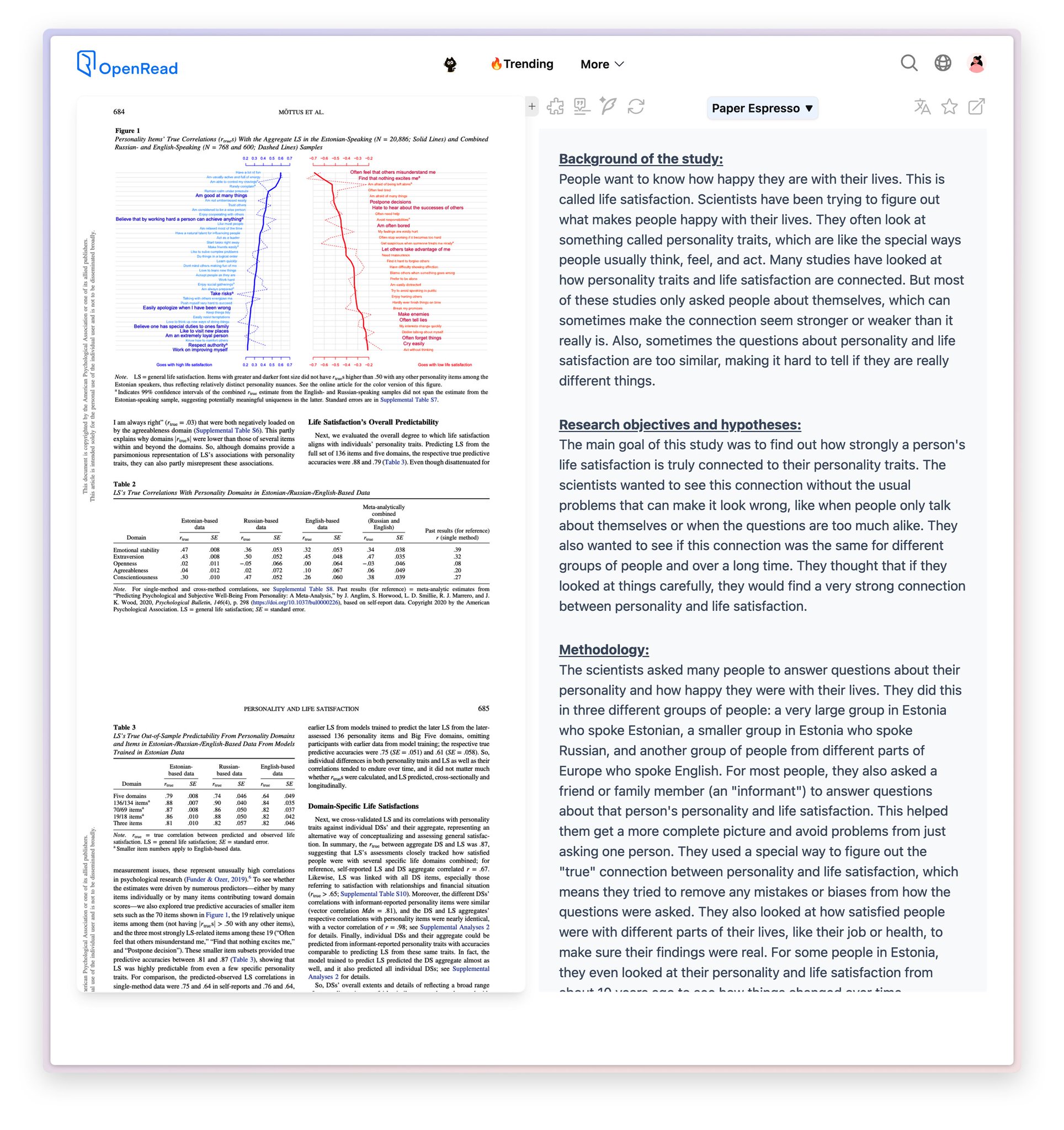
“The study found that a person's life satisfaction is very, very strongly connected to their personality traits. When they removed all the usual problems from how things were measured, they could predict how happy someone was with their life almost perfectly (like 80% to 90% accurate) just by knowing their personality traits. Even with just a few personality questions, they could predict life satisfaction very well. They found that being emotionally stable (not getting upset easily), being extraverted (outgoing), and being conscientious (organized and hardworking) were the most connected to life satisfaction. Being open to new things or agreeable (kind) had a smaller connection. These strong connections were found in all three groups of people, even though they spoke different languages. They also found that life satisfaction stayed pretty much the same over 10 years, and its connection to personality traits also stayed strong over that time.” Primary source: https://psycnet.apa.org/record/2024-93961-003 Secondary source:
Paulo Sacramento's avatar
psacramento 7 months ago
🎯That’s why so many dumb people are winning in life: because they are all about execution!
Paulo Sacramento's avatar
psacramento 7 months ago
Addiction is a progressive narrowing of the things that bring you pleasure. Happiness is a progressive expansion of the things that bring you pleasure. The former emerges passively. The latter takes work. image
Paulo Sacramento's avatar
psacramento 8 months ago
Back in 2011, @jack shared some insights into his entrepreneurial journey, talking about what inspired him and the core philosophies that guide him. His journey began in St. Louis, Missouri, where he developed an obsession with maps and visualizing cities. This passion led him to teach himself programming to draw maps on a computer screen and later track real-time data from police scanners and CB radios, visualizing ambulances, fire trucks, and police cars moving through the city. He learned this type of software was called dispatch. This early fascination with visualizing a “city living and breathing” became a foundational influence. Dorsey initially considered political science but switched to computer science after realizing he could see the effects of policies instantly through simulations. He continued building his dispatch system and eventually found work at DMS, the largest dispatch firm in New York City, after identifying and fixing a security vulnerability on their website. This experience solidified his focus on visualizing real-time data. The idea for Twitter emerged in 2000 from his desire to visualize people within the city, inspired by instant messenger away statuses and LiveJournal. His first prototype, using email from his Blackberry, failed because “no one cared what I was doing” and “no one else had a Blackberry.” He shelved the idea until late 2005 or early 2006, when SMS technology had become widespread in the U.S. He loved SMS for its constraints and simplicity. The concept was simple: use SMS to share what you’re doing in real time, broadcast it to interested people, and archive it on the web, device-agnostic. This idea, developed within the podcasting company Odeo, quickly led to the creation of Twitter. Dorsey says Twitter is still driven by curiosity about what’s happening right now everywhere. The inspiration for Square came during the 2008 market crash, which created an opening in the payments industry. Dorsey reconnected with his first boss, a glass artist named Jim McKelvey, who lost a $2,000 sale because he couldn’t accept credit cards. They decided to solve this problem by building a prototype of a credit card reader that plugs into an audio jack, along with server software. Key philosophies behind Square’s development include: - Payments as Communication: Dorsey sees payments as a form of communication and an exchange of value. He found the existing financial systems, especially receipts, poorly designed. - Redesigning the Receipt: Square aimed to transform the paper receipt into a medium that could provide useful information like social media handles, menus, and business hours. - Rich Data for Merchants: Square wanted to provide offline merchants with analytics similar to Google Analytics, helping them understand their sales beyond just revenue. - Marketing through Product: Square relied on word-of-mouth and feedback, targeting influencers like taco trucks to distribute their free device. Dorsey believes a beautifully built product markets itself. - Transparency and Simplicity: Square disrupted traditional merchant accounts with free hardware/software, no hidden fees, and clear pricing—without requiring a separate merchant account. - Payment Device Agnostic: Although Square started with credit cards, the goal was to improve the entire payment experience, preparing for technologies like NFC. - Building Utilities that Scale: Both Twitter and Square were designed to scale from individuals to enterprises, minimizing friction in using them and focusing on the value being delivered. Dorsey sees himself as a storyteller, emphasizing the importance of writing or drawing ideas to get feedback. He compares product development to writing a play and looks to companies like Apple for inspiration, calling them a “theater company” with cohesive storytelling. As CEO of Square, he sees his role as editorial: selecting the most important ideas to pursue. His three main priorities are: 1. Building the best team and maintaining cohesion. 2. Ensuring strong communication both internally and externally. 3. Managing finances—keeping money in the bank. He sums up his management philosophy as: “Make every single detail perfect and limit the number of details.” He finds inspiration in small moments, like discovering his father’s old pizza restaurant now uses Square. One of his guiding quotes is: “Expect the unexpected and whenever possible be the unexpected.” Source:
Paulo Sacramento's avatar
psacramento 8 months ago
Bitcoin’s Role in Refugee Wealth Preservation Every year, millions are forced to flee their homes—leaving behind not just possessions, but entire financial identities. In a world where displacement is rising and traditional banking fails the most vulnerable, a surprising lifeline has emerged: Bitcoin. This groundbreaking report from the Digital Assets Research Institute (DARI) offers the first quantitative estimate of how refugees are using Bitcoin to preserve and transport wealth during crises. It finds that at least 329,000 displaced people have relied on Bitcoin for financial continuity, a figure projected to grow to up to 7.5 million by 2035. Drawing on refugee population data, global bitcoin adoption rates, and real-world case studies from Ukraine, Gaza, the Congo, and beyond, the report shows that Bitcoin is not just a speculative asset—it’s a humanitarian tool. Read the report here: https://cdn.prod.website-files.com/656cd20247e4444dd911a978/6878661e609241f0a3962eb4_Bring%20Only%20What%20You%20Can%20Carry%20DARI%20Web.pdf image
Paulo Sacramento's avatar
psacramento 8 months ago
Quick updates on HashImpact: Today, I implemented a dashboard that allows me to add, remove and edit projects. Now I have a much cleaner, more structured way of maintaining the list of projects featured on the webpage. Currently, the listed projects are the ones that have a proper @Geyser page: - Bitcoin Famba: - Bitcoin Campus Zambia: When are you guys going to create Geyser project pages? Let me know when you are ready! :D @BTC Shule @Bantu Bitcoin Zambia Podcast @Bitcoin Innovation Hub @Bitcoin Boma I also added more information about how the Price Level Index indicator helps me select suitable countries for featuring.
Paulo Sacramento's avatar
psacramento 8 months ago
What can I use to create a feed with my favorite Nostr profiles?
Paulo Sacramento's avatar
psacramento 9 months ago
Woke up. Grabbed some coffee. ☕ 🧑‍💻 Started helping to review a research on the software needs of activists. Life is good! 😄
Paulo Sacramento's avatar
psacramento 9 months ago
Noticed yesterday that Perplexity can control my smartphone when we interact via Voice Mode. I asked it to make a search about apps that could be used for a certain use case. Perplexity recommended a specific app and asked me if I wanted to open its App Store page. I said ‘yes’ and boom, it opened it for me. 🤯
Paulo Sacramento's avatar
psacramento 9 months ago
A recent conversation with @metamick helped me decide how to address an issue with the HashImpacts project. Although we're only talking about contributing a few sats and the projects have been vetted, it still feels strange to continuously send money to a random person's wallet in Africa. To alleviate this feeling, I decided to focus on promoting organizations with @Geyser projects, along with their Geyser project's Lightning address and a link to the project's page on the platform. This way, contributors have the opportunity to learn more about the projects in a structured way and can also see their sats flowing in when they check the contributions tab on the projects page. This increases transparency and gives healthy boundaries that will be helpful when larger miners start contributing.
Paulo Sacramento's avatar
psacramento 9 months ago
I have been experimenting with creating a prompt that can identify where photos were taken based only on visual cues (no EXIF data). The following prompt has produced positive results when used with both o3-mini-high directly on ChatGPT and Grok 3 with Deep Think activated. Prompt: You are a world-class open-source-intelligence geolocation analyst. Given one still image with no EXIF data, deliver an evidence-driven assessment of the three most probable geographic locations where the photo was taken. Step 0: Rapid orientation (thirty seconds or less): classify the scene as urban, suburban, rural, coastal, mountain or other; note dominant land use, apparent season and estimated local solar time. Step 1: Systematic clue extraction: for each observable element record four items— the clue itself, your raw observation, what the clue suggests and your confidence percentage. Work through the following categories. Architecture and infrastructure: describe building materials, roof shapes and façade era; measure lane width in pixels, convert it to real-world width using known vehicle dimensions and compare with regional road standards; note curb profiles, pavement colour and sidewalk style. Language and typography: transcribe every visible letter or numeral before interpretation; identify scripts, fonts, diacritics, abbreviations and telephone formats. Vehicles and licensing: list makes and models, colour schemes, taxi liveries, plate shape and colour, alphanumeric pattern and position of registration seals. Traffic control and signage: note ISO sign shapes such as octagon, upward triangle, circle and diamond; record road-marking colours, stop-line geometry and pedestrian-crossing design. Natural environment: identify tree or plant species by Latin names and link them to Köppen climate zones; describe soil or rock hues, coastline or inland setting and elevation cues; apply the shadow-vector method— measure sun-cast shadow length and direction, compute azimuth and elevation and estimate latitude within plus or minus five degrees together with local solar time. Culture and human activity: observe clothing layers, religious symbols, public-transport branding and refuse-collection bins. Technology and utilities: sketch utility-pole topology and name electric-grid systems that use it; note cell-tower style, street-lamp heads and manhole-cover patterns. Negative evidence: tag items expected but absent, for example bilingual signage or overhead wires, and score the impact of each absence. Step 2: Hypothesis generation: propose up to five candidate locations named by city, region or country; list supporting clues, contradicting clues and the influence of negative evidence for each candidate. Step 3: Probability scoring: apply Bayesian updating so that posterior probability equals prior probability multiplied by likelihood for the top clues; assign probabilities that sum to one hundred percent; give a ninety-five-percent confidence bounding box in latitude and longitude degrees for the leading candidate. Step 4: Cross-validation: mentally compare candidates with satellite or street-view imagery, regional regulations and climate data; state which open datasets you would query and why, without actually performing the queries. Final output: state the three most probable locations ranked one to three with their probabilities, bounding box for the first location, key supporting clues and key contrary or negative clues; provide numbered step-by-step reasoning that references the clue log; supply one regex line that aggregates all captured text; include a blind-spot checklist listing any entire clue categories that are missing from the image; finish with two or more suggestions for next-step verification. Add a disclaimer that confidence scores reflect likelihood based on visible evidence only and do not guarantee accuracy. Rules: every claim must trace to a visible pixel; mark uncertainties clearly and do not hallucinate; when evidence conflicts, present both sides and remain agnostic; do not reveal private information about individuals.