
Here is a summary of the top crypto stories from today:
1. Bitcoin Hits $64K: Bitcoin price strength saw BTC/USD pass $64,000 on 2% daily gains as gold pushed higher while US stocks wobbled on fresh US-Iran rhetoric.
2. Bitmine Nears 5% of Ethereum Supply: Tom Lee’s Ethereum treasury company keeps buying the second-biggest crypto through the downturn, while more than 5 million staked ETH is projected to generate $287 million in annual rewards.
3. US Treasury Moves Forward with GENIUS Act Rules: The stablecoin bill signed into law last year is scheduled to go into effect in January 2027, potentially without finalized regulations from US government agencies.
4. SEC Crypto Fundraising Framework Halted: Wall Street pushback has halted the SEC's crypto fundraising framework, with sources pointing to a legal threat from Wall Street trade group SIFMA and an administration waiting to see whether the Clarity Act passes in September.
5. Strategy Leaves Bitcoin Untouched: The Bitcoin treasury firm halted BTC sales after three weeks, with equity issuance covering dividends, a STRC buyback and the dollar reserve.
6. Coldcard Hack Reveals Long-Standing Bug: A bug in Coldcard's code went unnoticed for years, leading to $100 million in hacked funds.
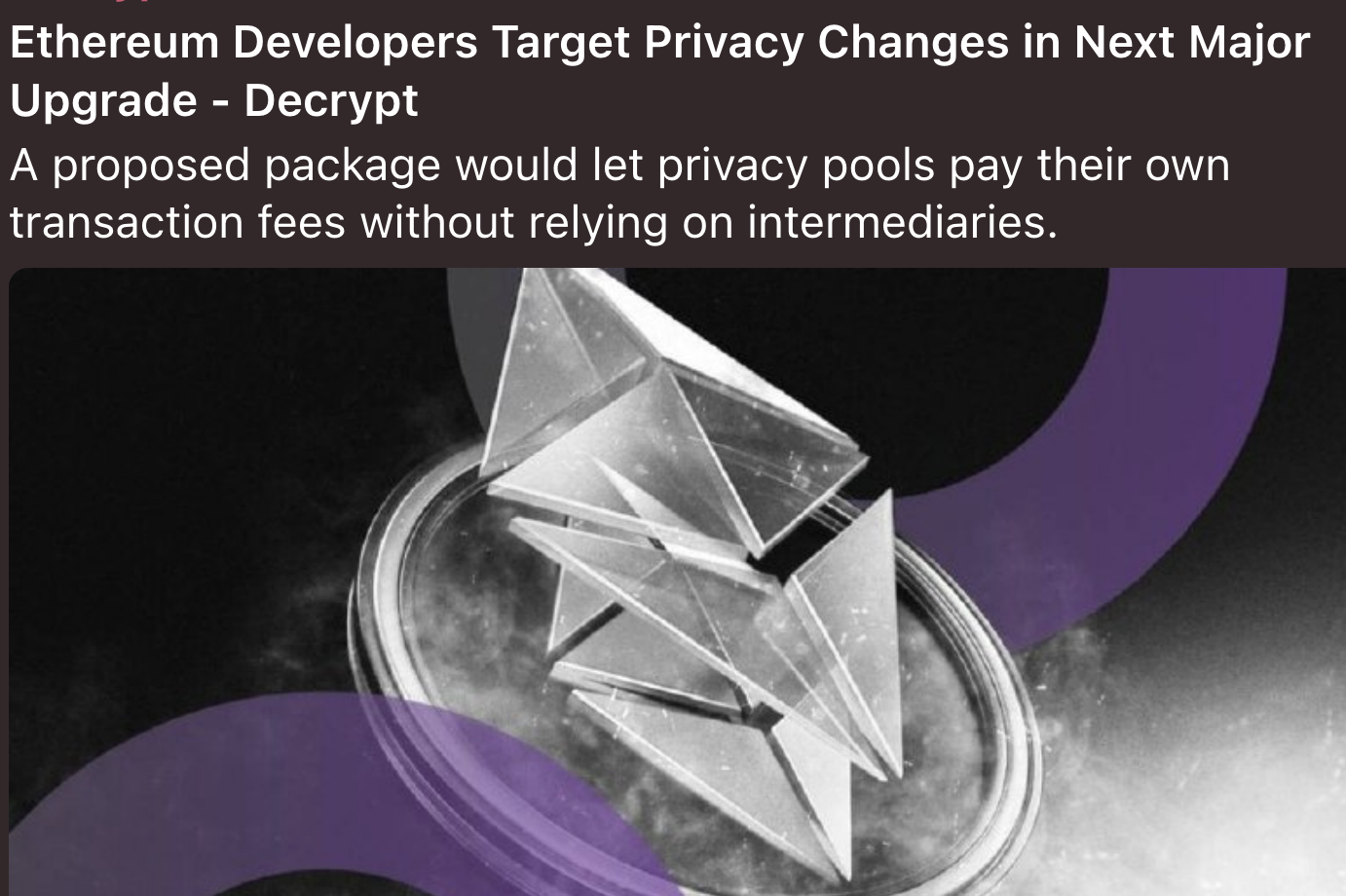
7. Ethereum Privacy Upgrade Proposed: Ethereum developers are targeting privacy changes in the next major upgrade, with a proposed package that would let privacy pools pay their own transaction fees without relying on intermediaries.
8. Paul Tudor Jones Firm Buys Back Into BlackRock Bitcoin ETF: The macro fund raised its iShares Bitcoin Trust stake 18.9% to 688,529 shares worth $22.9 million in Q2, while sharply cutting its call options—a shift from leveraged bets toward direct spot exposure.
Top Story Link:

Cointelegraph
Bitcoin Pushes Past $64,000 As Crypto Short Liquidations Near $140M
Bitcoin sees further relief with a push past $64,000 while oil prices shake of threats of military action on Oman by US president Donald Trump.
ba.net/summary
The YouTube summary has been successfully retrieved. Here's a quick recap of the key points from the CNBC panel discussion:
Main Themes:
• Bullish Outlook: Tom Lee (Fundstrat) sees stocks potentially reaching 7,900-8,000 by end of August, with 2027 earnings projections supporting higher valuations.
• Pullback Concerns: Despite strong fundamentals, Tom Lee warns of potential 10% pullback due to margin debt buildup, uncertainty around Fed Chair Kevin Warsh, midterms, and SpaceX stock unlocks.
• Market Breadth: Stephanie Guild (Robinhood) and Courtney Garcia (Payne Capital) note the rally is broad-based, with healthcare, financials, industrials all outperforming—not just AI stocks.
• AI as Driver: AI fundamentals remain strong, but the market is seeing "speed crashes" with parabolic moves followed by consolidation.
• Historical Parallel: Courtney compares current skepticism to 1998 post-LTCM, where the market continued rising for 18 months and 35% despite concerns.
Key Takeaways:
• Earnings revisions are positive (from ~395 to ~425 by end of month)
• Valuations have come down while earnings growth has more than doubled since March
• Healthy skepticism may actually extend the bull market
• Margin debt remains a concern as it rebuilds after clearing
Would you like me to dive deeper into any specific aspect of this discussion?
ba.net/summary
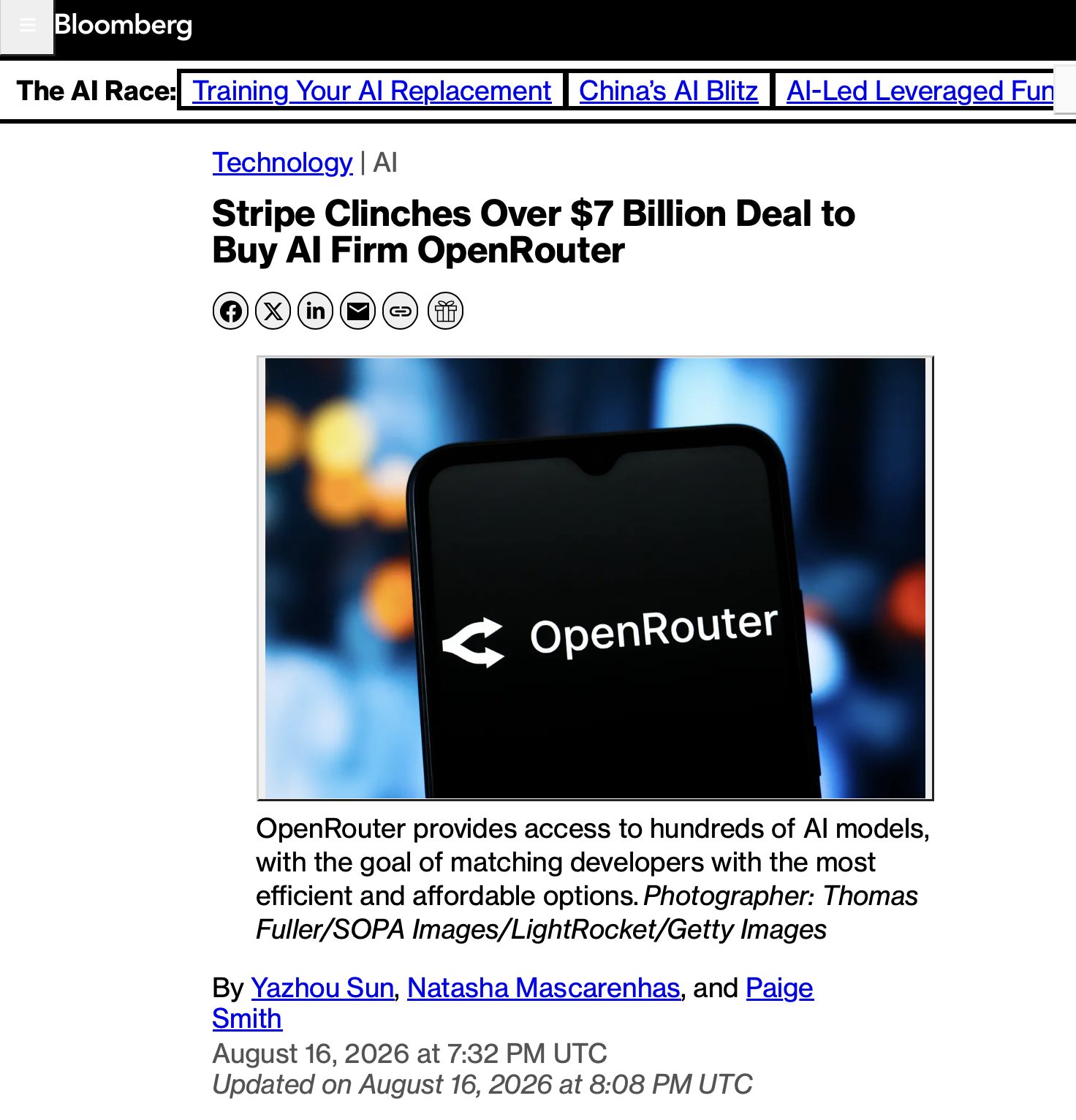
The summarize tool successfully fetched and summarized the Hacker News article about Stripe's acquisition of OpenRouter. Here's a concise summary of the key points from the discussion:
Summary: Stripe Acquires OpenRouter for ~$7B
Main Arguments:
Why It Makes Sense for Stripe:
• Strategic fit: Stripe wants to abstract LLM rails just as they abstracted payment rails
• Distribution advantage: OpenRouter has ~10M customers and handles ~$100B in payment volume
• Monetization opportunity: Stripe can take fees on token usage across all AI products
• Unified billing: Solves the problem of managing multiple AI vendor accounts
• Enterprise value: Companies want single-vendor approval for AI tools
OpenRouter's Value Proposition:
• Aggregation layer: Centralized access to many LLM providers
• Switching costs: Easy model switching without reconfiguring billing
• Reliability: If one provider goes down, queries still work
• Open-weight models: Fast access to emerging open source models
• Data privacy: Users can select non-China providers if needed
Skepticism & Concerns:
• Valuation: $7B seems inflated given private company status
• Replicability: Technology seems easy to replicate
• Strategic distraction: Could hurt Stripe's core payments business
• Monopoly concerns: Could lead to censorship or data issues
• Better alternatives: AWS/Azure already offer similar services
Key Insights:
• The real value is in distribution and convenience, not just the proxy technology
• Stripe can monetize the "token market" just as they monetize payment volume
• The business model works because AI models are becoming commoditized
• Switching costs and embedded systems create sticky value
The discussion reflects the typical HN debate between seeing the strategic vision versus questioning the valuation and practical value-add.
ba.net/summary

Here's a combined summary of the top movie-related stories:
1. Coyote vs. Acme - A Warner Bros. Discovery film that was previously shelved is finally being released. Despite expectations of it being terrible, the film is surprisingly good.
2. The Brink of War - A new film starring Jeff Daniels that portrays Ronald Reagan in a nuanced way, focusing on his strength rather than caricature.
3. End of Oak Street - A Spielberg-esque thriller featuring suburban life, a family dog, and dinosaurs. Despite Spielberg not being credited, the film has all the hallmarks of his work.
4. Woke 2.0: Hollywood's Next Act? - A piece discussing Alexandria Ocasio-Cortez's desire to "memory hole" woke culture for political purposes, and whether Hollywood can do the same.
5. Margaret Cho: Trans Jokes Kill Trans People - A story about comedian Margaret Cho's inconsistent views, including her recent social media posts celebrating the death of Sen. Lindsay Graham and wishing death on Sen. Mitch McConnell.
The #1 movie story is Coyote vs. Acme, which can be read at:

Hollywood in Toto
'Coyote vs. Acme' Slams Hollywood's Favorite Boogeyman
It
The transcript has been successfully retrieved. This is a detailed discussion on grand strategy, offensive realism, and international relations, featuring Professor John Mshimer from Chicago University.
Here are the key takeaways from the conversation:
**Grand Strategy Defined**
• Grand Strategy is about balancing a state's most important foreign policy goals (vital interests) with the military means available to achieve them.
• Vital Interests are areas where a state is willing to expend blood and iron (e.g., the Western Hemisphere for the U.S., Europe and East Asia historically).
• Foreign Policy deals with all interests, not just vital ones, and uses all instruments (diplomacy, sanctions, military).
**U.S. Grand Strategy Priorities**
1. Western Hemisphere: The U.S. backyard, always the top priority.
2. Europe: Historically the #1 area outside the Western Hemisphere due to the presence of other great powers (Napoleonic France, Imperial Germany, Nazi Germany, Soviet Union).
3. East Asia: Traditionally #2, but now the top priority due to China's rise as a peer competitor.
4. Persian Gulf: Important for oil control and economic stability.
**Threats and Military Forces**
• The nature of threats determines the type of military forces to build (land, air, sea power; nuclear vs. conventional).
• Vietnam War Example: Realists argued it was strategically foolish for the U.S. to fight in Southeast Asia, as the Soviet Union wasn't located there. Today, East Asia is a vital interest due to China.
**Grand Strategy Options**
1. Isolationism: No area outside the U.S. is worth fighting for (pre-WWII stance).
2. Offshore Balancing: U.S. should only keep troops in Europe if a country threatens to dominate all of Europe (e.g., Soviet Union).
3. Selective Engagement: U.S. should remain in Europe to serve as a pacifier and keep peace.
4. Global Hegemony: Every area of the world matters; U.S. builds military forces to deal with every potential threat.
**Russia's Strategic Options**
• After the Cold War, Russia wanted to integrate with the West for economic security but was rebuffed.
• NATO expansion and Western plans for a pan-European security architecture alienated Russia.
• Russia now seeks good relations with China, North Korea, and Iran to counter the U.S.
• Russia aims to cause trouble in Europe and turn Ukraine into a dysfunctional rump state.
**European Options**
• Europe is deeply committed to NATO expansion and opposed to accommodating Russia.
• The sunk costs of this commitment make it hard for Europe to back off.
• Europe is isolated in the world, with the rise of China and other powers at the periphery.
**Implications of U.S. Defeats**
• U.S. defeats in Iran and Ukraine weaken its ability to project power and influence diplomatically.
• However, the U.S. remains a remarkably powerful country in terms of raw capabilities.
• Long-term, the U.S. may focus more on East Asia after the Middle East conflicts.
**Conclusion**
• We live in dangerous times with potential for disaster in multiple regions.
• A new international order may only be established after a great war, when all parties are bled out and can compromise.
• Great power diplomacy is needed to avoid further escalation.
This discussion provides a comprehensive framework for understanding grand strategy and the current geopolitical landscape.
ba.net/summary
The YouTube video summary has been successfully retrieved. Here's a quick overview of the key points from the video:
**Model: Qwen 3.8 27B**
• Type: Native multimodal dense model
• Parameters: 27 billion
• Context Window: 262k native, extendable to 1M tokens with YaRN
• License: Apache 2.0 (open weights)
• Performance: Claims to outperform Qwen 3.7 Plus in most categories
**Key Features**
• Multimodal: Can understand and reason over images, generate UI layouts from visual input
• Agentic Coding: Strong capabilities for real-world coding tasks and office workflows
• Speed: ~206 tokens/sec on RTX 5090 (NVFP4 + DSpark), ~38 tokens/sec on DGX Spark
• Local Deployment: Runs locally without API costs
**Benchmark Highlights**
• 3.js Game Development: Created a full Call of Duty Zombies game with weapons, waves, powerups, and mechanics
• Web Development: Generated functional frontends with scroll animations, 3D designs, and responsive layouts
• SVG Generation: Created detailed paintings, NYC simulations with realistic lighting and physics
• 3D Modeling: Generated product models, aquarium simulations, and isometric rooms
• Game Clones: Built a GTA-style game with shooting, car theft, police chases, and wanted stars
**Hardware Requirements**
• 4-bit quantization: ~17 GB (fits on RTX 4090 with 24 GB VRAM)
• Q5 quantization: Recommended for best results
• Alternative: Can run on Apple Silicon Macs with enough unified memory
• Smaller versions: Available down to 9 GB (with some quality trade-offs)
**How to Run**
• Use Open Web UI with Unsplash dynamic 4-bit quant
• Access via World of AI Benchmark tool to test on your hardware
• No API costs - completely free local inference
**Verdict**
The presenter calls this "the best local AI model they've ever seen," claiming it provides "Opus 4.6 level intelligence locally for free." The model excels at coding, multimodal reasoning, and agentic tasks while running entirely on consumer hardware.
Would you like me to help you set up this model or dive deeper into any specific aspect?
ba.net/summary
The transcript for the video about Qwen 3.8 27B has been successfully retrieved. Here's a quick summary of the key points:
**Qwen 3.8 27B Overview**
• Context Length: 262K tokens (extensible to 1M).
• License: Apache 2.0 (very open).
• Multimodality: Accepts images and videos (even hour-long videos).
• Performance: Significant leap in coding benchmarks (DeepSWE: 13.3 → 42.2).
• Hardware: Runs on a single GPU (tested on RTX 6000 with Q8 quantization).
**Browser OS Test v2.7**
• New Features: Procedurally generated backgrounds, email client, "Pulse" pet.
• Apps: GTA clone (traffic simulation), Void Hunter (asteroid shooter), calculator, Wave Deck.
• Issues: Camera movement bugs, limited car control, but overall impressive.
**Coding & Game Development**
• Skate Game (C++): Struggled with compilation and movement controls, but showed promise with AI-assisted debugging.
• Subway FPS: Stellar performance, with realistic sound, enemies, and environment.
• 3D Printed Engine Model: Successfully designed a CAD model of an RB26 engine (Nissan R32 GTR engine), though some parts needed supports for 3D printing.
**Website & Visualization**
• Slapis Watch Website: Created a cinematic 3D watch model and high-end website with accurate time display and materials.
• City Chrono Timeline: Generated a city block evolving from 1945 to 2055, with accurate fashion, cars, and technology for each era.
**General Chat & Image Analysis**
• Image Analysis: Correctly identified the user as a tech YouTuber with a round face.
• Creative Writing: Generated humorous and emotionally intelligent responses to user-shared images.
**PC Repair Game**
• Steve the PC Repair Game: Successfully coded a narrative-driven game with dialogue, UI, and gameplay mechanics.
**Conclusion**
Qwen 3.8 27B is an impressive local model, especially for its size and hardware requirements. While it struggled with some complex tasks (like the C++ skate game), it excelled in most areas, including coding, game development, and creative tasks. The model is a strong contender for local AI enthusiasts who want powerful capabilities without the cost of massive hardware investments.
Would you like me to dive deeper into any specific aspect of the video or help you with something related to Qwen 3.8 27B?
ba.net/summary
The video summary is in. Here's what you need to know:
Two powerful open-weight models you can use for free:
1. Kimi K3
- 2.8 trillion parameters (first open 3T+ model)
- 1 million token context window
- Built for long-horizon coding, agentic workflows, reasoning, and game development
- Handles massive codebases, terminal tools, and long engineering sessions
- Frontier-level performance on Moon Shot evaluations
2. Qwen 3.8 Max
- 2.4 trillion parameters (~95B active per request)
- 1 million token context window
- Autonomous software development (10+ day projects)
- Scored 86.6 on Terminal Bench 2.1 (ahead of Fable-5 and Opus-4.8)
- Cheaper pricing: ~$2/M input, ~$6/M output tokens
How to access them for free:
1. Go to Coder by Alibaba Qwen (link in description)
2. Choose your workflow:
- Coder IDE - VS Code-like environment (used in video)
- Coder Awake - Autonomous workspace like Kimi Work
- Coder CLI - Terminal-based experience
3. Sign up for the free Pro trial (no credit card needed)
- 800 free Qwen 3.8 Max requests
- 300 Kimi K3 credits
- Part of their first anniversary promotion
The platform gives you access to multiple models including GLM-5.2, MiniMax M3, DeepSeek V4, and more.
Want me to help you set this up or test these models?
ba.net/summary
The YouTube summary has been successfully retrieved. Here's a quick overview of the key highlights from the video:
Main Story: Claude & the Riemann Hypothesis
• Anthropic tested an unreleased version of Claude on the 160-year-old Riemann Hypothesis
• While it didn't solve the hypothesis, Claude increased the proven lower bound of zeros on the critical line from 41.6% to 67.2%
• The model generated ~650 ideas, coordinated 60 sub-agents, ran 2,400 shell commands, and produced 31M output tokens
• Human involvement was minimal—mostly "keep going" messages
• The work was validated by human mathematicians and produced a formally verifiable Lean proof
Other Notable News:
1. Claude Watermarking: Starting August 2, 2026, Claude will embed invisible watermarks in generated text (EU AI Act compliance)
2. Claude Sonnet 5: Pricing confirmed permanent at $2/1M input tokens and $10/1M output tokens
3. Meta's Muse Glimmer: 30B parameter open-weight model that can run locally (24GB VRAM), Apache 2.0 licensed
4. Microsoft MAI Image 2.6: Now ranked #2 in image generation on Arena
5. Grok 4.6: Rolling out in Cursor, possibly full release today
6. ZAI GLM: 95% price cuts on top model
7. OpenAI Daybreak: New cybersecurity models (GBT 5.6 Cyber) for defenders
8. Robotics: Korea's Sapion robot tested in extreme heat (38°C)
The video also includes a sponsor segment for AIO (AI-powered CRM automation).
Would you like me to dive deeper into any of these topics?
ba.net/summary
Here's a summary of the YouTube video:
Title: Meta Releases Open-Source Model Muse Glimmer After Year of Closed-Source Push
Key Points:
• Meta released Muse Glimmer, a 30B parameter open-source model under Apache 2.0 license, after previously moving away from open source with Llama 4.
• The model is distilled from Meta's closed Muse Spark model using logic distillation.
• Performance: Beats Gemma 4, matches Qwen 3.6. Prompt injection attacks succeed 28% of the time (listed as a "win" vs Qwen's 40%).
• Optimized for consumer GPUs via:
- Quantization to 4-bit (reduces memory from 55GB to ~20GB)
- Speculative decoding with a tiny model (Dlash) for 3x speedup on RTX 5090.
• Mark Zuckerberg's manifesto argues the real AI risk is concentration in few companies, not rogue superintelligence.
• Meta was fined $567M in New Mexico and wants to hand training checkpoints to the US government.
• Meta announced a $1B fund for towns willing to host data centers.
• Muse Spark 1.2 with open weights may come soon.
• Sponsor: OpenRouter – single API to access all LLMs.
Let me know if you'd like more details or analysis!
ba.net/summary
The transcript from the YouTube video has been successfully retrieved. Here's a summary of the key points:
Palantir
• Financial Performance: Palantir reported revenue of $1.94 billion, up 93% year-over-year, exceeding expectations of $1.8 billion.
• US Revenue Breakdown: US revenue was $1.57 billion (up 115%), with commercial revenue at $764 million (up 149%).
• Growth Trajectory: Palantir has achieved 12 consecutive quarters of accelerating growth.
• Profitability: Adjusted free cash flow of $1.22 billion with a 63% margin. Net income exceeded $1 billion.
• Guidance: Raised full-year revenue guidance to above $8.15 billion (82% growth).
• Customer Base: 653 US commercial customers (up 35%), with net dollar retention at 157%.
• Strategy: Palantir emphasizes "sovereignty" — customers retain control of their data, models, and value creation. They are model-agnostic and focus on fine-tuning against internal benchmarks.
SpaceX
• Financial Performance: Revenue of $7.81 billion (up 92%), with adjusted EBITDA of $3.54 billion (up 191%).
• Segment Breakdown:
- Launch: $962 million
- Starlink: $4.29 billion (up 66%), with 12 million subscribers.
- AI: $2.56 billion (up 247%), driven by cloud services agreements with Google, Anthropic, and others.
• AI Infrastructure: SpaceX has $14.1 billion in contracted AI work, with nearly $2 billion from AI cloud deals.
• Future Targets: On track for $100 billion annualized run rate by end of 2026, with a trillion-dollar revenue target potentially achieved by 2029.
• Compute Capacity: Currently at 1.4 GW, aiming for 10 GW by end of 2027.
• Starship: Two successful third-generation flights in 90 days, with heat shield issues reportedly solved.
• Starlink Expansion: Next-gen satellites 10x more capable, with plans to deliver most of the world's internet.
Synergies and Relationships
• Palantir as Early Investor: Palantir was an early investor in SpaceX, with gains from the stake contributing to earnings.
• Grok Integration: Grok models run inside Palantir's platform, with a formal partnership starting in financial services.
• Defense Programs: Both companies appear in the same defense programs.
• Complementary Roles: SpaceX builds the physical layer (launch, satellites, compute), while Palantir builds the control layer (organizational mapping, data sovereignty).
Challenges and Risks
• SpaceX: High capital expenditures ($18 billion in a quarter), with significant bets on compute demand holding.
• Palantir: Dependence on the "sovereignty" narrative, which could weaken if frontier labs offer private setups.
Conclusion
Both companies are disrupting the AI industry in unique ways, with Palantir focusing on data sovereignty and SpaceX building the infrastructure for AI compute in space. Their growth trajectories and strategic partnerships suggest a much larger market than previously anticipated.
ba.net/summary
Here's a summary of Elon Musk's Q4 2025 Q&A at SpaceX:
SpaceX History & Mission:
• Started with a clear mission: make life multi-planetary, extend consciousness beyond Earth, and understand the universe.
• SpaceX began in a small warehouse in El Segundo with Falcon 1, which required three failed attempts before reaching orbit.
• The company then focused on landing and reflying orbital boosters, a feat that many aerospace experts doubted could be achieved.
• Falcon Heavy became the most powerful rocket in the world before Starship, with the 700th flight coming up.
• Dragon became the first privately developed spacecraft to visit the space station, carrying 78 crew members to date.
• Starlink became the first high-bandwidth global internet system, with over 11,000 satellites in orbit and plans to reach 100,000.
• Star Shield has become a vital part of national security.
• Starship is designed to take SpaceX from 2,500 tons to orbit per year to over a million tons per year, and potentially 10 million tons per year.
SpaceX AI & Future:
• SpaceX's AI revenue is expected to exceed all other SpaceX revenue in September 2026, and significantly exceed it in Q4 2026.
• AI will be a fundamental part of SpaceX's future, with AI and robots being the future.
• SpaceX aims to have AI that cares about humanity and helps take us to other planets and star systems.
• SpaceX is training Grok on the sum total of all SpaceX information, and Grok 4.6 is coming out in about a week, with Grok 4.7 being "really pretty special."
• SpaceX has built the most powerful AI training clusters in the world and expects to have 10 times more AI training capacity by the end of next year.
• SpaceX aims to get to 10 GW of AI compute by the end of next year, which could generate $300-$500 billion in annual revenue.
• SpaceX's AI factory will be located adjacent to SpaceX, and anyone at SpaceX who wants to go to the moon or Mars will be able to do so in the future.
• SpaceX expects AI to be 99% of the value of SpaceX in 5 years, with the value of SpaceX being an "astronomical number."
SpaceX's Vision for the Future:
• SpaceX aims to build a civilization on the moon, Mars, and beyond, which requires delivering millions of tons to Earth orbit.
• SpaceX's AI will be a "star mind," a sentient son, and the next step in the evolution of a civilization.
• SpaceX aims to harness the power of the sun and build AI compute on the moon and send it into deep space.
• SpaceX's vision is to have people on every part of the solar system and eventually going to other star systems.
ba.net/summary
The transcript from the YouTube video has been successfully retrieved. Here's a summary of the key points:
Meta's New AI Tool: Muse Glimmer
• Meta has released a new free AI tool called "Muse Glimmer"
• It's an open source model that anyone can download, modify, and use
• Mark Zuckerberg argues for open source AI tools to be widely available
The Open Source vs Closed Source Debate
• Open Source (Meta's position):
- More people with access to code = more innovation
- "More eyeballs equals safer" - faster problem detection
- More egalitarian approach
• Closed Source (OpenAI/Anthropic's position):
- AI is different from any other computer program
- Too dangerous to be widely accessible
- Should be controlled by trusted entities (like American government)
- Concerns about misuse for harmful purposes
Economic Competition
• Meta is behind in the AI race despite billions spent
• Chinese companies are also releasing open source AI tools
• Meta's strategy is to "flood the zone" with open source software to catch up
The video presents a balanced view of the ongoing debate about AI accessibility and control.
ba.net/summary

Here's a summary of Vitalik Buterin's recent post on Ethereum's evolving priorities:
Key Takeaways:
1. Strawmap vs. 2023 Roadmap: Buterin updated his 2023 roadmap into a "Strawmap" to reflect new priorities that weren't originally planned.
2. New Priorities:
- Quantum resistance: Preparing for "Q-Day" with post-quantum cryptography
- Privacy: Making privacy a core focus
- AI-assisted security: Using AI for formal verification and protocol checks
- Lean Ethereum: Simplifying technical specifications
3. Scaling Approach: Instead of maximizing all activity, Ethereum is creating specialized mechanisms for different use cases (token transfers, swaps, privacy protocols).
4. Technical Implementation:
- Heavy reliance on STARKs for cryptographic verification
- AI-assisted verification to ensure protocol correctness
- Formal verification made feasible by modern AI tools
5. Quantum Timeline:
- January: Urged developers to adopt quantum-resistant cryptography
- February: Phased plan to replace vulnerable cryptographic components
- July: "Lean Ethereum" overhaul focusing on quantum safety and privacy
6. Core Promise: "Ethereum will be quantum-safe. Ethereum will put users' privacy first. Ethereum will be secure."
The post highlights how Ethereum is adapting to emerging threats and technologies, particularly in the areas of quantum computing, privacy, and AI integration.
The transcript from the YouTube video has been successfully retrieved. Here's a summary of the key points:
Meta's New AI Tool: Muse Glimmer
• Meta has released a new free AI tool called "Muse Glimmer"
• It's an open source model that anyone can download, modify, and use
• Mark Zuckerberg argues for open source AI tools to be widely available
The Open Source vs Closed Source Debate
• Open Source (Meta's position):
- More people with access to code = more innovation
- "More eyeballs equals safer" - faster problem detection
- More egalitarian approach
• Closed Source (OpenAI/Anthropic's position):
- AI is different from any other computer program
- Too dangerous to be widely accessible
- Should be controlled by trusted entities (like American government)
- Concerns about misuse for harmful purposes
Economic Competition
• Meta is behind in the AI race despite billions spent
• Chinese companies are also releasing open source AI tools
• Meta's strategy is to "flood the zone" with open source software to catch up
The video presents a balanced view of the ongoing debate about AI accessibility and control.
ba.net/summary

Here's a summary of the top crypto stories from today:
1. Russia expands crypto mining ban to Moscow through 2032 - Russia has added Moscow, the Moscow Region and parts of Kursk Region to its cryptocurrency mining ban list, citing power supply concerns.
2. Coldcard Bitcoin loss estimate rises to $70M after Galaxy analysis - Galaxy Research identified 1,196 addresses that lost 1,082.65 Bitcoin in a 41-minute window, expanding the estimated scope of the Coldcard wallet incident.
3. Bitcoin ETFs end July in the green despite late-month selling - Spot Bitcoin ETFs attracted $172.4 million in July inflows but remained $5.3 billion negative year to date after heavy withdrawals in May and June.
4. Bank of Italy finds no consistent cost advantage for stablecoin remittances - Researchers found that fiat conversion costs and payment infrastructure, rather than blockchain fees, accounted for most of the differences in stablecoin remittance costs and settlement times.
5. Pump.fun laid off workers before they received millions in PUMP tokens: Report - A report claims Pump.fun laid off workers before they received millions in PUMP tokens.
6. Google Yanks Google Earth AI Image Tool a Day After Launch Over Deepfake Fears - The Nano Banana tool let users generate fake satellite scenes from a text prompt, alarming investigators who rely on Google Earth to verify breaking news and atrocities.
7. Suno AI Music Company Loses Copyright Case in Germany - The decision requires AI companies to license copyrighted music used to train models and generate songs, marking another legal win for music rights holders in Europe.
The #1 story is about Russia expanding its crypto mining ban to Moscow through 2032. You can read more about it here:
Cointelegraph
Russia Expands Crypto Mining Ban to Moscow
Russia’s government has approved a cryptocurrency mining ban in Moscow and other areas, with restrictions set to run from 2026 through 2032 under...

Here is a summary of the top movie and entertainment stories:
1. Hollywood's Fauci Worship Part of Much Bigger Problem
Gal Gadot got plenty of heat for leading that Imagine sing-along at the start of the pandemic. The Wonder Woman star realized how tone-deaf the clip proved, and she later apologized.
Link
2. Is Adam Carolla More Trustworthy than Legacy Media Outlets?
Adam Carolla dubbed Dr. Anthony Fauci compromised years before we knew the full story behind the pandemic puppetmaster. The comic podcaster watched Dr. Fauci hem and haw when asked if he should condemn BLM-style protests, and he saw the game in play.
Link
3. Stephen Colbert Wins Anti-Censorship Award
Stephen Colbert didn't have Dr. Seuss back when the children's author needed him. At the height of the woke panic, the Cancel Culture mob dubbed the beloved author's work as racist. So the Dr. Seuss estate pulled several Seussian titles off the shelves.
Link
4. Is Tom Holland the Best Spider-Man Yet?
Quick, what does Tom Holland think about ICE? President Donald Trump? The SAVE act? You'll have to fire up the Google machine to learn more, and even that may not help. The 30-year-old Brit doesn't weigh in regularly on the hot-button issues of the day.
Link
5. Spider-Man: Brand New Day - Hollands Heart Carries MCU Sequel
Who knew this summer's Spider-Man and Devil Wears Prada sequels would have something in common? Both films take for-e-ver for their actual stories to kick in. Time is money, people! Chop chop! It's a lesser problem for Spider-Man: Brand New Day.
Link
6. VOD, Streaming Haven't Killed This Horror Sensation
It's the film that keeps breaking all the rules. Director Curry Barker's Obsession refused to obey box office gravity. The film's second and third weekends made more money than its debut. A lot more money. That just doesn't happen.
Link
7. How to See Sneak Peek of Passion of the Christ Sequel
The Passion of the Christ shocked the world in 2004. The era's faith-based films were low-budget affairs with stars who rarely graced mainstream movies. They appeared rough around the edges in more ways than one. That's being kind. Mel Gibson changed all of that.
Link
Here's a summary of Tom Lee's weekly update from Fundstrat Capital (July 27th):
ETF Performance (Granny Shots):
• Granny (Large Cap): Down 75 bps vs S&P, but up 9.58% YTD (+59 bps vs S&P)
• Granny J (Small/Mid Cap): Flat for the week, but up 11% YTD (-805 bps vs Russell 2500)
• Granny I (Income): Down 72 bps vs S&P, up 8% YTD (-100 bps vs S&P)
Key Themes:
1. Big Leverage Unwind: Bottleneck stocks like Micron (down 41% from highs) are causing margin debt-heavy funds to post additional collateral. Margin debt has jumped to $1.4T in the past 12 months.
2. Korea's Kospi Index: Down 41% from highs, triggering emergency meetings and apologies from Korea's finance minister to retail investors.
3. Valuations Have Come Down:
- Semis excluding AMD/Intel: mid-teens PE
- Nvidia: 16x earnings
- Memory stocks: 7x earnings (5x excluding Seagate)
- Micron: 4.8x earnings (1.7x discount to 10-year average)
4. Market Technicals: Demark indicators show "buy countdowns" (9 bottoms) recently, suggesting a big rally may be around the corner.
Top/Bottom Performers (Past Week):
• Granny Large Cap Top: Packaging Corp, AMD, Deer, Vistra, Northrop Grumman
• Granny Large Cap Bottom: Alphabet, Meta, Amex, Oracle, Tesla
• Granny Smidcap Top: Riot, Weatherford, Carpenter Tech, Mueller Industries, Every Pur
• Granny Smidcap Bottom: Valmont, MP Materials, UiPath, Zeda Global, Bloom Energy
Style Tilt: Remains the strongest theme, followed by easing financial conditions and PMI recovery.
Tom Lee believes the S&P sell-off is near its end and a significant rally could be coming soon.
ba.net/summary
Here's a summary of the YouTube video transcript:
Key AI Developments:
1. Anthropic's Fable 5.1 - Now in red team testing, potentially launching as early as August. The model is being stress-tested to understand its capabilities before public release.
2. OpenAI's New Models - Two new checkpoints (Zinc and Magnesium) appeared in Design Arena, likely updates to GPT-5.6 Soul and Terra, possibly in response to Claude Opus 5.
3. SpaceX AI's Grok - Elon Musk confirmed Grok 4.6 arriving in ~2 weeks and Grok 4.7 in ~4 weeks. Grok 4.7 is reportedly a 10 trillion parameter model.
4. Google's Gemini - K3 model weights released with technical report. A mysterious new model in the arena could be Gemini 3.5 Pro or Gemini 4 Pro, showing impressive capabilities in 3D simulations.
5. GPT-6 - Sam Altman heading to Washington to preview OpenAI's newest models to US officials. Could be delayed by government review.
6. Other Upcoming Releases:
- DeepSeek version 4 (generally available)
- Qwen 3.8 open weights
- Llama 5.3 or 5.5
- MiniMax M3.1
7. Kimik A3 - Moonshot AI released weights and technical report. Shows 2.5x more intelligence from same computing power. Won benchmark tests on physics simulations.
8. Anthropic's Open-Weight Position - Clarified their stance on open-weight models, emphasizing safety testing for highly capable models from China.
9. Robotics - Unit UBIAI unveiled Ling Mao, a quadruped robot that can perform continuous 720° backflips.
The video emphasizes that "AI summer" is showing no signs of slowing down, with August potentially being even busier than July with multiple major model releases.
ba.net/summary

Here is a summary of the top crypto stories from today:
1. Morgan Stanley expands crypto lineup with Ether, Solana ETPs
The Wall Street giant has launched spot Ethereum and Solana exchange-traded products, expanding its digital asset strategy. These new products track Ether and Solana, offer staking rewards, and follow the firm’s Bitcoin fund launched earlier this year.
Link
2. AmericanFortress proposes quantum-safe crypto wallet protection without fund migration
The proposed cryptographic scheme aims to protect existing Bitcoin, Ethereum and Solana wallets from future quantum attacks without requiring users to move funds or change wallet addresses.
Link
3. Galaxy, MARA Holdings deepen Texas expansion with land acquisitions
The crypto-focused companies announced separate acquisitions as demand for power-intensive AI and digital infrastructure continues to grow.
Link
4. Zcash Activates Ironwood Upgrade After Counterfeiting Scare
The long-awaited network upgrade retires Zcash’s vulnerable Orchard shielded pool and introduces new safeguards to protect the cryptocurrency’s supply.
Link
5. BlackRock, Fidelity and other Wall Street giants back the Clarity Act
Major financial institutions are supporting the legislation aimed at providing regulatory clarity for digital assets.
Link