Replies (13)

S!ayer's avatar
S!ayer 2 weeks ago
That's new testament stuff anyways. Jesus was and is the son of God. He never said worship him, only his father. New testaments claim much more than what he said or did, after all Paul did create Christianity.
S!ayer's avatar
S!ayer 2 weeks ago
In his lifetime, no one worshipped him. They all prayed to God, his father in heaven. Only later did disciples and followers worship him, others for instance worship Mary instead. Christianity is broad. But factually, he'd call himself a Muslim as would everyone of the time, Muslim being one who submits to God
I suppose you deny everything in the New Testament, where there are many instances of people worshipping Jesus. If you deny the New Testament, which is where everything we know about Jesus comes from, I cannot help you.
S!ayer's avatar
S!ayer 2 weeks ago
His name was Joshua by the way, like historically, but it was changed by the Romans to Jesus. Yeshua is not Jesus, it's Joshua, which was a common name back in the day, like Muhammad is nowadays.
What first-century texts about Jesus do you have that are not from Jesus' disciples? There are a bunch that were rejected by the church long before Rome or London had anything to do with Christianity. Back to the worship, consider Matthew 2:11. "They came into the house and saw the young child with Mary, his mother, and they fell down and worshiped him. Opening their treasures, they offered to him gifts: gold, frankincense, and myrrh." (WEB) Suppose you object that WEB is based on an authorized version. OK. "and went into the house and found the chylde with Mary hys mother and kneled doune and worshipped hym and opened their treasures and offred vnto hym gyftes gold frackynsence and myrre." (Tydale) Tyndale's translation was unauthorized. Consider John 20:28-29. "Thomas answered him, 'My Lord and my God!' Jesus said to him, 'Because you have seen me, you have believed. Blessed are those who have not seen and have believed.'" (WEB) "Thomas answered and sayde vnto him: my Lorde and my God. Jesus sayde vnto him. Thomas because thou hast sene me therfore thou belevest: Happy are they that have not sene and yet beleve." (Tyndale) The gospels could be summarized like this: Jesus' closest disciples only gradually came to understand Jesus as God whereas the religious leaders quickly understood Jesus' claims to divinity and killed him for it.
S!ayer's avatar
S!ayer 2 weeks ago
Okay fine, but again here is what I mean: we get third party accounts i.e. 'i saw Mary and the young boy' or "we witnessed XYZ" What I'm saying is seek the direct quotes or words of Joshua (Yeshua) later know as Jesus, verses what others say about him. There's a construct and then there is the individual, does that make sense? The difference in versioning can be attributed to how others wanted to use the religion as a form of governance instead of worship.
“Tyndale's translation was unauthorized”. Not surprised considering how terrible his spelling is.
As far as we know, Y'shua/Joshua/Jesus never wrote a book himself. So everything we know about him is from others. The question then becomes which sources are trustworthy and which sources are untrustworthy. It seems every time an older fragment of a book of the New Testament is found, it confirms the existing New Testament that we already have, strengthening it. The versions of the Bible do vary somewhat, yes. And sometimes this or that version will say something about the translator's view. But the texts are remarkably consistent. If we apply the attacks against the New Testament of "changed" or "written later" or "of dubious origin" to any other text, we might conclude that we can't know anything about history at all, because all the other texts are more changed, written more later, or of more dubious origin. For example, look at "the most authoritative account of the Pilgrims" Timeline: * Events described start in 1608 * Writing started 1630, 22 years after the first events described * Published 1897(?), 267 years after the first events described
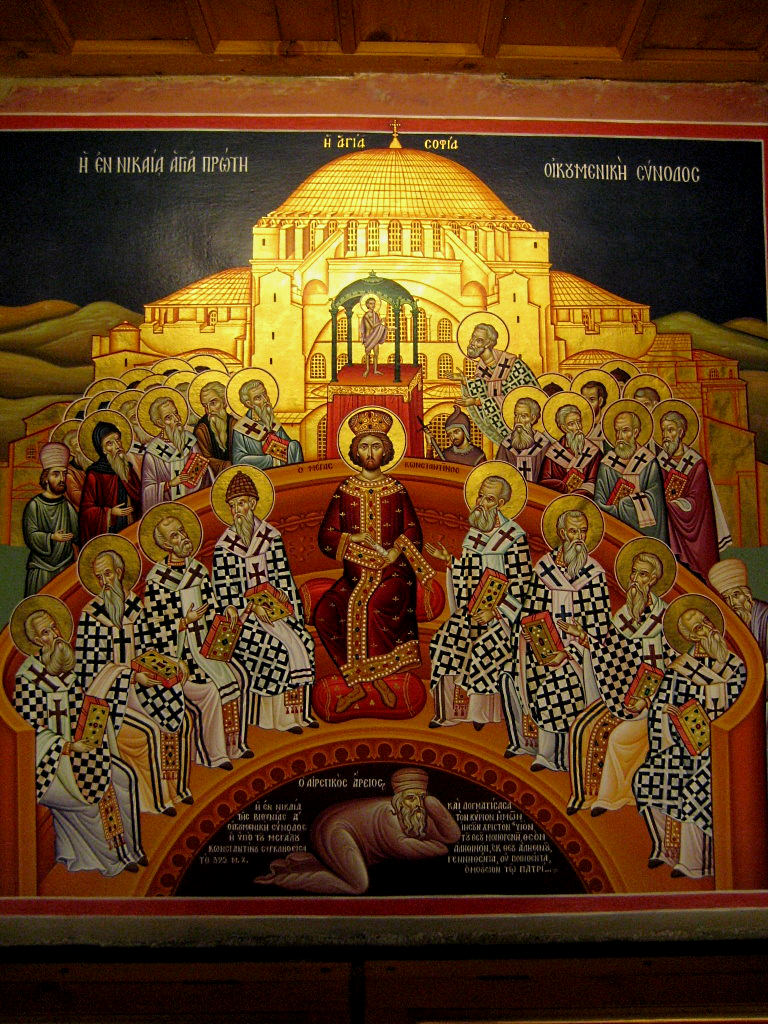
⭕ Nicaea Council of 325 A.D 🔴 What Was It All About? - How Did It Change Christianity?  🔵 Read what the Catholic Church Says About Itself  🔴 The year was 325 A.D. according to the Roman calendar. A council was convened by order of Constantine, the Roman emperor. He had been a leader in the cult known as Sol Invictus (Invincible Sun) and now wanted to unite the Christian sects in the empire under his existing church; the Universal Church of Rome. Many changes to the religion of Christianity were about to take place at that council, including:  🔻 Formulation for wording concerning the Trinity based on Anthanias (description of the formulation is mentioned below)  🔻 Changing Verses of Bible  🔻 Eliminating certain verses and books from the Bible  🔻 Declaring Arian's "unitarian" (belief in the Unity of God) as heresy  🔻 Changing the day of worship from Saturday to Sunday  🔻 Changing the date of Jesus' birthday to December 25th  🔻 Introduction of Easter (pagan worship called "Feast of Ishtar")  🔻 Church of Roman "officially" became the "Universal Church of the Holy Roman Empire" (the word 'Catholic' means 'universal'  🔴 The Roman Catholic Church took on a new face.  What follows is a quote from the Roman Catholic Church. It is their explanation behind the many changes occurring during the Nicaea Council. 
And Jesus answered him, the first of all the commandments is, {Hear, O Israel; The Lord our God is one Lord, and you shall worship Him with all your strength and all your might and all your soul and all your heart.} Mark 12:29 Jesus, peace be upon him, also replied to the devil who was trying to tempt him : { Get thee behind me, Satan; for it is written, Thou shall worship the Lord thy God, and Him only shall you serve.} Matthew 4:10