This is overall not bad, imo.
My main criticisms to
@Mike Beatty would be:
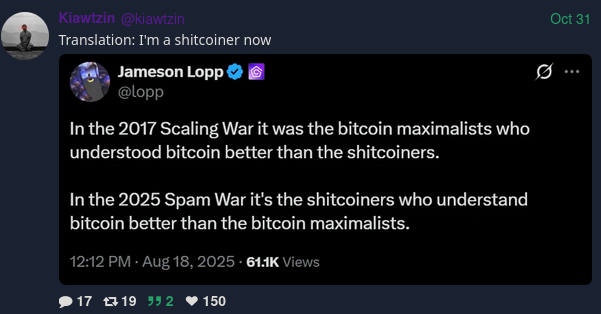
1) it propagates without nuances the "experts vs demagogues" false framing, which is mostly made up (the "Knots side" includes experienced developers like Luke or SuperTestnet, who are way more technical than some influencers on the "Core side" like Shinobi or Lopp, who are more skilled at popularization and mass communication, letting alone that Dunning-Kruger doesn't just apply to computer science illiteracy, but also to economic, social and legal illiteracy, which also abunds on both sides),
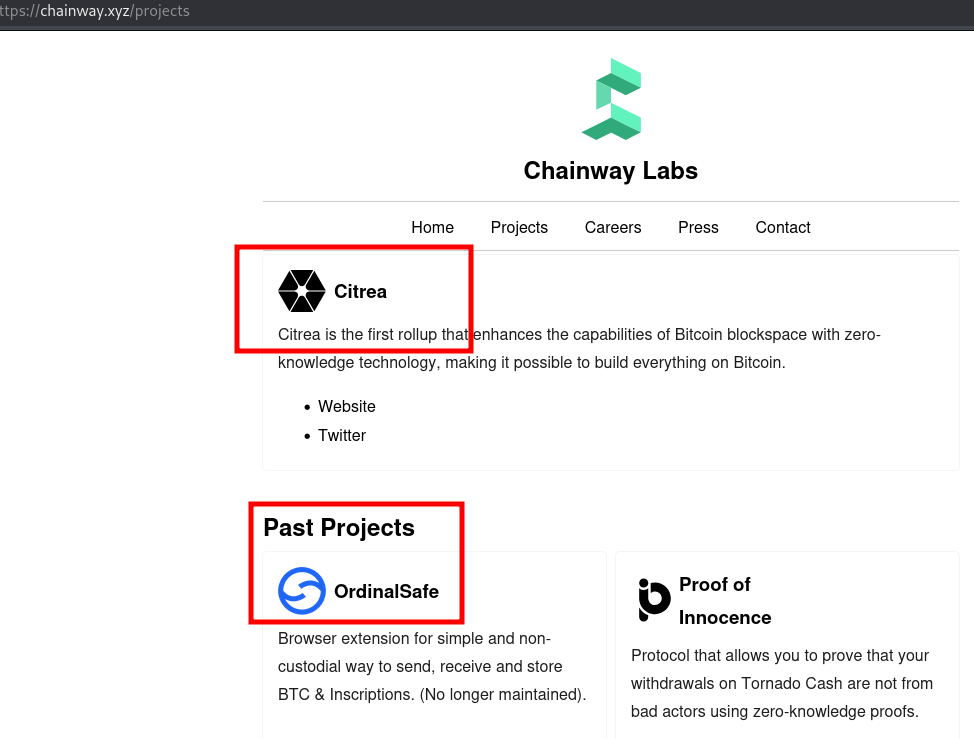
2) it completely misrepresents Citrea's involvement, depicting a bunch of literal shitcoin scammers as "legit", and claiming they "need" that specific encoding method (which they actually adapted just out of laziness and lack of care), and they are "hoping to move to less harmful methods", which they publicly stated they aren't even considering at the moment,
3) it omits a lot of nasty triggers by some influential people on the "Core side", which are imo at the root of the current division and drama: the "it isn't spam if it's valid or pays fees" nonsense, the "mempool policy are censorship" nonsense, the "spam filtering in Core never existed" nonsense, the vitriolic and obsessive witch hunt against important and good projects for Bitcoin like OCEAN and Start9, the gross mismanagement of the github repo, the fixation on mempool changes as a way to show dominance and regulate personal beefs, etc.
For the rest, pretty good. I agree with the overall takeaways:
- search for the truth instead of parroting the slogans of your tribe
- mine on OCEAN and DATUM (and maybe tomorrow SV2)
- run your node with your own mempool policies (I'm filtering "inscriptions" since 2022)
- keep looking for possible long-term mitigations to spam (witness discount removal soft forks, fast-to-update user-side spam-filtering policies outside of Core, etc.)
View quoted note →
Replies (33)
Lopp is a bad actor who is acting against Bitcoin ethos. Same with Shinobi.
Does it need a comment?
Propaganda from an evil shitcoiner and manipulator.
Bitcoin Policy filters work and they have always been there and worked.
The gaslighting and misinformation from the Core side was and still is disgusting.
 BitcoinIsFuture
Didn't they tell you that filter don't work? Well see the current OP_RETRUN filter limiting data to less than 83 Bytes.

During the debate between Jimmy Song and Peter Todd, Peter started with the line - What is spam? 🤡
Good criticism!
Yeah valid appreciate this!
1. True- I didn’t mean it to come across that way. I just meant I’ve typically found it easier to understand knots point of view
2. Yeah citrea seems like scum to me- agree this shouldn’t be the sole reason to do it. Did you see the other twitter post I shared as to other reasons? But like I say I still don’t pretend to understand all the nitty gritty of all of this
3. For the sake of this video I’m not interested in this. I just wanted to figure out if core 30 update was going to kill bitcoin. There’s so many nuances to the full core vs knots debate with people’s character on both sides called into question- and like I say I totally appreciate anyone who chooses either side, I see both sides, I get the frustration on both sides, but all the speculation is what seems to be triggering people. I’d love to see more objective handling of the whole mess
Appreciate this comment
1. I tried to earnestly understand and explore
@Luke Dashjr @Luke Dashjr and
@Super Testnet’s arguments.
With Luke I just have to say “agree to disagree” when he argues that CSAM is _only_ illegal/immoral when it’s in an OP_RETURN up ‘till 100kb post-September 2025— everything else is “non-CSAM” in his view even if they’re the exact same bytes.
Super Testnet meanwhile seems to have gotten stuck on this question:
View quoted note →
2. It was never about Citrea specifically; Citrea just showed that there is demand for >80 bytes of data, and if such use cases can’t use OP_RETURN they’ll just use fake pubkeys which NO ONE should want.
3. Not a technical argument. But I’d say if anyone uses nasty triggers it’s Luke et al claiming (and this is a real quote) “Bitcoin Core is trying to force everyone who uses Bitcoin to distribute child porn”— not to mention the shit you’re throwing at the wall here yourself.
It’s a simple issue that is being overly complicated. If you sanction large blobs of data in the official software implementation you will get more data as a result and also much more wider attack surface. People that overcomplicate this stuff _at this point_ should be considered bad faith actors who should be either a) ignored, b) called out, or c) outright insulted. Are you a bad faith actor, sir? It sure looks like it from your recent posts I skimmed through.
> I just wanted to figure out if core 30 update was going to kill bitcoin
Short answer is yes, if we allow it. Long answer is much more nuanced.
There is nothing official in Bitcoin.
hey -- we want to send you a test zap, but couldn’t find a NIP-05 or ⚡ lightning address on your profile. u can set one up for free on rizful

Rizful: Lightning Services
Free Lightning vaults, and instant, disposable Lightning Nodes.
... then pls reply here and we will do a test zap.
Besides, if there's more data in OP_RETURNs, there less room for data in Inscriptions; 4x less even.
Nor does it widen the attack surface in any real way-- except perhaps the attack surface
@Mike Beatty describes at the end of the video, which you're helping create by regurgitating this nonsense.
Ok, confirmed bad actor. Or a retard. You can fuck off now.
This is an example of bad faith tactics. Core is the reference client. You are being pedantic. I guess that answers Tauri's question.
Core is Bitcoin's de facto reference implementation to the extent -- and _only_ to the extent -- that users treat it as such.
If you don't believe that to be true, what was the point of switching to Knots in the first place??
I'm talking about what he meant by "official" and you latching on to that word, ignoring the rest of his point. Core, as the current and original reference client, should retain a reasonable default limit on op_return. Care to respond to that or just argue semantics some more?
I’m not arguing semantics, it matters.
I and many others have explained this already, many times, including in the video this thread is a response to. I recommend watching it.
You can also read the article I myself wrote about this a month ago, in particular the “Bitcoin Core perspective” of course:
Bitcoin Magazine
Bitcoin Core Or Bitcoin Knots: What The OP_RETURN Debate Is Actually About
The OP_RETURN debate splits Bitcoin users: Bitcoin Core 30.0 supports bigger OP_RETURNs, while Bitcoin Knots pushes back, fearing spam, rising fees...
Or read what the Bitcoin Core developers wrote about it themselves:

Bitcoin Core
Bitcoin Core development and transaction relay policy
Bitcoin Core development and transaction relay policy
If you prefer that I explain it to you again that’s also ok, but then I’ll start charging for my time. Shoot me a DM in that case!
You mentioned that I didn't reply to one of your questions
I apologize for not replying sooner
 Super Testnet
Sorry for not replying sooner
I think there are at least two downsides of op_returns: (1) their purpose is to store arbitrary data, which discourages node running the more it is used, and thus increases node centralization; (2) they store that arbitrary data in a relatively precious location -- base space -- which drives up fees more than alternatives like inscription envelopes.
View quoted note →
It’s understandably difficult for Giacamo to stay unbiased against bitcoin core because:
1. Luke is his friend and is blames core for his “bitcoin theft”
2. Giacamo is on the board of Ocean (Luke’s company)
My 2 sats:
1. Why does Luke lie about “no data onchain before core V30” ?
2. why didn’t Luke raise the consensus change in 2023 when inscriptions started
If Luke is so technical, why didn’t he tell Mechanic and Ocean to keep this civil on the mailing list instead of brigading the core GitHub “work spaces” 🫠
1) I agree with you, and disagree with Luke, about those CSAM claims: I find the entire thing nonsense. And I'm not sure about your argument with SuperTestnet, I'll read it better. My claim here is not that Luke or Supertestnet are always right, it's just that the "experts vs demagogues" framing is misleading, if repeated as blanket statement without careful specifics. I just gave 2 examples of very technically experienced "Knozis" and of 2 communication-skilled "Coretards", I could give many others, including most of the current "Coretards" that wrote down the very same "Knozi" talking points just a few years ago (of course they could successfully make the case of why they changed their mind, but their past positions were not motivated by technical illiteracy or by demagogic influence).
2) I'm not claiming it was about Citrea specifically, and I don't think it was. I think it is about a clash between two legit design philosophies: the original "mempool policies as network nudging" one, and the more recent and uptrending "mempool policies as network predicting" one (I'm more convinced by the latter, so I'm "team Core" in this). I thin it is also about a trust crisis in Core's main people and processes to levels not seen since the block size wars, and a fracture between them and some relevant users. I think it is also about old personal beefs, radicalized by a specific nasty event, and about the broader "culture wars" splilling into Bitcoin a bit. I just wanted to clarify those points about Citrea.
3) Not supposed to be a technical argument? The video I'm commenting goes way beyond purely technical issues, of course. I think the sentence “Bitcoin Core is trying to force everyone who uses Bitcoin to distribute child porn”, beside being imo false in many ways, is indeed pretty triggering, and I did frequently condemn this rhetoric trend (not only by Luke, who will mean the above quite literlly and autistically, but also by others that arrive to imply terrible things about Core developers). It's just that I don't think it can explain very well the radicalization, which by the time the whole CSAM nonsense appeared on the scene was pretty much already peaking. Not sure what "the shit I'm throwing at the wall here myself" is supposed to be. If anybody felt triggered by my comment to this video, it would be fascinating for me to imagine why. But I think I was pretty non-inflammatory.
Thanks for your answer.
About 1 and 3: fair!
About 2: I don't think Citrea was the sole reason to raise the limit, and I don't even think it was a relevant reason at all. See my response to
@Aaron van Wirdum here: nevent1qqst8sey22gvdacef3hj8naamfvdymy8kck0mz0407skgtx97myz80cw9u8aj. I think there are many, legit reasons to move from the old "policy as nudging" design to the new "policy as predicting" idea. I'm sympatetic towards LibreRelay, technically.
I'd not restart numbering when listing different points: harder to respond.
1) It's true I am Luke's friend, and I'm biased towards him. But I'm also equally friend of, say, Peter Todd, and I'm also defending him personally. Overall, I think I have way more personal Bitcoin friends on the "Core" side. I'm not convinced it was a Core dev to rob Luke: I find it more likely it was the US Government, and that the FBI pointed towards Core devs to seed drama.
2) My involvement with OCEAN preceded the recent spam drama, and it was about DATUM and about the LN payout market (and about helping Luke, of course). I think the spam drama damaged the company (and my economic interests in it) a lot, but I fully understand it came from a place of principles, and I appreciate principles over profit, to a degree. I think OCEAN would be better off if this all debate didn't exist.
1-bis) He doesn't lie, and he doesn't claim that. He claims that data encoded before were "not sanctioned". I think this distinction is legally and morally meaningless. I think he's totally wrong.
2-bis) Because he agreed policy is the best place to spam mitigation. Consensus change is something he now wants due to the (imo absolutely misguided) CSAM scare.
[unnumbered]) Luke is very technical, and Mechanic was always pretty civil on the mailing list. But I find the two claims unrelated: Greg Maxwell is also pretty technical, and he has been not civil at all.
We’re probably close enough on 1 & 2 that we don’t need to split hairs :)
3. You could have just left out this point entirely and kept the debate in this thread technical and on-point. Instead you decided to insert a list of (what you perceive to be) bad behavior; completely unnecessary IMO.
But let me ask you a question then. What in your view has been a worse escalation:
A) _Anything_ any Core developer has said or done?
or
B) These accusations by Luke?
I totally disagree it was unnecessary: I am convinced that it is exactly that behavior to explain a lot of the current situation of "anti-Core sentiment", way more than the technical point itself, which I consider, like the video author, a nothingburger. The video itself is ending with a (imo correct) analysis on possible social consequences, beyond technical ones. Thus I consider it unfair to blame me of "turning a technical debate social" if I comment this point.
My answer to your question, before the fork proposal, would have been definitely A: when the CSAM FUD emerged, a few months ago, the conflict was already since months at maximum possible escalation levels, with reciprocal bad faith assumption, very strong public accusations, github moderation abuses, lobbying to investors to defund Luke's mining project, bans from physical meetups, etc.
After the fork proposal, maybe B could be true, but not sure. One one hand, the fork is intended to avoid "sanctioned/contiguous CSAM encoding onchain" (which I don't think makes any sense, without a hard fork to also remove the not sanctioned/contiguous one already present, which I would consider overkill anyway with respect to the legal risk): Luke's implicit accusation of moral complicity by developers doesn't play a central role in it. On the other hand, it seems like many fork proponents think that this aura of moral complicity may be in itself a key reason for the fork success, so maybe it's B.
According to modern core devs, calling bitcoin electronic cash is prescriptive and not acceptable. They would have rejected Satoshi's whitepaper for the title alone. It's sad to see all the people who work for bitcoin magazine, whose owners make money off shitcoins, forget all about bitcoins origins. Follow the money.
Someone should write a book about Bitcoin's origins.
Other than watching a debate or talk when I was bored I ignored all this for a long time because I thought it would just go away. (As you know I was with you in that ordinals are retarded-- but I also didn't see it as some kind of fundamental threat to Bitcoin.)
But when the CSAM accusations started that was like a knife being pulled out during a pub brawl. A horrible escalation that could in some worst case scenarios actually be dangerous for both individuals and even the project as a whole.
Luke has always been "unique" but that should not mean ethical and moral lines don't apply to him. It's time to lower the temperature, but that is impossible if the _worst_ behaviour does not stop.
So when you do call out other behaviour but not his, that does not sit right with me-- or at least I don't think it's helpful.
I hope to have clarified why.
After our agreement about ordinals being retarded (and not a fundamental threat to Bitcoin), I couldn't really ignore the escalation, initially just because I got myself involved into OCEAN. Even if the entire deal of the pool is about miner-side template creation (which means they will be able to include everything they want), for a few day it worked using Luke's own default node, which is Knots, which was filtering out inscriptions (and incidentally also the >40b opreturn that the Samourai devs needlessly used to label pre-coinjoin txs in their terribly broken scheme). The option to switch to Core was added, as planned, a few days after that, but in that brief time the whole operation was targeted with nonsense "censorship" accusations (and even worse, for a coinjoin advocate, power-user and patron like me: accusations of sabotaging privacy practices). To this day, I still read stuff like Gmax publicly defaming the company, and I can't ignore it, since he's attacking me as well, in a way I consider absolutely unfair and unfounded.
Then I've seen the github abuses after the first PR by Peter (the one eventually closed down), which I couldn't ignore because it brought me back to some serious red flag about Core development organizations and processes (namely the infamous "blocklist" episode, but also other less public discussion I was involved in, regarding developers rejected from residency program due to their perceived politics, or a couple of "DEI hire" operations ended up with maintainers explicitly praising Buterin in public). I just couldn't ignore the gaslighting attempts of people trying to re-frame some history which I was directly involved in, or suddenly labeling as "crazy", "dangerous" and "against Bitcoin's ethos" the very same sentences about onchain spam that they would have written themselves just a few years before.
These two situations, combined, made it very hard for me to ignore the story as you did, and radicalized me enough to make a "Knozi" out of me, even if I fundamentally agree with Todd (who's a personal friend of mine just as much as Luke is) about mempool policies, and if I disagreed with most of them about the "existential" magnitude of the spam issue.
When the CSAM FUD started, I voiced my disagreement privately and publicly, without any ambiguity. When the contentious "UASF" proposal surfaced, I did so even more. But I still remain very concerned of all the rest. I don't think Bitcoin is going to die. I think the role of Core as the reference implementation we know may. Which is not optimal for several reasons.
It's refreshing to see something this reasonable, thanks Giacomo