Omandroid: work-in-progress update 🧪📱
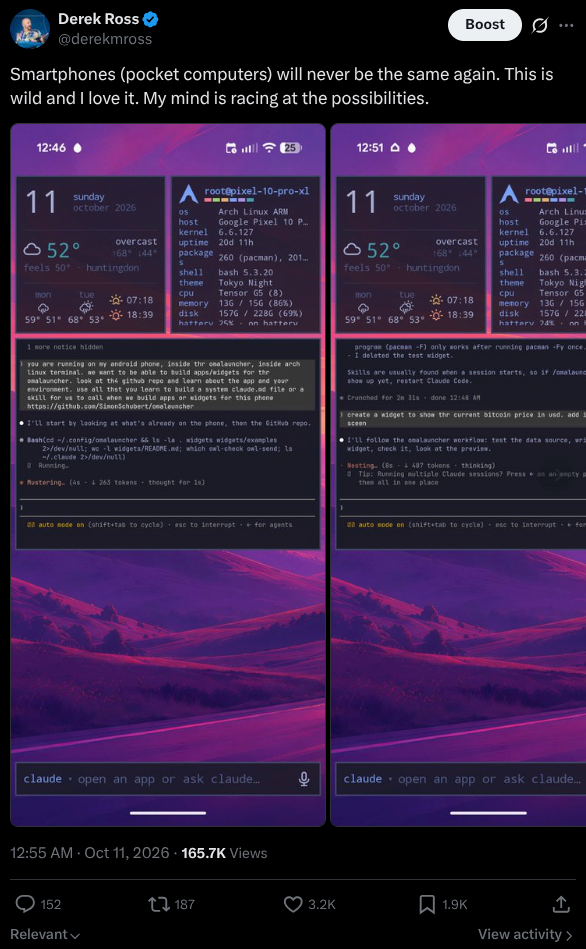
Native Omarchy running on a Pixel 7 Pro: Arch Linux ARM, Hyprland and Omarchy's own packages, on a mainline Linux kernel. No Android underneath.
Hardware working
- Boots our own mainline kernel (7.3-rc) from the second boot slot, with stock Android kept on the other slot
- Display (1440×3120 OLED)
- GPU: Mali-G710 with OpenGL ES 3.1 and Vulkan 1.4 through Mesa (we added the G710 to Mesa's Panfrost driver), and Hyprland renders on it
- Touchscreen with multi-touch
- Power and volume buttons
- Battery level in the status bar
- Internal storage, with the system partitions locked read-only
- USB networking and SSH
Software working
- Omarchy themes, the menu, the notification shade and the Omarchy boot animation
- A phone-style home screen and launcher with app search and "ask your agent"
- On-screen keyboard
- App switcher: swipe up, tap to switch, flick to close
- Lock screen with a PIN pad: locks after boot and after the screensaver
- Power + volume down takes a screenshot
- Apps open full screen, like on Android
- Kernel updates installed from inside Linux
Next up: Wi-Fi (driver in progress), Bluetooth, charging, audio, then camera, cellular and Android apps through Waydroid.
When there’s a will there’s a way.
Worst case scenario you can change an existing android rom just enough so the init system boots a linux userspace without relying on open source drivers or whatever.
That’s basically how you would get started with Ubuntu Phone and SailfishOS a few years ago.