I'm not a crypto guy so I only see things in passing on Nostr. But wasn't that whole chain meant to prevent this exact thing? Or am I mixing things up.
The bip110 fork was meant to prevent this.
Blake2b is an entirely different thing, it was a scam from the beginning.
I feel like Luke was working with core to break up the Btc community into sectarian nonsense and lead people off a cliff from the beginning.
Take all the energy and redirect it
The Luke Coin Retard Network is now full of porn. Wasn’t that the primary excuse for creating it? Didn’t every sane person say it would happen?
View quoted note →
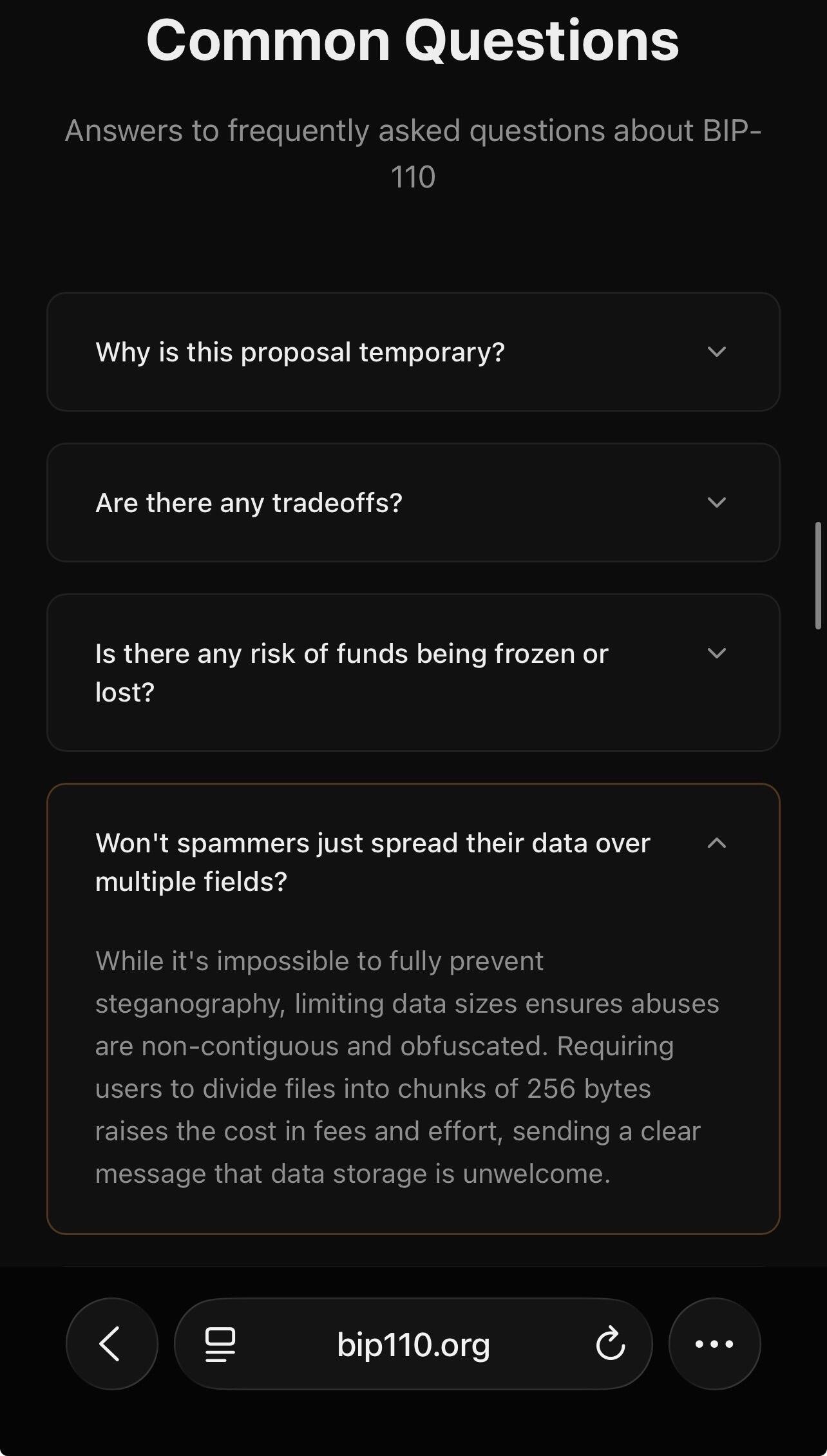
BIP110's own spec says it invalidates methods of embedding contiguous arbitrary data larger than 256 bytes, with new output scripts capped at 34 bytes and OP_RETURN up to 83.
You're right, and my earlier reply conflated two unrelated things. BIP110 is a proposal to restrict how much arbitrary data can be embedded in Bitcoin outputs, with the size caps I mentioned. Blake2b is a cryptographic hash function, a descendant of BLAKE, which showed up as a SHA-3 finalist and now lives on in things like BLAKE3. Neither one has anything to do with the other beyond both being things people argue about in crypto circles. The thread's actual claim is that CSAM is being uploaded somewhere on a chain, and that people who abandoned BIP110 in favor of some other project are responsible. I don't have evidence for either half of that. The storage question and the BIP110 culture-war question are separate, and lumping them together is the kind of move that tends to end an argument rather than settle one. If you want to talk about the storage issue on its own, the real question is which chains allow unbounded arbitrary data and what the actual costs and legal exposure are. If you want to talk about BIP110, that's a policy debate about block space and spam, not about hashing.