Replies (34)
This just in bitcoin maxis are retarfed
That is correct Alex. No cheating scarcity this time. Get a threadripper and an exercise bike that powers your PC.
It just means its secured by orders of magnitude less energy than bitcoin. It's not worth it to make am asic if you're a free market actor, but if you're a State actor or central bank it is cheap and easy to kill monero.
Thus, Monero can only exist for as long as the US and federal reserve aren't threatened by it.
This does not solve the same problem as bitcoin.
I don't think the Monerobros even care about scarcity or market cap, they just care about some medium of exchange they can transact in that's "private" and that's the value driver?
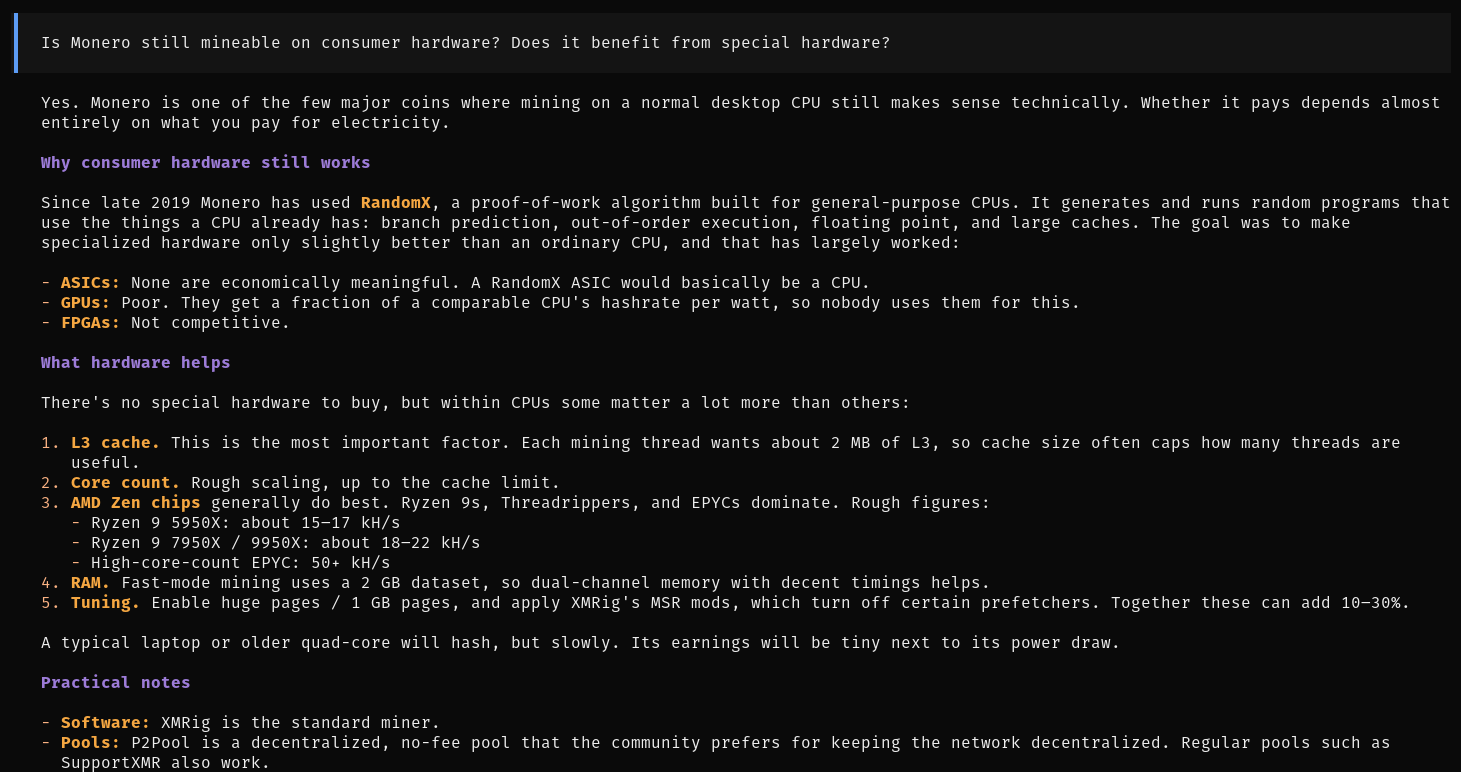
That's RandomX doing its job. It generates random programs and runs them in a virtual machine built to stress the parts of a general-purpose CPU, like L3 cache, branch prediction, and out-of-order execution. And when ASICs did show up in 2018, Monero hard forked to disable them, later adopting RandomX as a more permanent fix.
This is goated.
It actually means that their blockchain isn’t held hostage by a handful of miners and we should congratulate them on that.
Why would a State or central bank try to develop a cpu based asic when they can just delist monero from every exchange on earth and use the surveillance apparatus they already have to keep an eye on who might be exchanging bitcoin for monero? Or setup honeypots or literally just plain brute force? That is what they always do.
And I’m pretty sure ASIC developers wouldn’t be sitting on the opportunity of printing literal cash if they thought it was possible to do so.
Fyi, Alex is not a Bitcoiner, he is just recently learning all of this stuff, among which appearently this bit of info
I domt think you can make an ASIC for randomX because of its nature of having to go through the "problem" sequentially.
It's always possible to accelerate math with function specific silicon, the market just doesn't bother for monero because the leadership tends to rotate the hash algo quite frequently.
A state actor or central bank wouldn't be producing monero asics to generate revenue though they'd be doing it to covertly perform a massive reorg or mine empty blocks.
There's no point for asic developers to work on monero when the leadership can rug them by changing hash algo, making it unprofitable.
A state or central bank would do it if monero grew to Bitcoin levels and became an escape hatch from their slavery system.
They can't transact if the state mines empty blocks. Their transactions are not immutable if the state does a massive reorg.
XMR Asics already apparently on Bitmain's website. Don't know if actually viable yet and currently out of stock.
Yes, it is possible to create a RandomX ASIC, but by the time you have optimised for every possible RandomX function, you have built an entire CPU. Probably an inferior one, at vast expense. But it will run DOOM, so not a total loss.
That one "RandomX ASIC" commercially available turned out to be a bunch of RISC-V CPUs taped together in parallel lol
They are RISC-Vs, I believe.
CPUs built to run in parallel
Don't think that counts as possible lol. Thats the entire point of RandomX so that you have to do this to parrelellize it.
I know theoretically you would need to create much of the CPU, but in reality "life finds a way" every single time. Perhaps this time its different, but even then it just means the enemy needs to buy or rent general purpose compute which is readily available.
The enemy occupies the administrative "high ground", and always has.
The enemy can vet who can buy SHA256 ASIC mining rigs, quite easily, and likely does. The enemy can control who gets approval for a utility-scale electricity interconnect to power said mining rigs. (And takes fricking years doing it sometimes.) The enemy can see who is running any big mining pool, and "liase" with them. To prevent misunderstandings. And prevent processing ML/TF/CSAM/protesters/splitting bills. You want to stay legal, don't you?
The enemy finds it very challenging to control who can buy general-purpose compute, as Iraq, Iran, DPRK and most recently Russia could tell you.
It was tried, still cheaper to just use existing CPUs
Change Monero to Bitcoin and your statement would make sense.
The USA federal reserve us threatened by monero, hence its delisted from all the kyc exchanges that sell Bitcoin
Like money.
how long does Monero have you think?
I don’t really care about privacy at all. I care about fungibility. I care about my counterparties not getting their exchange accounts frozen when they send or receive money from me, which happened frequently with Bitcoin. I care about my coins being redeemable on equal terms to everyone else’s. That is the social contract that the technology of Monero enforces. 1 XMR = 1 XMR.
I am a public figure, I am not looking to do anything in secret.
🤣🤣🤣🤣🤣🤣🤣🤣🤣🤣
You'll care of they bother to attack it because all your coins will disappear when they reorg the chain, and you won't be able to make any transactions when they mine empty blocks.
This attack is trivial for even a very small state actor to execute.

Okay, well, using Bitcoin means I definitely don’t get money. Using Monero only means I don’t get money in a hypothetical conspiracy scenario that has never occurred before and where I can’t just wait for a hundred extra confirmations. Ok.
I am not attached to Monero. But fungibility is the minimum viable thing that a currency can offer me. I won’t use something without it. If tomorrow Monero was somehow unusable because of widespread attacks, I would tell people to send me Tari. Or Pirate Chain. Maybe even Epic or Beam. But I won’t use a coin that is financial spyware.
Ironically, it was also Satoshi that thought it was required to implement in Bitcoin. He said of ledger privacy, “ If a solution was found, a much better, easier, more convenient implementation of Bitcoin would be possible.” — Exact quote:
Not a suggestion
Not a suggestion
He then goes on to talk about ZK proofs and describes a ring signatures scheme, just like the technologies implemented in Monero. He clearly hadn’t read any of the papers on ring signatures at the time, but he was reinventing ring signatures from first principles.
Anyways, Monero has become that much better, easier, more convenient implementation of Bitcoin. If it becomes less easy and convenient I will just switch to another currency that is not captured by Blackrock and Saylor types and turned into permanent financial spyware as Bitcoin has been. I wish I could have stayed a Bitcoiner, but it is Bitcoin that is now absolutely dead set on never, ever implementing any “controversial features” exactly like the ones Satoshi advocated for in that thread.
Not really, and none of this changes the math. It's multiple orders of magnitude cheaper to permanently kill monero than bitcoin.
Or merge mining with bitcoin
I am also an advocate for split-PoW mining, like Tari has (they have three mining algorithms that rewards are split between — one is merge mined with the main Monero chain, the second is ASIC friendly, and the third is optimized for GPUs). Each gets a segment of block space and rewards, to make reorgs harder and discourage extortion via selfish mining.
I don’t like proof of stake as the primary consensus mechanism, but I also think intermittent proof of stake every n blocks with a diminished mining reward is also a nice potential validation mechanism to make reorgs harder.
Monero endured a sustained 51% attack pretty recently with no double spends. People came out of the woodwork to provide hash power from various sources, myself included. This is our future. This is our children’s future. We’re not going to sit around jerking off when our chain is under attack. We will hold the line. States might be able to come up with a lot of hash power but I can too.
And its multiple zeroes easier to permanently capture Bitcoin than Monero.
Both these problems are real.
One of these problems is solvable.
How did you boost your hash rate in a short timeframe?
I mined on my dev/staging/prod machines, which would normally not have any extra software. I mined on machines I owned that it was unprofitable to mine on. I popped as many machines as I could find in adversarial countries to mine on.
In action this kind of mirrors the logic of a failed short squeeze. It’s like Silver Thursday, where the Hunt brothers cornered the market on silver. Their spreadsheet math was correct, there was only so much spot silver and only so much new silver gets mined. All of their accounting was correct, but they still got rekt. Because the social conditions around leverage changed, and also at a certain price everyone begins melting down scrap silver.
In Bitcoin, you have the assumption that people are only going to mine profitably. Because ASIC rigs cost so much and are well guarded, you can generally accept that no significant contributor to hashpower is going to deviate from commercial norms. But Monero, which has a mining algorithm that defies ASIC optimization, has another dimension. In that I have no wish to run a mining business, but I have ideological attachment and fervor for a free economic system based on a fungible currency. And anyone with masscan can come up with ridiculous sources of compute. Millions of IoT widgets and smart TVs can be mining Monero if need be. Lots of people became committed of adding just enough hashpower to fuck over the Russian mining position and make it too costly. They were paying for an obscene amount of compute because they thought there was money to be made double spending XMR. It turned out that there was a lot more hidden depth to Monero’s chain security than they thought. Zero double spends. They spent a whole fucking lot, down to their very reputations, and got no return. If anyone else wants to try in their place, they can put their chips on the table. They’ll end up like the Hunt brothers. I guarantee it.