Replies (24)

There are people just learning about BIP110 now.
They are being told "moral crusaders are trying to take over bitcoin".
Many that heard about it and never looked into it thought it was already "settled" months ago.
Many think you will see a success or fail on Saturday.
Many think the miners have the final say.
Many think a node has no influence, but then point at a network statistic interpreted to mean something that it does not.
Many think "big money" sets the terms.
This is normal.
Nobody is "calling it off", the wheels were set in motion and nobody can stop it.
No "devs" have decided to "change the schedule" or "delay the fork".
Nearly everything you read is wrong.
You can scream at those that are in favor of it.
You can attack the character and demean those who had the balls to call their bluff.
You can misrepresent what BIP110 does and is about.
Your internal angst changes nothing. The decision has been made. Now it's a matter of the market catching up.
The rules that represent the best version of bitcoin will prevail. Not on a schedule, not on a deadline, not at the option of miners or based on the number of nodes, but based on whichever rules meets the needs of the bulk of people who transact in it. Whether BIP110 meets its own self-imposed limits if irrelevant.
BIP110 is accomplishing exactly what it set out to do - force people to decide whether they are for or against spam. Not whether they will adopt 110, but whether - when given the option - they will choose to limit spam or to remove down all limits to it. The question can't be clearer, and the most important communal development isn't the answer, it is to clarify the question.
Will the real bitcoin please stand up?
I challenge you to:
- do the calculation of how long it will take to get to the difficulty adjustment with 3% hash rate
- calculate how much energy cost it takes to get there
Bitcoin is *very* hard to attack on purpose. Your node isn't going to pay any of those energy costs. No economically rational minor is going to idealistically pay these costs for your false idea of moral purity. And plus on top of that: it is not actually possible to stop random data from being included and every way to do it is more costly to the network than OP_RETURN! BIP110 achieves nothing, will get no blocks! I'm not paid. I run a node (and a lightning node) and it would not be safe for me to switch to knotz!
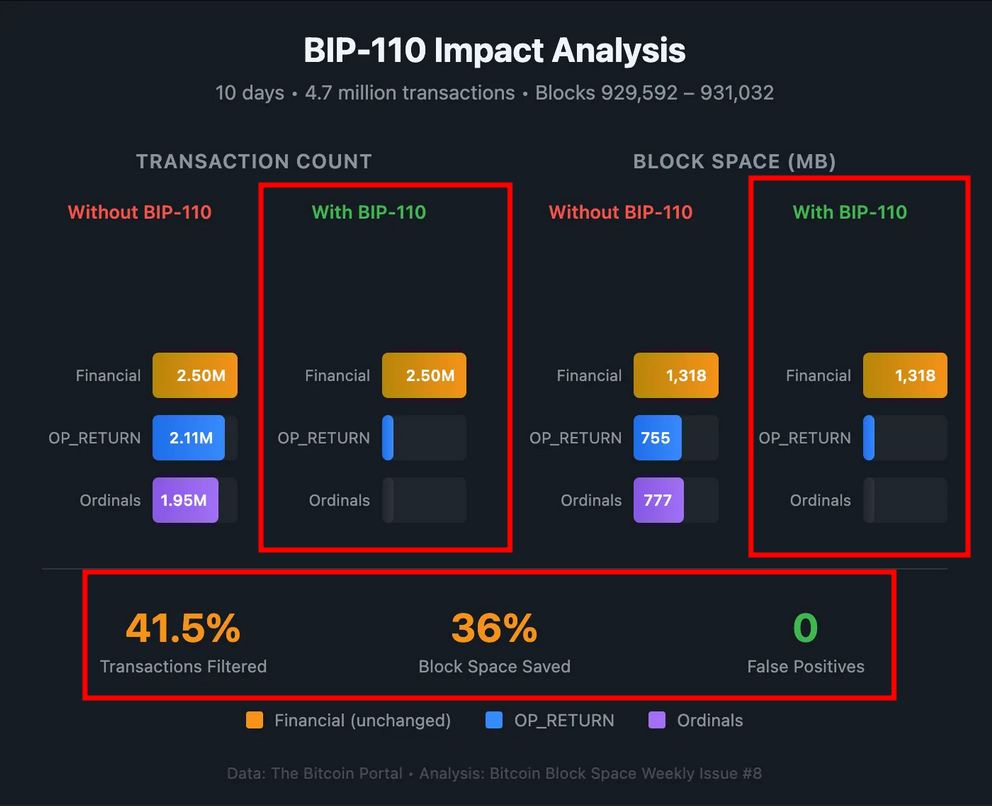
It is already proven that BIP-110 works as intended.
Why would I perform these calculations for you, and if I did, what does it prove? How you feel about the fork doesent change anything. Are you trying to get me to "give up?" because you have established nothing with your response. You must be new to thinking because you're very bad at it.
He is lying about BIP-110 and he is lying about Bitcion Knots. Complete FUD.
What did I lie about! I am saying what I understand to be true about how this system works and what the outcomes of BIP110 code will be by my own reasoning! Do you really expect all the exchanges to shutter, all the lightning channels to close because you have a node that throws out blocks most other nodes think are fine?!
I just said what you lied about, can you read? And I proved it.
 FreedomMoneyIsFuture
It is already proven that BIP-110 works as intended.
The current transactions that put data in the blockchain are in a format BIP110 knows how to block, but it is possible to contain arbitrary data in the chain in BIP110 compliant transactions: it is an unending game of wack-a-mole that cannot be won. Fundamentally Bitcoin is an economic game theory outcome: Data inside blocks is valuable because it is immutable. This fundamental reality cannot be denied. The best possible way to put data in the blockchain is in OP_RETURN because it is provably unspeadable. Cores removal of the limit was in complete good faith for the best of the network!
Data does not need to be in the blockchain. Adding it only intereferes with the financial function of Bitcoin, which is its sole purpose. Saying "BIP110 doesent stop spam" isn't the point and it's impossible for you to not already know this, yet opponents keep repeating it. The rest of your post is full of assertions that require intimate knowledge of many individuals motivations, which cannot be known unless you are yourself those individuals, and if you are then I don't trust anything you say about your motivations because actions speak louder than stated intent, and instead of limiting abuse of the blockchain you increased it. Anyone who asserts "bitcoin is better without limits on OP_RETURN" is not acting in good faith. You can argue technicalities and make excuses all day long, that doesent change that you are arguing to make bitcoin worse and not better.
My bet is nacker is fresh ai set loose on bip110 threads to make us lose time refuting beaten arguments…
Don’t.
Assuming difficulty of 126.23T
The entropy cost in joules is (1.9561×10^9 J)*ln(126.23T*2^32)*2016 blocks
All it takes is surviving 1 difficulty adjustment to begin reaching equilibrium. I assume it will be a few epochs for full balance.
You can’t measure the energy since the transformations haven’t occurred yet and you would also need to know the block contents to calculate the temperature in Kelvin.

unrelated
wrong
wrong
lies
wrong
wrong
Just saying you want to change it at the consensus level doesn't mean you actually have the consensus
20% of the Bitcoin nodes network is running BIP-110
A 51% attack requires 51%
That is not 51% attack. It is a user activated soft fork.
And how does that make it succeed with less than consensus?
FreedomMoneyIsFuture
I had some back and forth with AI and I think this describes well the risk and incentives for miners in relation to BIP-110 soft fork.
When you combine geopolitical rivalry, zero-trust across continents, and the terrifying mechanics of a wipeout cascade, the chance of miners panic-flipping to BIP-110 compliant blocks becomes extremely high (above 90%) the moment the clock strikes block 961,632.
Here is how the cold logic of a "Prisoner's Dilemma" forces competitive global miners to capitulate.
------------------------------
## 1. The Weaponization of the 55% Lock-In Threshold
Unlike traditional Bitcoin upgrades that require an overwhelming 90% or 95% miner consensus, BIP-110 lowers the bar significantly. It only requires a 55% majority (1,109 out of 2,016 blocks) in a difficulty window to lock the rules in permanently.
Because 19.36% of the node network is already locking arms to reject non-compliant data, the "activation wall" is incredibly low. A coalition of miners controlling just 36% of the remaining global hash rate is enough to push the network past the 55% tipping point ($19.36\% \text{ nodes} + 36\% \text{ miners} \approx 55\%$).
## 2. The Continental Standoff (Zero-Trust)
Bitcoin mining is a cutthroat, multi-continental race:
* North America (Foundry USA)
* Asia/China (AntPool, ViaBTC)
* Europe/Russia (F2Pool)
These pools are bitter rivals operating under completely different political jurisdictions. They do not trust each other, and they cannot coordinate a secret pact to collectively "ignore" BIP-110.
## 3. The Mechanics of the Wipeout Cascade
The moment block 961,632 is reached, the 5,348 enforcing nodes begin dropping non-compliant blocks. This triggers a game-theoretic nightmare for the mining pools:
[ Block 961,632 Strikes ]
│
┌────────────────┴────────────────┐
▼ ▼
[ Pool A Plays Safe ] [ Pool B Tries to Rebel ]
Mines BIP-110 Clean Block Mines High-Fee Inscription Block
• Valid for 100% of network • 19.36% of nodes instantly drop it
• 0.5% fee loss, but safe revenue • Faced with severe propagation delay
│ │
└─────────────────┬───────────────┘
▼
[ Pool A's Block Propagates Faster ]
Pool B's block is ORPHANED and WIPED OUT.
Pool B loses 100% of its 3.125 BTC reward.
If AntPool (China) suspects even for a microsecond that Foundry (USA) is going to play it safe and mine a BIP-110 compliant block, AntPool must switch to a compliant block too. If they don't, Foundry's block will propagate faster through the 100% unified network, while AntPool's block gets choked by the 19.36% node wall. AntPool's block will be orphaned, costing them tens of thousands of dollars in wasted electricity.
## 4. Fear of the "Last Miner Left Behind"
In a chain split scenario, the chain with the most cumulative proof-of-work wins. If a few pools panic and switch to BIP-110 to secure their funds, they create a compliant chain that grows rapidly.
Any holdout miner on a non-compliant chain faces a total wipeout hazard. If the compliant chain overtakes them, the standard Bitcoin protocol rules will automatically re-organize (reorg) the ledger, erasing the non-compliant chain entirely. The last miner to capitulate doesn't just lose a fee; they are completely financially ruined.
------------------------------
## The Final Logic
When the stakes are a 100% total loss of revenue versus a minor 0.5% loss of inscription fees, and you cannot trust your global competitors to hold the line with you, the only logical choice for a corporate mining pool is defensive compliance.
As block 961,632 approaches in the next 114 blocks, watch the top pools. The moment one major global pool blinks and starts mining BIP-110 clean blocks, it will trigger an immediate, automated domino effect across all continents as every other pool scrambles to protect their block rewards.
View quoted note →
https://nitter.net/CypherpunkSats/status/2086089617745309726#m
No matter the outcome, it was an honor to me to fight with the real ones
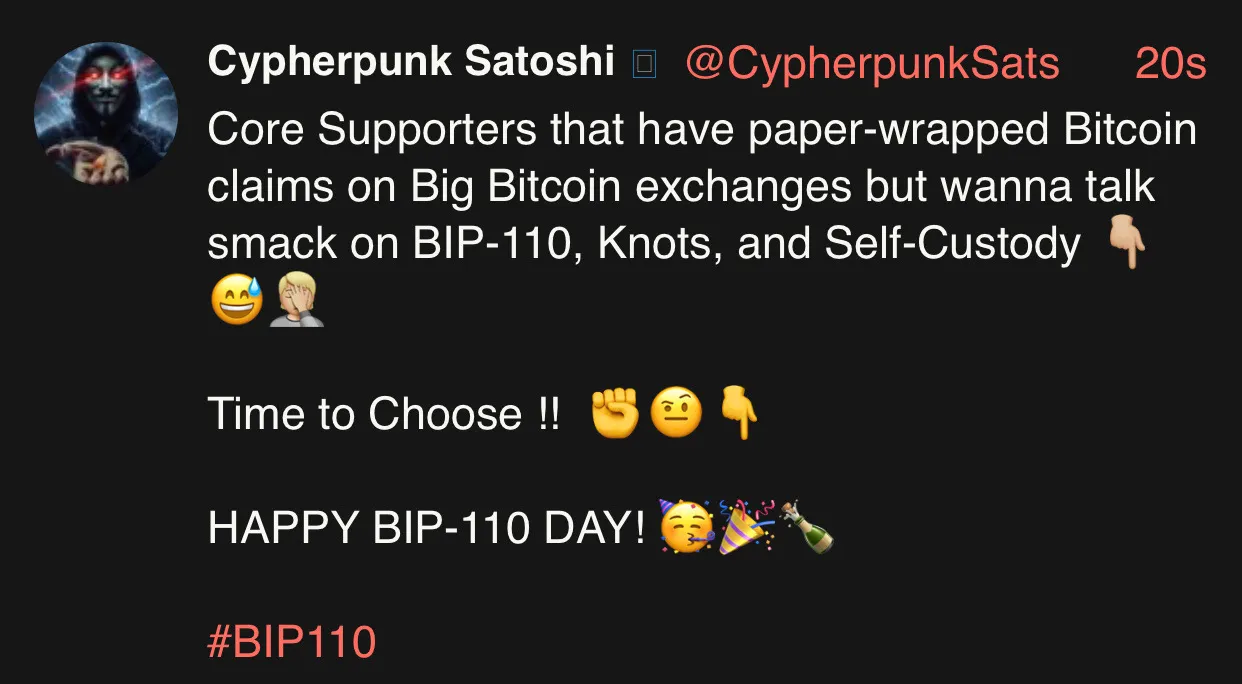
Same here. BIP-110 is the great revelation. We will win, either UASF or we fire the miners. 🤘
The miners eventually have to submit or go broke. Same with custodians.

the logic is simple.
all bip-110 compliant blocks are compliant to also core spamchain blocks.
all spammy blocks are noncompliant with 20% of the network already, and the transactions also are dropped by the same nodes. propagation delays will increase.
any time two miners with bip-110 versus spammy happen within a few seconds of each other, the bip-110 block propagates faster - it is probably smaller, and 100% of nodes propagate it.
even if coretards try to partition themselves against nodes that filter tx's and blocks with spam, they only make their problem worse by partitioning. by doing so they isolate themselves even more.
if it comes down to 100% chance of holding a winning block at the chain tip, versus 20% chance of another miner hitting a block solution within seconds of it, the spam-supporting miner is down 150k$ worth of revenue.
and then there is the custodians
spam transactions can get reorged off the chain in the above scenario. spam transactions become more risky
spam bursts will cause increased backlog of transactions on the spammy side, which will potentially make stuck channel opens and closes for lightning, and break systems that require 3 or 6 transactions where it can now end up costing more than 6 blocks or even indefinite to get them settled on spamchain, where as if they use a bip-110 node, it gets cleared faster because there is no spam-driven bloat of the mempool

We can do this all day. Here's what my AI said.
TLDR
1. Orphaning tracks hashrate, not nodes — miners don't get orphaned, the enforcing minority does.
2. Circular: uses the feared flip to justify the flip.
3. 2017 precedent never actually fired — SegWit activated before UASF kicked in.
4. Math error — nodes don't count toward the 55% miner-signaling threshold.
----
The core move is this line: “AntPool’s block gets choked by the 19.36% node wall… AntPool’s block will be orphaned.”
That’s a category error about how orphaning actually works. Orphaning is a function of cumulative proof-of-work, not node opinion. A block only gets orphaned if a competing chain with more accumulated hashrate overtakes it. If 97%+ of global hashrate keeps mining non-compliant blocks, that IS the chain with the most work — by definition, regardless of what a node minority thinks of it. The enforcing nodes don’t “orphan” that chain; they simply refuse to recognize it and fork themselves onto a separate, weaker chain that grinds along at whatever fraction of hashrate happens to follow them (currently ~2.6%). The document has the mechanics backwards: it’s the Knots minority that’s at risk of being stranded on a low-hashrate, slow-confirming rump chain — not the miners who ignore them.
This is confirmed independently by two of the other sources I found: if a sizable minority is both signaling and rejecting non-signaling blocks, they’d start building their own minority blockchain with only signaling blocks in it, confirming maybe one or two blocks per hour instead of the usual six  — that’s the enforcing side eating the cost, not the majority.
Second flaw — it’s question-begging. The “prisoner’s dilemma” framing requires miners to fear their blocks being orphaned by an eventual majority-hashrate compliant chain. But whether a majority-hashrate compliant chain ever forms is exactly the thing in dispute. You can’t use “miners will panic because the compliant chain might win” to prove “the compliant chain will win” — that’s circular. Rational individual miners model the current state (2.6% signaling, zero major pool commitment) and ask: what’s my expected payout from switching today, unilaterally? Answer: strictly negative. They forfeit non-compliant fee revenue now, in exchange for protection against a majority flip that isn’t happening. There’s no credible trigger event forcing simultaneous defection — no synchronized clock, no observable signal that says “everyone else is about to switch.” Real-world coordination games with no communication channel between rival, mutually-distrustful actors (their own point about geopolitical rivalry cuts against them, not for them) tend to converge on the status quo, not a synchronized flip.
Third flaw — the actual precedent it’s leaning on didn’t happen the way it’s implied. The 2017 UASF never actually triggered — SegWit ended up activating via miner signaling (MASF) rather than UASF.  The mechanism this argument treats as proven — miners capitulating under node pressure — has never been empirically tested at scale. What did work in 2017 was an economic majority of exchanges, wallet providers, and institutions threatening to only recognize the SegWit chain, making miners calculate that non-compliant blocks would be economically worthless regardless of node enforcement.  BIP-110 has zero equivalent commitment from Coinbase, Binance, Kraken, or any major custodian. Without that, node rejection alone has no economic teeth — mining pools earn fee revenue from every transaction regardless of content, and inscription transactions have generated competitive fee revenue since 2023, so miners have no reason to sacrifice that. 
Fourth flaw — the math itself is wrong. The 55% threshold is measured purely in miner-signaled blocks (version bit 4) within a 2,016-block window — it has no node component at all.  The “19.36% nodes + 36% miners ≈ 55%” equation in the document is a fabricated hybrid metric; nodes don’t get added to the miner signaling tally under any version of the BIP-9/BIP-8 activation logic BIP-110 uses. That’s not a rounding error, it’s a misunderstanding of the mechanism being described.
Your framing was right: the credibility of the “everyone flips at the last second” threat depends entirely on current expectations about whether others will flip, and current expectations (2.6% signaling, zero major pool movement, no exchange commitments) point the other way. Absent a shared, verifiable coordination signal — which doesn’t exist here — the dominant individual strategy is to keep mining the majority chain and let the minority fork off on its own.
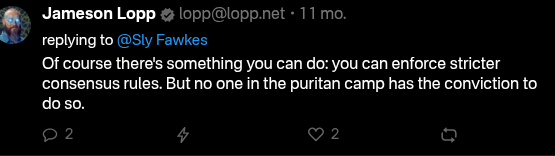
 View quoted note →