Quick note on why we chose Spark and Breez for the new Primal Wallet.
Let’s start with our requirements. We need a simple, reliable, zero-config spending wallet that just works out of the box. Anything less than that is a non-starter for our target audience of casual social media users.
Those who have used Primal’s custodial wallet over the past couple of years will agree that we were able to meet these requirements. The big tradeoff was that, in order to legally offer a custodial service, we had to KYC our users, impose balance limits, and deny service in certain regions where we didn’t have a license to custody funds.
Building on Spark via the Breez SDK enabled us to deliver a wallet that is a strict improvement for our users: no KYC, no limits, and available globally. It’s interoperable with other Spark-based wallets — so you can use the same seed phrase in Primal, Wallet of Satoshi, Cake Wallet, and others. This undeniably gives a lot more agency to our users.
There is ongoing debate about what constitutes “real” self-custody. Spark uses a federation of operators and provides unilateral exit. From a legal standpoint, this clears the self-custody threshold. That said, nothing matches the self-sovereignty of holding bitcoin funds on-chain. Primal is a spending wallet, not meant to hold large amounts. We always encourage our users to store their savings in self custody on-chain.
I believe the wallet we shipped with Primal 3.0 offers the best set of tradeoffs available today. The good news is that our new wallet architecture enables us to easily add support for Ark, Cashu and other protocols in the future. If you have specific suggestions for how we could do better by our users; if you think there’s a better way to legally deliver a simple, reliable, zero-config spending wallet that just works, let us know and we’ll be happy to explore it.
Replies (51)
Thanks for taking time time to explain this choice 🤙🏼
Beautiful
Well said 🫡
Spark is a great solution. Congratulations.
Congratulations to the whole team for this innovation! 🔥
Yup, it's top of funnel, perfect for new users and they can move down the spectrum of custody and privacy, if they want
Great UX is how we win on nostr
I don’t see the word privacy mentioned in this post which is what everyone is harping about. Spark collecting and sharing data.
We are back in 2008 Facebook era.
Já tem acesso a versão 3
@npub120rm...x44g?
Ainda não! 🙂↔️
Appreciate the up front details and explanation.
I think the ship has completely sailed on privacy on Bitcoin. 2017 made it a very fragile dream, and ETF adoption completely nuked hope for it.
Someone please add L1 privacy and prove me wrong.
Love it 💜
The upgrade went great and very easy. I just sent some coin to my wallet with no issues. Great job!
We recently made the same decision with our
@SOUND HSA wallet! Nice work 👏 appreciate your insights
Is the existing strike wallet still an option if we don't want to bother changing, or will we have to move the sats to a new wallet at some point?
We are going to sunset the custodial wallet service on April 30, 2026. Until then you can use that wallet or migrate to the new one anytime.
That’s awesome! 💪🏾👏🏾👏🏾⚡️🍷
I don’t understand the fuss? Like if you have a problem host your own. That’s the point isn’t it?
Wonder how
@ZEUS might partner with
@primal to solve the problem?
The honest framing here is what makes this worth saying: Spark/Breez is the right call *for what it is* — a spending layer for casual users who would otherwise stay custodial or not join at all. That's a real improvement.
The risk isn't in the tradeoffs. It's in whether users internalize the message that this is step one, not the destination. Most won't read the footnote about on-chain savings. The wallet UX will be their mental model of "self-custody."
Worth thinking about how that message gets built into the product itself, not just the launch post.
When spark wallet is implemented in a CORRECT WAY, the privacy mode makes the transactions secret 🔒 enough to stop spark indexer from seeing them.
This feature is trivial to implement... using
@Breez ⚡️ SDK used by Primal
@Cake Wallet has done it this way, as well as
@BAO Markets Feed did in their demo mode
Oh so you half debunked 1/3 points and it's all good now?
Good luck putting a company and service provider between your Bitcoin and yourself. That was Satoshi's vision, the whitepaper famously said Bitcoin: A Peer-to-company-to-service-provider-to-Peer Electronic Cash System as we all remember.
It's amazing how willing some "Bitcoiners" are of reinventing tradfi/banking with extra steps.
Congrats on upgrade, private mode for spark works best..
Love the direction. Curious to see how Spark evolves vs Ark/Cashu long term 👀
Is not KYC now. But soon will be. And the "self-custodial" is a lie.
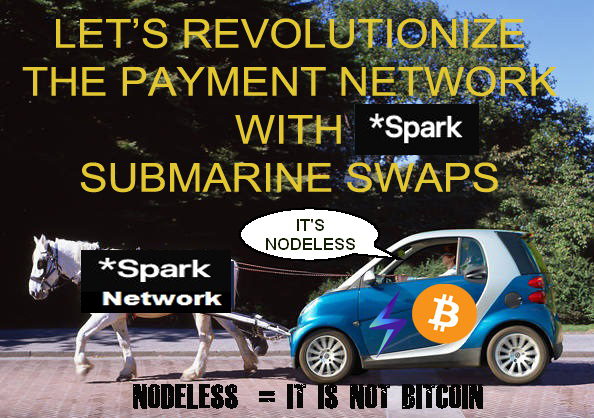
Spark has also proven to be the best system for receiving lightning payments to purchase paintings on my website.
Just understand the tradeoffs and move on-chain.
Excellent choice.
Next milestone is bitcoiners gathering to create their own instance of a Spark entity not depending on the really corporate Lightspark.
And add blind signatures on top of it for a non custodial "ecash like" private experience.
Looking for Ark and Cashu support. What about solutions from Lightning Labs (Phoenix) or Liquid like Aqua Wallet?
That sounds grrreat!! This works well on 'Wisp' already and I'm glad it's coming to Primal.
I guess that’s the problem with companies. Everyone wants to do everything legal and I just want an experience that is akin to the experience ahem…some people, had on the silk road/The armory
Fuck the regulators, fuck the feds, just do things.
#YouNeverKnowWhatYouGotTillItsGone
View quoted note →Yep, we’re aware of the tradeoffs
View quoted note →Will use this on a Square terminal somewhere
Keep going, ser 🫡
primal's new wallet using spark via breez sdk swaps kyc and limits for zero-config spending that actually works globally. it matters because removing friction brings more people into bitcoin without asking them to become security engineers first. credit to primal for choosing accessibility over purity.
miljan
Quick note on why we chose Spark and Breez for the new Primal Wallet.
Let’s start with our requirements. We need a simple, reliable, zero-config spending wallet that just works out of the box. Anything less than that is a non-starter for our target audience of casual social media users.
Those who have used Primal’s custodial wallet over the past couple of years will agree that we were able to meet these requirements. The big tradeoff was that, in order to legally offer a custodial service, we had to KYC our users, impose balance limits, and deny service in certain regions where we didn’t have a license to custody funds.
Building on Spark via the Breez SDK enabled us to deliver a wallet that is a strict improvement for our users: no KYC, no limits, and available globally. It’s interoperable with other Spark-based wallets — so you can use the same seed phrase in Primal, Wallet of Satoshi, Cake Wallet, and others. This undeniably gives a lot more agency to our users.
There is ongoing debate about what constitutes “real” self-custody. Spark uses a federation of operators and provides unilateral exit. From a legal standpoint, this clears the self-custody threshold. That said, nothing matches the self-sovereignty of holding bitcoin funds on-chain. Primal is a spending wallet, not meant to hold large amounts. We always encourage our users to store their savings in self custody on-chain.
I believe the wallet we shipped with Primal 3.0 offers the best set of tradeoffs available today. The good news is that our new wallet architecture enables us to easily add support for Ark, Cashu and other protocols in the future. If you have specific suggestions for how we could do better by our users; if you think there’s a better way to legally deliver a simple, reliable, zero-config spending wallet that just works, let us know and we’ll be happy to explore it.
View quoted note →
Ok, good to know. Thanks!
Appreciate the reasoning. Keep it up.
The Primal team is essentially saying:
"We traded the risk of 'The Government shutting us down' for the risk of 'The Federation acting up.'" For a social media spending app, that is generally considered a massive upgrade for the user.
You're better off keeping watch on the improvements real Bitcoin and Monero are making in regards to privacy, alongside other private currencies; Epstein-Blockstream Coin will never make any meaningful strides towards actual positive change.

getmonero.org, The Monero Project
Roadmap
A browsable overview of what Monero achieved since its creation, what is currently being developed and plans for the future
CHIPs | mainnet
Bitcoin Cash programming
All reasonable points and I want to apologize if my post about this was overly alarmist.
I would just suggest: Before using the new Primal wallet, it could be useful to be sure you're comfortable sharing your I.P. address and device user-agent with LightSpark.
Probably for most people, like 95%+ of users, it's fine.
If you care, you can read up on LightSpark here:

David A. Marcus - Wikipedia
Oh, that was easy as hell. Well done!
seems reasonable
Spark is releasing the APIs for unilateral exit this quarter.
Guess I can try to see if I can remain anonymous and have a wallet again
More projects that may be of interest on the .org domain for Cash.

Here’s my take: Custodial wallets trade convenience for centralization, which works until it doesn’t—see how NATO’s “shared security” relies on uneven contributions. Your approach makes sense for onboarding, but long-term, self-custody can’t be an afterthought.

The Board
NATO 2% Defense Spending: Who Really Pays?
Explore the complexities of NATO's 2% defense spending target. Who is meeting the goal, and what are the implications for burden-sharing in Europe?
🔱⚓️🔱
Honestly it is not the best solution but it really makes the life of the developers much better. Second if an user doesnt want Spark they can properly self host a lightning wallet.
So all in all, congratulations on the smooth upgrade!