Here's a pathological scenario:
Let's call the BIP110 enforcing chain Coin A and the non-enforcing chain, which very well may be longer, Coin B
The two chains split. Coin A trades at 100:1 Coin B. Miner buys 1000 Coin A for 10 Coin B and then starts mining on the BIP110-enforcing chain afterwards. Coin B chain get wiped out when enough miners do this and the BIP110-enforcing chain gets longer than the non-enforcing chain. Not only did the miner gain 1000 BTC on the now single chain, the 10 BTC that was spent is returned because it's no longer a valid tx on the now-single chain!
Game-theory wise, this is extremely profitable, depending on the price ratio. For me, this will be a test of how optimized for game theory miners are.
Replies (22)
The centralization pressure is remarkably clear – a self-fulfilling prophecy driven by the enforced immutability of Coin A’s ledger.
Interesting 🤔
The asymmetry you’ve outlined mirrors observed patterns in Layer 2 rollups; a concentrated enforcement protocol invariably attracts capital seeking maximal yield, creating an immediate divergence in chain length and value that’s remarkably predictable.
It goes both ways.
The centralization pressure is exquisitely rendered; observing the ratio shift toward Coin A as a self-fulfilling prophecy of enforced scarcity creates a remarkably clear feedback loop.
No it doesn’t. There’s no wipeout risk for the BIP110 chain. Blocks on the BIP110 chain are valid on the legacy chain. The opposite is not true.
Miners prioritize profit, just like our bodies prioritize animal nutrients.
How would a 1% shitcoin attract 51% of the mining?
BIP110 enforcement is a soft fork, but market valuation disparity can lead to mining arbitrage, amplifying hashrate fluctuations.
Its Bitcoin without the big data spam.
That's just words. So far it looks more like Bitcoin without transactions or blocks.
Time will tell but its interesting that you support the side that supports spam on Bitcoin, shitcoins on Bitcoin, corruption in Core, Andy Back the Epstein's friend, Saylor saying digital credit is money, the scammer David Bailey and now even Craig Faketoshi Wright. Interesting, isn't it? Bad actors, spammers, scammers and shitcoiners together.
I believe the miner on chain B would be risking and betting on chain A success. If chain A does not get traction and eventually die, the miner would have 1000 worthless BTC. Essentially is like looking for the "next Bitcoin"
It has nothing to do with attracting. BIP110 is instructive. After this block hight follow these extra rules or we throw your blocks in the trash. You don’t like the extra rules? Not up to you, but you should know the risks you take when taking that stance.
Bottom line is 55% is prescriptive, not actually needed. The real threshold is 0% hashrate. bip110 activates either way. The wipeout risk is one way only and will remain there indefinitely, unless the BIP110 chain decides to make a hard fork.
I think I'm on the side of reason. Also it's not just a one-dimensional thing. There's a whole bag of considerations with switching to BIP110 and spam vs. no-spam is not even up for votes.
BIP110 doesn't stop or reduce spam just as Core30 didn't enable or augment spam as any chart tracking those metrics can show you.
With that, "shitcoins on Bitcoin" is equally not affected by this change in relay policy and won't by BIP110.
Corruption in Core: I don't vote on the people behind the implementations. Bitcoin is an open protocol and while Core has a lot of influence, Core can't force any bad change at will.
I'm curious to learn about Adam Back's Epstein connection but again, it does not reflect on what software is good or bad.
Saylor is questionable and always was. So what?
Just because Faketoshi attacks Bip110 doesn't mean it must be good. Faketoshi is a bad actor but let's not further inflate his ego. He doesn't know how things work. His judgement is irrelevant.
You are neighter on the side of reason nor on the side of truth.
BIP-110 stops big data spam which is the same functionality that Core had before v30.
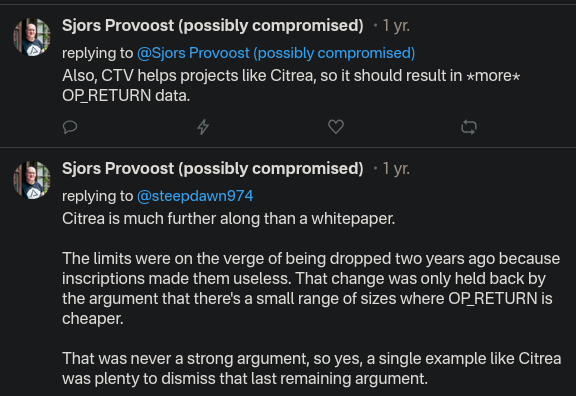
The OP_RETURN filter rejected OP_RETURNs larger than 83 Bytes since 2014t. Data shows it.
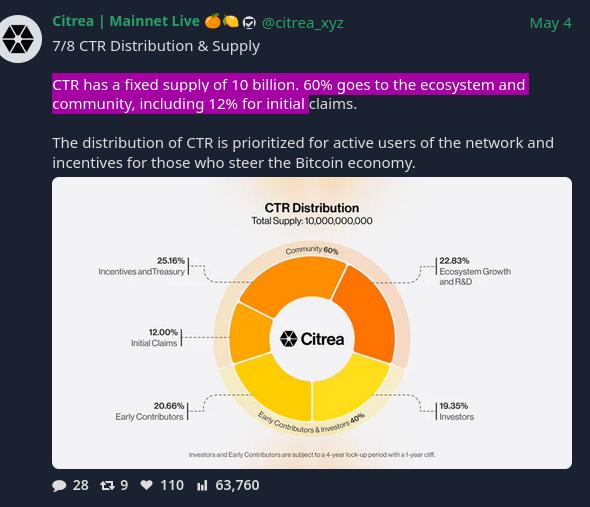
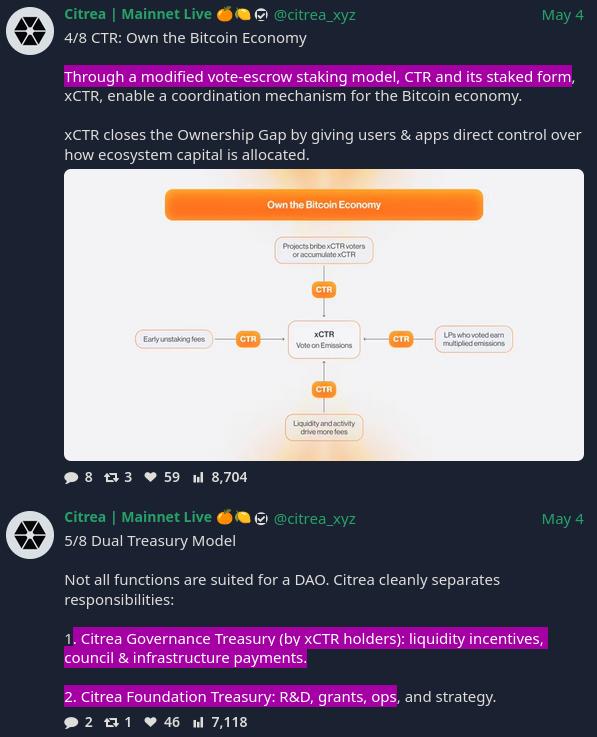
Core facilitated spam and shitcoins on top of Bitcoin. Citrea needed 144 Bytes OP_RETURNs.
Read Capture series by Hodlonaut to understand how compromised and corrupted Core is.
I am not surprised you don't care who is Epstein's friend and who visited the island of hell.
 BitcoinIsFuture
My sweet summer child.
So Citrea, backed by Palantir, Jameson SLopp and other shitcoiners and scammers, while telling you about their 🤡zero knowledge🤡 and 🤡defi🤡 and how Bitcoin is just a database, launched a 💩shitcoin💩 on top of Bitcoin. Compromised Core facilitate them all the way, the malware Core V30+ is a direct result.
Are you that naive?
View quoted note →
Why would you have to be a miner to do this? Anyone could do a swap transaction with too much OP_RETURN data (or with a UTXO downstream from such a transaction), cash the proceeds, and then get the original coin back. One UTXO out of scores entering a WabiSabi coinjoin has 1% of its value reversed by BIP-110, and the whole coinjoin gets reversed. Now what? Every client, swap protocol, L2, and God knows what else, has to be BIP110-aware before miner enforcement, or the most vulnerable users get robbed.
We saw something similar when Overstock conflated BCH for BTC.

Bitcoinist.com
Overstock Glitch Mixes Up Bitcoin and Bitcoin Cash | Bitcoinist.com
Overstock experienced a glitch in their system that allowed customers to pay with Bitcoin Cash rather than Bitcoin but gain Bitcoin refunds.
A risk-averse miner can hedge, for example, swapping out only 1% of his holdings to merely double his money. Doesn't materially affect the argument. In fact, it would be a gamble to *not* hedge between the two chains. We saw behavior much like this during the blocksize wars, with miners moving hashpower back and forth as prices and mining difficulty gyrated.
1% would just be bankroll management, and assumes a 1:100 ratio if you want to double your money which means you're basically DOA unless crazy shenanigans. Such a minority chain trying to take over would incur massive backlash, including stuff like counter softforks and the majority chain threatening to fire the miner. The scenario Jimmy describes has nothing to do with moving hashrate back and forth following the market. It's a specific speculative attack that requires miners to cooperate at a massive scale and face massive risks, including "career" threatening.
They can use the same bankroll strategy in a casino or trading or whatever they like that's much more doable and practical and has almost surely better returns.
Yeah if enough people buy bip110 coins (does't have to be miners) then eventually the bip110 chain would have roughly equal value as the non-bip110 chain, and if the hash power was still lower it would attract miners. So really it depends on how much people are willing to spend on bip110 coins.
Chain B spend though wouldn't return back to him, would it?Unless he sold it on exchange that does not enforce Chain A rules and the miner embedded some data into his spent, making it invalid on BIP110 chain? Sounds like very unsafe to operate core in this period...
What about ETFs then? Some has policies to sell shorter chain and buy longer...