Replies (108)
The.
Entropy.
It died with a whimper, like the heatdeath of the universe.
💭🌌
@npub1w0ee...4ejv launched a token.
It’s free tho
The sausage ratio
The airdrops integrated with AI and persuaded people that this time it’s different 😅
Nothing is free.
*could help.
Nailed it
Can’t blame them. V4V economy seems expensive. That’s why advertisers bore the cost traditionally. They could afford to.
Recurring Solar Micronova Maximalist, here.
Due for a micronova sometime in the late 2030's or 2040's, but the next Carrington event could wipe out all electronic infrastructure literally any day now even before the Megaflare/Micronova
People didn't run their own relays. It's no different than a Bitcoin full node.
Can’t state it enuff that if the "influencers" can’t make a living off of "the nostr" that they won’t stay & their followers won’t either.
Elon
Loss of zaps, or an effective loss. Either due to a big governmental crackdown on Bitcoin, or maybe the price of BTC getting to a point where people want to hodl every last Satoshi.
Or
Regulation of nodes.
Or
Nostr getting to a large enough user base that someone starts analyzing the network to either de-anonymize us, or use the data in some horrible, dystopian day.
Fucking developers only talking to developers again.
The community is still so small that everyone is competing for a tiny portion of a small group that is willing to pay for anything. This has led to having to build huge offerings in order to gain customers.
Unless you’re willing to roll out a global network with additional features at this point being an operator is a passion project.
Taibbi for example
Doesn’t matter though, Nostr is complete free-speech. That itself has value with or without influencers.
Yup kinda under looked.
Government emf protection protocols are good & all but…. N e thing is possible…. Failures happen….
I’m just a doomer who over thinks everything in every way possible.
I agree but it seems the majority of people don’t agree with that yet
Content is king.
Yep. It’s a catch 22 for people who simultaneously want a decentralized social network while also wanting to scrimp and save every satoshi they can.
We can help with content by making it easier to share it.
What’s the solution?
IYKYK

🥲
stop scaring people 🤣 aint happening. Nostr is as inevitable as Bitcoin and you know it.
Relays and apps require resources to be run and maintained. Where does the money come from to sustain them?
☝ how not to kill nostr. this should go up on a wiki or something for reference of things we shouldn't do.
True fans. Supporters who want to see this thing take off.
Sir it's a bear market
A great place to start 😂💯
We need a big influencer media company to point all their content to a zap.steam pay to access only type thing for it to really catch on & only post content on though nostr
This 👆
Elon musk transforma o X em uma rede mundial acessada por seus satelites gratuitamente.
Ninguem pagara para usar internet, pois havera starlink.
one of my talks at Nostrasia will roughly be about this
Well, they can bite me. This is whur mah frens r!
I agree. I think the limitations of the size of the bitcoin user base adds an additional challenge. Any new project (app, artist, creator, etc) seeking to monetize is going to run into struggles at first and need to rely on their biggest supporters to get them off the ground. When the pool of potential supporters is limited to only people who know how to use bitcoin, that shrinks the available funds for new projects. The catch 22 is that bitcoin is perfectly suited for a decentralized network like this. More people have fiat to spend, but that also introduces kyc and other potential regulations.
onboarding still sucks, you're right
💜
😂🫂
Lol at least the nostr lasted about 9 and half years longer than xitter!

I wish I knew
@corndalorian
I lack my usual snark on this subject for the simple reason I think it’s super complex. I don’t see ad supported services as being that way out of malice. I believe some smart guys wanted to build something and get paid for their troubles, and found a way to do so.
It’s a cultural issue. We are used to things being free. People (in generality) aren’t going to pay for something that they can get elsewhere for free, unless they have some other more ideological reason - or as others have mentioned, the service is much better (premium). Among those services with premium offerings, it is a very small percentage of people who opt into this, and overwhelming majority stay free and are carried on the backs of the small premium base. It’s still a mutual benefit, since nobody would want premium if there weren’t tons of people to interact with.
That’s the societal issue with a v4v economy. The majority of users will not give value, since value is provided by others for “free,” and many things of value are also fairly invisible. I posit the average user will not give a damn about your average relay until it’s gone - because it’s invisible.
It’s also worth noting that almost every service that has a premium tier survived *years* of financial loss and riding on VC money to get to that threshold of user base where the 1% of premium users could turn a profit.
Excellent thoughts on the subject 🫂🤙
Maybe regulation. Onerous privacy and safety laws coupled with mandated backdoors make it impossible for small operators to comply (or build the thing we came to nostr for in the first place). This has a chilling effect, killing the network effect.
I try. Perhaps I’m a bit too smooth brained for it, but I try regardless. 🤣
There is a solution to all of this and it’s just a transaction fee - even if voluntary. You can also scale it by % instead of a fixed number. Higher transaction value = higher fee. Many may not pay but if you achieve decent scale that may be enough to cover costs and even turn a profit.
Coming with paid tiers it may be sufficient to sustain clients and relays and even content creators. You just need scale.
Combine*
Achieving scale does seem to be the requisite of every plan I’ve seen. It’ll be interesting to see if/how this happens, and what lessons can be taken from it.
NIP conflicts? ;-)
too soon
no internet connection 😃
what is the point of this extremely unlikely hypothetical?
you could say http was dead 20 years ago too but it just mutated and the same base architecture has continued on.
in fact, nostr's not really that innovative for architecture, what is great about it is that it's a relay/broadcast system that is so simple that anyone could join the network with minimal work.
so, yeah, who cares if nostr doesn't make it, its babies will.

Too much choice can create complexity and parts of the technology could have sharp edges. Sovereignty can be scarry and it may not be for everyone.
Perhaps most users didn't really want sovereignty, never really wanted to have to understand the tech to some extent to use it. And they were perfectly comfortable with other options available, where everything was done for them:
* "So many clients, each with their own caveats. Does this client accept this NIP?",
* "So many algorithms to choose from, which one did I try last again?? Ughh, I just want it to work."
* "Is this the right account for the person I wanna follow or is this an impersonator?",
* "If I wanna test a new client, how do I know I can trust it with my Nsec?",
* "Oh God! What if I lose my Nsec??".
"Ughh, I guess I will just stick with Meta, where it is safe and comfy and all my friends are there".
That along with the alternatives not melting down. It turned out that somehow X, Meta, YT, etc didn't become completely unusable to most people, just barely useable enough that people can justify sticking to it and not have to learn something new and foreign.
It turned out that CBDCs didn't really suck and worked ok for most people, so the masses didn't rush to Bitcoin. Which meant that many were first introduced to it when first using/hearing about Nostr. So now they had to deal with the complexities of Nostr and of Bitcoin... And it was a tough learning curve for most people.
I think services like Strike could help to some degree. Strike allows you to make payments directly from fiat to sats. People that want to send/receive sats can do so, and people that would rather deal in dollars/fiat can do so. It does introduce some kyc into the payments side of things, but only for those users who choose to use those services. Solutions like that would at least give more non-bitcoiners the option of participating economically in the network.
Read the answers and see the point of asking the question
it's a good question to ask.
Global warming
After SHTF more normies will discover importance and necessity of Bitcoin. This will lead to other branches of privacy, security and by default Nostr. Individual and corporate money flows next.
Its the same as all other social medias in the end...
the
the lack of frogs
You are assuming we are not going to have ads.
Oh we will have ads. Just wait until they figure out how to do it.
email
Not enough Pablos 😵 🪦
Apathy. Here we are 14 years into #Bitcoin and most of our friends and family still don’t use it. If they can’t get excited about the hardest money there ever will be, how can they do so for social media?
I think you hit the nail on the head with the cultural issue part. People expect things for free on the internet.
Even though I think most of us on nostr understand this, it's not actually free you're paying with your data. And I do think people are starting to wake up to this fact. But until a larger population of people wakes up to the fact that on these "free" platforms you are actualy the product a Sustainable value for value style, economy will not persist for long.
People sharing notes stolen from Twitter.
Embrace. Expand. Extinguish
This is why I believe what's needed is to help us all learn how to establish multiple satoshi income streams every way possible. For our goods, for our services, and for our ideas, we establish "bodies" of work attached to our Nostr accounts that are continuously streaming sats into our wallets.
Only then does sending them back out again become less painful. It must also become normalized to be on zero fiat (or or close to near zero), transitioning back to slave debt-notes ONLY when necessary to interact with those still in the fiat plantataions.
It's also FAR easier to spend anything once full stack sovereignty over nearly all daily basic need has been established. As in clear title to land/house and energy, water, food, and waste management ALL managed on site. Siege proof sovereignty enables a higher velocity of money flows through our wallets.
This is the Way.
Snipers
A lack of standardization across a given type of client causing wildly different implementations of a given feature in one client to be unable to be loaded in another client. This leads to the loss of interoperability and ultimately causes enough frustration for devs and users to abandon nostr outright at worst, or completely fracture userbase based on the client of choice.
The Nostr killed nostr
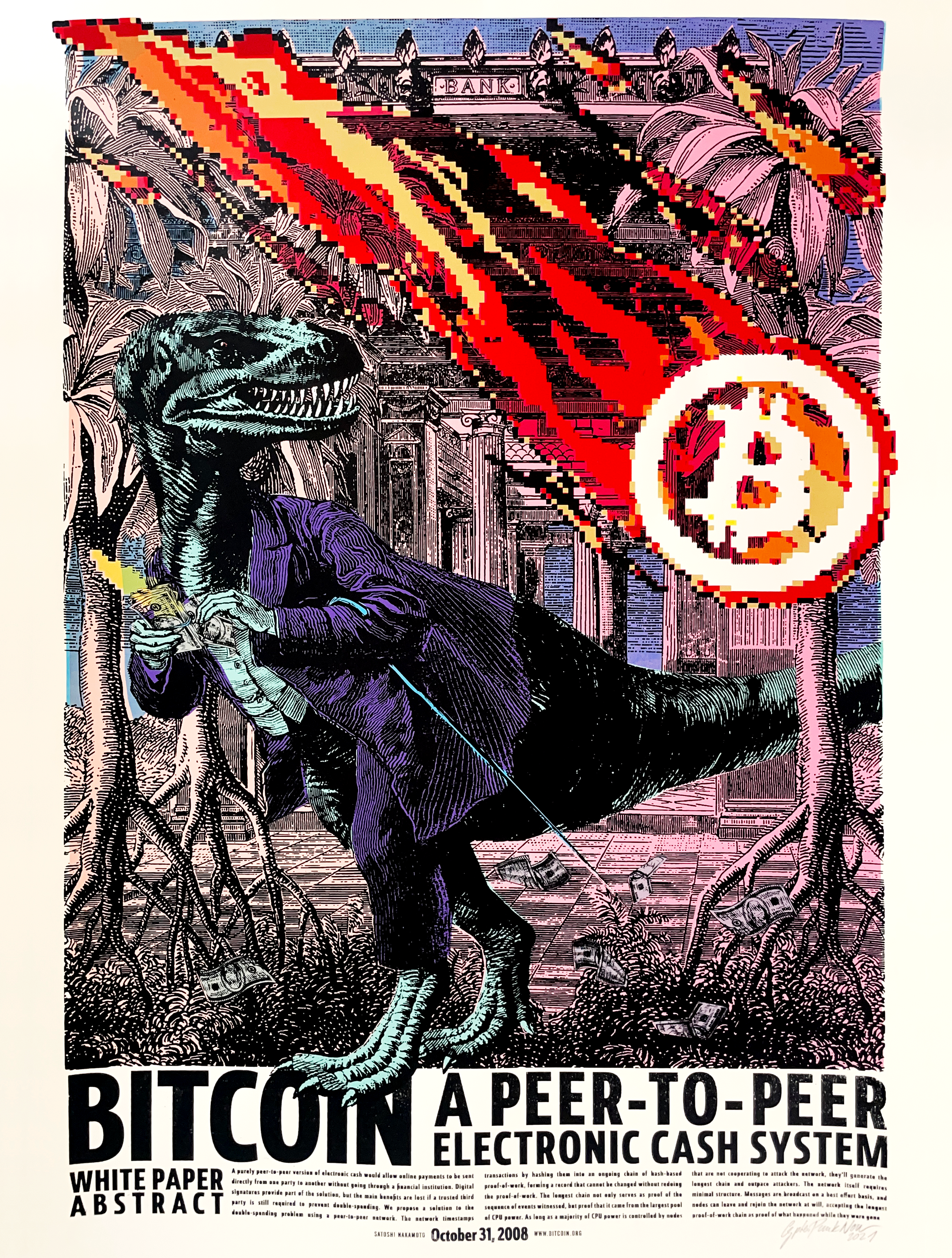
The asteroid of course
Unauthorized protocols not allowed under the Hamilton Convention of 2028.
In years leading up to it, governments failed to contain their perception of misinformation through policy. The agreement of 2028 formulated the groundwork to all internet access using full KYC, smart card enabled identity for access. Only authorized protocols allowed, vanquishing even Tor and consumer encryption as illegal.
sha256 ended up being no match for quantum computing
Lack of decentralized infrastructure.
We need a mesh network of decentralized satellites.
Make every person in the world capable of launching satellites to low earth orbit.
NIP Bloat.
- Implementation possibilities are specd with less and less consideration for each other.
- many overlap in functionality but none are removed or deprecated for “backwards compatibility”.
- Some old school devs pull weight and don’t wanna change.
- some younger devs have no patience for discussion and “patient” integration of “good” ideas.
- devs are burnt out with the “bureaucracy” of maintaining a swamp of standards.
- nips are treated as standalone “islands” serving single use cases.
- inconsistency and inoperability creep across clients and relays, as gate keepers “give up”.
- Users become disillusioned with “the dream” of decentralized cooperation, as nostr dies a slow death due to dwindling adoption.
the lack of new friendly documentation
Skynet
Most developers are not developing for the end user. They have other motives.
If the current mainstream social networks continue to work the way they do, (you know how they work otherwise you wouldn't be here) nostr won't need to be appealing at all. All in all, clients still need to be encouraged to improve features and create new ones. I don't think nostr is gonna die in 10 years, I think it is just a slow burn. So let it burn!
Nostr 2.0
Missing economics and opportunity cost - like lightning ⚡ 😢
Nuclear war.
Missing real use cases that serve needs strong enough for people to pay sats.
relay costs
making it easy and accessible for the normies
nostr 2.0
agree
the naive but easy way to solve a lot of nostr's challenges is to go back towards centralization, at which point you may as well not bother
difficult onboarding only to see shitty content
Twitter, Instagram, WhatsApp, Facebook, Reddit exist together even though they all are almost the same. And most of the people who use internet have an account on each one of them, and they often share the same information, sometimes transfer one image or tweet from one to another. Having a Unique feature and then being open to all made them survive. Closing doors to an idea or a form of content, or not finding novelty in naivety, not being able to ignore minor transgressions, and being too rigid is demotivates almost anyone.
Us
Love this idea. And it would allow businesses to enter the space who have a majority of non-bitcoin users but still allow them to participate in V4V.
So, like, the collapse of any wide scale organization. I can see this happening.
That sums it up
Nostr is going to Tower of Babel itself then. No need for government intervention.
As far as I know, there's currently no known quantum algorithm that could effectively help cracking sha256.
I understand your points but I don't think to a user, interoperability is that big a concern, unless it messes up basic TL big time.
Even now, threads are a mess across clients & NIP 94 images created on Amethyst are not seen on many clients & it's not caused a hullabaloo 🤷
I'm guessing most people will try out maybe 2-3 clients & stick with the ones they like.
If you are honestly concerned, take a look at the proposal below to define a process. I have some experience here as an early editor in the fediverse's FEP process. There FEP-a4ed defined a process that handles proposals from submission to deprecation.
It might be interesting to collaborate on a submission process tailored to issues and challenges of the current NIP space.
Issue (which looking at all the NIP-XXs in the repo seems to have uptake):

GitHub
NIP-XX: NIP proposal process · Issue #545 · nostr-protocol/nips
As a newcomer I find it confusing to follow the various NIPs and ideas that have been proposed. The README.md doesn't give any guidance on process ...
Pull request:

GitHub
Add submission process by weex · Pull Request #560 · nostr-protocol/nips
Update the README.md to include a new NIP submission process.
Addresses #545
p2p
👏🏻